Sunday, February 7, 2021

February 7, 2021: Common Redpolls visit the Lakes Region

Hello February, what a great winter month!  The days are already longer; the sun a little brighter, a little warmer.  New snow comes frequently to freshen the world and cold weather is consistent enough to allow a host of winter activities.  Lake Winnipesaukee is now iced-in so the Pond Hockey Classic on Meredith Bay was a go for this weekend, as is the fishing derby next weekend.

As the winter progresses and cold temperatures take over the northern hemisphere, the Lakes Region sometimes hosts transient birds visiting all the way from the artic in search of food - and maybe warmer weather.  It's the only time of year we are able to see the beautiful snowy owl, for example.  Another visitor from the north stopped by our bird feeder this week, a whole flock of them in fact.

Common Redpolls

Common redpolls spend the summer far up in Canada, breeding in pine, spruce and birch forests as far north as Greenland.  In winter they head south, sometimes all the way down to the southern Massachusetts border depending on the available food supply, often in large flocks, and this is when we might see them.  Redpolls prefer small seeds like thistle and millet that fit in their beak, both of which we have in at least one of our feeders.  

Those tiny seeds are perfect for crunching in their small beaks.

Traveling in large flocks, they can be aggressive toward other birds, even those in their own flock when feeding.

The flock commandeered the feeder.

I watched them fluff their feathers and thrust their open beaks at other birds to shoo them away; even the usual bully white-breasted nuthatch was put off.  But sometimes a nuthatch or a brave chick-a-dee would flit in quickly to steal a seed from an open perch.

A chick-a-dee braves the rebuff of the redpolls (note upper left) to steal a seed.

When I saw the first bird I didn't know what it was and had to look it up.  The black face is good identifying feature if you can get one to look at you.

Note the black face.

It's always a treat when you get to see a bird that doesn't regularly visit the area.  

A fellow birder just north of the Lakes Region shared a picture (thanks EKJ and RH!) of a pine grosbeak in they saw in Campton.  

Edie Kressy caught this pine grosbeak in Campton.

This is another northern bird; the Cornell Ornithology range map shows it just sneaking down into the northern half of New Hampshire, a part of its range listed as "scarce".  Like the red-bellied woodpecker that's moved north into our region, the pine grosbeak may soon move farther north and out of New Hampshire altogether to find the climate it needs, so that was a nice sighting.

I mentioned that the ice on Meredith Bay is sound enough for the winter activities this year. 

The Pond Hockey Tournament was on, but at reduced size and without spectators in the rink area.
But one should still be careful travelling on the ice as many areas on the larger lakes are still not safe for travel.  Even Lake Wicwas which has been iced-in for over a month still has dangerous spots, as we discovered this week poking around in some shallow areas near shore.  
Unsafe ice still exists in spots on Lake Wicwas

I'll finish out the week with a few pictures of February in the Lakes Region.


Nature never disappoints.


Sunday, January 31, 2021

January 31, 2021: Windy Winter Days

Old mother west wind, to borrow a phrase from Thornton Burgess, sure was busy this week.  Not only did she usher in some real cold, but she swept almost the entire surface of Lake Wicwas clear of the recent snow.

Ready for skating again.

The snow could be seen blowing through the air, swirling into snow-tornadoes rushing down the lake before being dumped on windward shores where the trees ended their journey.  There were parts of the lake that didn't want to release its snow, hanging on to it in variously shaped islands with sculpted cliffs, a miniature version of the geological facies found in southwest regions like Moab and Bryce Canyon.


On one of those windy days I came across a set of tracks in the piled up snow near shore that I wouldn't have identified if I hadn't seen the culprit in action.

Who left these?

I could have spent hours searching through tracking books and not identified them.  I'll share a few more pictures before I reveal the perpetrator in case you want to figure it out.


Hint:  Remember it was a windy day, and it was close to shore.


So here's the answer:

That old mother west wind was having a good time tossing a white pine cone around the lake.


I have a recollection of seeing a mark similar to this in the past, but wasn't sure what caused it; having seen proof now I hope the memory will stick for future observations.  

With the cold and the wind I didn't observe much animal activity out there, and whatever tracks they made were quickly filled in with blowing snow.  But I did come across this tiny set of mouse tracks in a sheltered spot.

A mouse travelling back and forth between hidey-holes in the snow.

The strong wind also did some work on the ice hanging off the eaves where snow had frozen and slid slowly out to hang in the breeze.  

More wind sculptures.


I was fortunate enough to pick the calmest day of the week to ski up Mt. Cardigan, and though it was perfectly calm on the summit, proof of the wind was visible in the wind-scoured rocks and rime ice formations.


With the cold weather, Meredith Bay is also finally iced-over, getting prepared for the Pond Hockey Tournament next weekend.

A cold day on Meredith Bay, with the Belknap Range in the background.


The coldest days in winter do tend to be the prettiest!


Sunday, January 24, 2021

January 24, 2021: Hidden Secrets of Plants in Winter

January doesn't provide a lot of opportunities for plant observations because so many of them have closed up shop for the winter.  Flowers are either dormant below the snow or have died and left only their seed behind, waiting for the encouragement of the spring sun to spur them back to life.  The deciduous trees have cast off their leaves and sent all the energy they created over the summer down into their roots, also waiting for spring to warm the soil.  But the bareness of January does divulge some secrets that are concealed or inaccessible - or both - when the lakes are alive with summer greenery.  One such plant confessed its hidden beauty to me on a recent walk on the ice.

Tiny, spent blossoms of the leatherleaf.

These plants are abundant in the marshes around Lake Wicwas, the dominant plant in fact of many bogs around the lake.  I didn't immediately recognize it even though in the summer I'd seen it many times, it's pretty white flowers drawing my attention.  Now in winter, those tiny blossoms, still clinging to the branches, once again caught my eye.  Looking it up in the guide book reminded me it's leatherleaf.  

Next year's buds are already in place.

Here's the leatherleaf in its spring dress.

Leatherleaf  in its May glory.

Leatherleaf is classified as an evergreen (though it's leaves turn reddish-brown in winter). I should have recognized it!  

On the same winter walk on the lake we came across another plant exposing it's secrets.


This fruiting shrub is growing on a tiny island in the lake, and is one I still haven't positively identified but my best guess is a variety of viburnum.  It has large, dark berries that are not yet desiccated, but also not consumed by the birds. 


 Any suggestions?

Of course, in winter there are plenty of other trees that, like leatherleaf, keep their leaves all winter - pines, hemlocks, spruce, laurels, both mountain and sheep, and sometimes in winter the heat they absorb from the sun, combined with surrounding cold air, creates icicles as on these spruce trees in the Sandwich Range at an elevation of about 3000'.  

Photo by Jim Lerner.

With more snow and cold blustery weather, it's finally feeling like winter in New Hampshire!

An untracked trail leads up to Jennings Peak.

But down under that cover of snow and ice there are plants and fish and amphibians, all waiting out these cold, blustery days, anticipating the time they can rise again.

Wind and snow add texture to the lake.

Sunday, January 17, 2021

January 17, 2021: Hungry Squirrels and Ice Art

Jack frost was busy this week, spreading his creative artwork generously in multiple locations; he really seems to revel in wide fluctuations of weather and temperature.  One of the most intricate of his creations appears when he goes out on a cold night right after a rather humid day, before the moisture in the atmosphere can escape his grasp, and he snatches it out of the air and locks it onto whatever surface he can find, in this case, our windows.
Jack Frost's artwork adorns the windows.


He most often shows his harder edges, but sometimes he relaxes a bit and shows his softer side with smooth, circular, swoops.

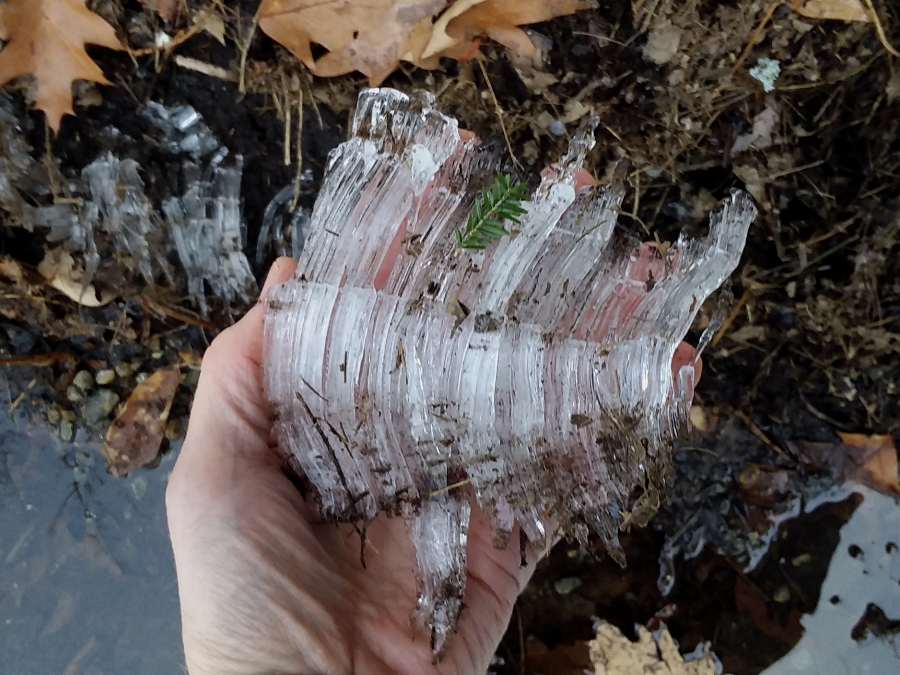
The very next night he walked along a small drainage that was still flowing with snow melt from the warm weather.  Here he chilled the saturated soil enough that it froze at the surface and was forced to release its heat up into the cold air, growing more of the ice needles that he usually makes early in the season.  With a plentiful supply of warm water and cold air, he made some pretty large needles.
Some of the larger ice needles I've seen.


Another interesting ice formation was several weeks in the making, but it also has do with changing weather:  Jack made us a lake-volcano.


I call these volcanoes because it appears a rock has erupted up out of the ice.  But of course, the lake froze right after the water level was high due to the melting of three feet of snow, and when the water drained out, the ice dropped back down around the rock.  A couple of weeks ago we had an earthquake; this week, a volcano.

I received a couple of enquires this week about all the holes in the snow with leaf debris scattered about them.
Who lives down there?


These aren't actually homes, but are signs of red squirrels foraging down below the snow cover for something to eat.  Looking carefully I could sometimes determine if they were successful in obtaining a meal, and if so, what they extracted.  Here's a hole where it's pretty clear the squirrel came up with an acorn or two.
Acorn Scraps


Other holes showed a lot of conifer debris thrown out of the hole, making me think the little guy was in search of hemlock or pine cones.  


It's not obvious that our friend found anything to eat in this next one, but it certainly found oak leaves and a pine cone.


Why it didn't open the cone is unknow to me - did it know there were no developed seeds inside?  Perhaps it was focused more on acorns as all the oak leaves suggest.  Another question is how they know just where to dig.  I can only assume they're able to smell oak or pine or hemlock aromas down below the snow - the rodent equivalent of following your nose to the bakery aisle at Moulton Farm.

Finally, I'm happy to report, in addition to squirrel tracks, there are miles of human tracks everywhere on the lake and on the trails all around the Lakes Region.
Lots of people have been enjoying the Bald Ledge Trail at Sky Pond in New Hampton.

The surface of Lake Wicwas is peppered with boot prints, ski tracks, ice fishing holes and sled trails, even mountain bike tracks.  Jack Frost isn't the only person taking advantage of the beautiful winter weather.
The Snake River draining Lake Winona into Lake Waukewan. (Bald Ledge)

Sunday, January 10, 2021

January 10, 2021: Remembering Peter Miller

If you have ever walked the trails of the Hamlin-Eames conservation area, you have walked in the path of Peter Miller.  If you have enjoyed the produce of Picnic Rock (Longridge Farm) you have reaped the benefits of Peter's work.  Peter Miller was a tireless conservationist who, among his many conservation projects, wrote the grants that secured the funding to conserve Picnic Rock and the Eames Wildlife Area, and he personally spent hundreds of hours in the Hamlin forest searching out the best views, the most interesting features, and the best way to route trails to experience them all.  I believe it was Peter who discovered the 450 year old black gum tree high up on the ridge near the White Mountain Ledge.  Peter Passed away on January 2nd from complications related to COVID; he will be greatly missed.  You can read his obituary here.

Peter Miller, 1942 - 2021

Of course, the impact of conservation efforts is to ensure there will be wild spaces for the generations that will come after us.  We can't imagine what central New Hampshire will look like in 50 or 500 years, but we can trust that protected land will provide at least some green space for wildlife and humans alike.  And even today we can enjoy experiencing nature.  Several people sent me photos of their own observations of wildlife this week, including this very nice example of a fox track on Lake Wicwas (thank you NC!).

Fox tracks in the snow.  Photo by Neil Crimins.

This is a beautiful example of what's called a c-gallop, created when a fox is moving along at a pretty good clip - a gallop, but not full speed.  

When a fox trots, it leaves a precise, linear track, with each hind foot falling exactly on top of where its front foot landed, a trait known as "direct registering".  Fox are so precise in their travel that I have followed a track, for a long distance, only to suddenly have it split into two tracks, and then return to one.  The explanation is that two foxes, most certainly a mating pair, were traveling together, with the second animal stepping exactly in the tracks of the lead fox.  

A linear fox trot.

As a fox increases its rate of travel this line will change into sets of four diagonal prints; faster still, into a lope which creates the curved set of four tracks.  At yet higher rates, it becomes a gallop where the hind feet land in front of the front feet within each set of four prints.  

The larger prints below are from the front feet, the smaller rear prints are above.

The front paws are larger than the rear due to the fact that a fox carries most of its weight on its front legs.  

Eventually, at a full speed gallop, the tracks again return to a straight line.  But the fox is a very efficient animal, and most often I see the energy-efficient track of a trot.  Efficiency also explains why they place one foot directly in the print of another, and why two foxes will follow exactly in the other's footprints.  Here's another example of efficiency:  It never fails that when a fox comes upon a ski track, it will jump right in and take advantage of easier travel.

Following along in a ski track.

Someone else sent me a picture of a bobcat print (thank you LH!).

A very nice bobcat print.  Photo by Linda Hammill.

Fox and bobcat prints can be hard to differentiate, but in this clear print you can see the distinguishing features:  a round print versus the elongated print of a fox, and a lack of toenail imprints, as cats can retract their claws.  You may have noticed this print has too many toes.  Why?  The bobcat is also a direct registering animal!
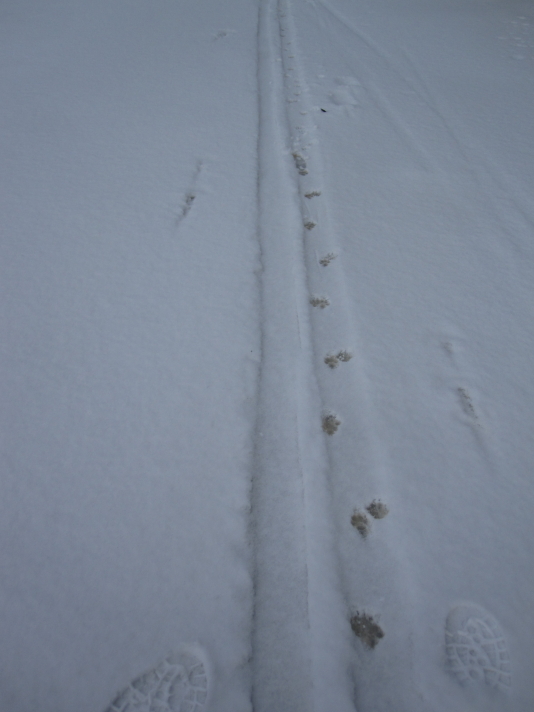
On the subject of differentiating prints, I saw a nice example of fox versus coyote tracks on the lake this week as both animals passed through the marsh behind Sheep Island.  

Coyote on left, fox on right.

The larger size of the coyote print is evident, as are the toenail imprints in both animals' tracks.

Here's a foot for scale.

We are so fortunate to have the wild spaces that let us experience these animals.  When you're exploring the forests, fields, and lakes in Meredith and you see the signs of fox, moose, fisher, mink, and the many other animals that find comfort there - including humans - remember Peter.

Sunrise on Crockett's Ledge, Hamlin Conservation Area.