Showing posts with label Needle Ice. Show all posts

Sunday, December 7, 2025

December 7, 2025: Winter Arrives

Winter arrived this week, in a serious, but not too harsh manner.  We had two nights with temperatures in the single digits which ushered in eight inches of beautiful light snow.  It made for easy shoveling and some fabulous early season skiing.


There weren't many animals tracks in the fresh snow, perhaps because of the cold.  I saw only fox tracks and a few short squirrel tracks where they went digging in the snow for food.  I always enjoy seeing the fox use my ski track for easy transportation.


They'll follow the packed down track for long distances, stepping out here and there to investigate a scent or detour to a known good hunting spot, but soon return to the trail.


The snow caused our cove to freeze up, with 4 inches of ice by Friday, though the main part of the lake was still wide open.

Did you see full moon this week?

Still open water on Friday

By Saturday, with calm overnight, most of the lake was iced in, which is a little concerning considering the juvenile loon was still on the lake on Friday.  People are watching carefully to see if she's gone or still swimming in a little sliver of open water.  


I took one last hike up behind the lake before the snow fell and I was able to find one set of needle ice growing beside the trail.

Needle Ice growing out of damp soil.

That will be it for needle ice this year.  I wrote more information about this interesting ice formation a couple of years ago:  Needle Ice


Through the bare branches in the woods, I noticed for the first time a couple of caves in the ledges along the Red Trail.


Curiosity made me investigate whether anyone was living there; I found no signs of porcupine (the caves are too large for them) or bears (the caves may not be well enough insulated with the large, exposed openings).


I also could see the cliff face at Crockett's Ledge.


It's incredible how trees can find the smallest foothold to take up residence in a granite face.


I also witnessed a nice turkey parade as they followed their leader calmly away from my presence.


Now I'll probably only be seeing their tracks in the snow, because winter is here, and it's probably here to stay.

The scene at Cannon Mountain this week.


Sunday, November 26, 2023

November 26, 2023: Ice & Snow, Needles & Birds

I had the good fortune this week to be walking the trails behind Lake Wicwas with a group of friends when we came upon some needle ice beside the trail.  The ground was warm and well saturated from recent rain and snow, and the night before was cold enough to freeze water exposed to the surface, providing the right ingredients for these cool crystals to grow.

Needle ice growing up out of warm, wet soil.

Once an ice crystal is formed on the bottom of a grain of sand, heat from below is transferred through the stone to the air which cools the water beneath it, resulting in more water freezing at the bottom of the crystal.  As the process continues the crystal grows skyward creating needle ice.   

Sand and small stones provide the heat path to start the process.  A few beechnut shells rode up on top.

Late fall is the time when conditions are right for these to form, and it's always a treat to find them.  

On cold, calm nights this week, interesting ice patterns were forming in other places too, such as on the surface of the lake in secluded areas.


These always remind me of Disney's Fantasia, and the fairies transforming water into ice to the music of Tchaikovsky's Waltz of the Flowers from his Nutcracker Suite.   I didn't realize those swirling ice creations were real until I saw these flourishes for the first time with my own eyes.  


Wednesday morning we got our first measurable snow, which thankfully was cleared out in time for the big Thanksgiving travel day.  And as if on queue, that morning the snow birds appeared - a big flock of them.  

Dark-eyed juncos, aka snowbirds.

They were happily picking seeds that were exposed where I had cleared snow from the road.  There are lots of hemlocks and a few while pines over the road here, so those are most likely what they were feasting on.  

We've all noticed how big the white pine seed crop was this year, as have the squirrels.  I came across this huge stash of white pine cones which a red squirrel must have collected this fall.  

A large cache of pine cones collected beneath a large Eastern white pine. 


Then, just a few feet away, were three more piles.

The pantry is strategically located around the dining table where
Mr. Squirrel can safely observe his surroundings while he dines.

This is quite a winter pantry - one squirrel won't go hungry this winter.  I'll try to remember to visit this spot a few times during the winter.


I hope the juncos and squirrels weren't the only creatures that feasted well this week.  I hope you too had a wonderful Thanksgiving with food, family, and friends - quiet, peaceful, and safe.

Happy Thanksgiving from Lake Wicwas.


Sunday, November 27, 2022

November 27, 2022: A Gaggle of Goldeneye

There were a lot of feathered creatures out celebrating Thanksgiving this week:  woodpeckers, goldeneyes, mallards, geese - but none that I saw were turkeys.  Of these, the most interesting to watch was the pileated woodpecker.  It caught my eye as it flew, the flashes of white in its wings divulging its identity, and it was easy to follow it to its destination on an oak tree with a promising rotten spot on a large branch.  

This branch caught the pileated's trained eye.

It hopped up on the branch and listened for signs of life inside the decaying wood.

The red stripe on the cheek indicates this is a male.  Females have a black stripe.

He apparently found what he was looking for and pinpointed the exact spot to attack.

Right there, in that little gap surrounded by lichen.

He began his assault, chopping at the branch with long strokes of his powerful neck, up and down, up and down.  First he broke through the bark, making a small mark on the branch.

Woodpeckers use their strong tail as a third contact point to brace against as they drive their chisel into the wood.  This video, though blurry and out of focus, at least shows the force a pileated can apply to its work.  Note how he keeps his tail pressed against the tree, and stops to listen now and then:

As he worked, the hole enlarged and deepened.

Soon he broke through the outer wood and opened up a pathway to the insects' home inside, most likely a nest of carpenter ants, at which point he simply stuck his beak in the hole, pushing his sticky, barbed tongue into the nest - a pileated can extend its tongue out two inches - pulling out ant after ant, and maybe some eggs too.  

He sat for long time feasting on the high protein food inside.  

The whole process, from when he landed to when he got his first morsel took just five minutes.  Here's a video of him reaping the fruits of his labor.


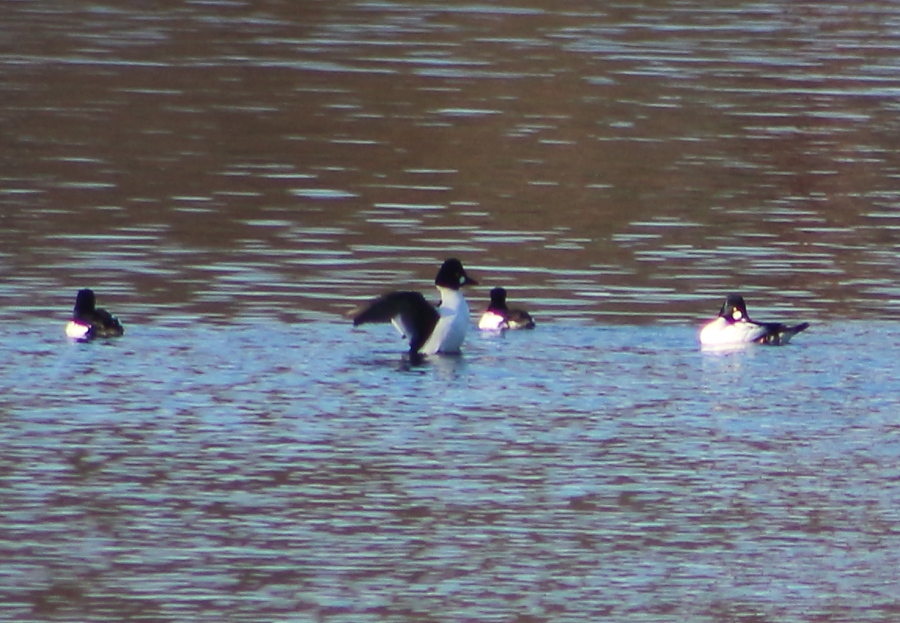
The next bird encounter came on Thursday morning when we took a walk along the WOW Trail between Laconia and Lakeport to rev up our appetite for Thanksgiving dinner.  There in Opechee Bay was a huge gaggle of goldeneyes that had gathered for their own Thanksgiving celebration - over 30 of them.

Goldeneyes, thankful for making it unscathed through the first half of hunting season.
For some reason, there was one lone hooded merganser leading the flock.
Or perhaps being chased by the flock?
I've seen large gaggles of goldeneyes on Lake Waukewan as well, but only small groups on Wicwas - it must be too small a water body for large family gatherings.  These are pretty little ducks with their white cheeks and bright golden eyes.


There were also a few mallards in the bay.
Mrs. Mallard stretches her wings.


Lastly, I'll share some pictures of needle ice that I found on a run up to the White Mountain Ledge in the Hamlin Town Forest.  I keep my eye out for this on the first cold days of the year, but these were easy to find as they were right in the middle of the trail.  
Needle ice on the Red Trail leading to the White Mountain Ledge
Needle ice forms when the earth is wet and still warm, but the air gets cold so water on the surface of the ground freezes.  As water in the soil is cooled from above, it freezes onto the bottom of the ice crystal, and the needle grows skyward.

The intersection of water and cold always fascinates me. 


Sunday, January 17, 2021

January 17, 2021: Hungry Squirrels and Ice Art

Jack frost was busy this week, spreading his creative artwork generously in multiple locations; he really seems to revel in wide fluctuations of weather and temperature.  One of the most intricate of his creations appears when he goes out on a cold night right after a rather humid day, before the moisture in the atmosphere can escape his grasp, and he snatches it out of the air and locks it onto whatever surface he can find, in this case, our windows.
Jack Frost's artwork adorns the windows.


He most often shows his harder edges, but sometimes he relaxes a bit and shows his softer side with smooth, circular, swoops.

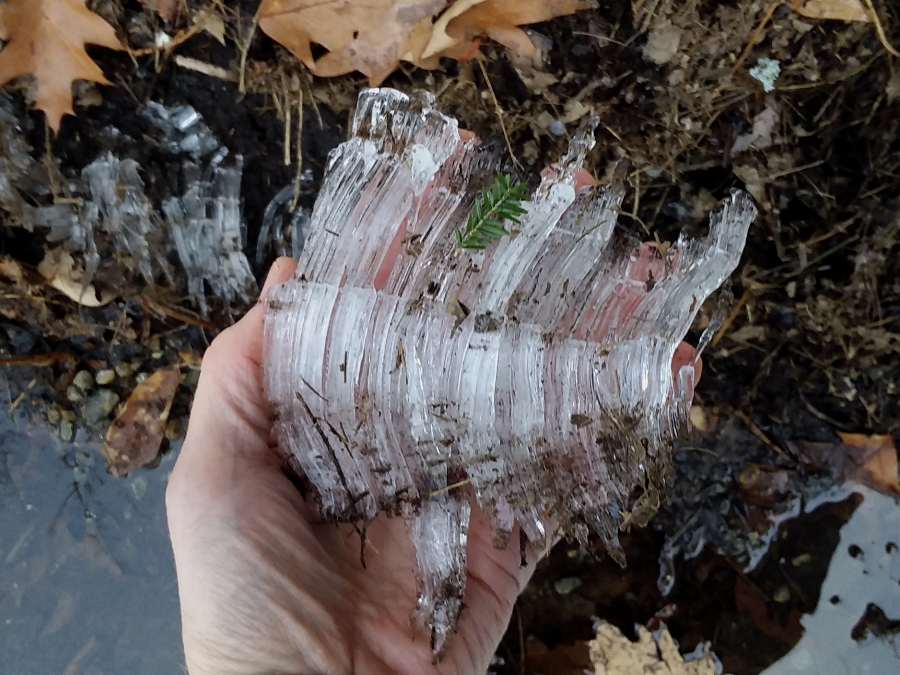
The very next night he walked along a small drainage that was still flowing with snow melt from the warm weather.  Here he chilled the saturated soil enough that it froze at the surface and was forced to release its heat up into the cold air, growing more of the ice needles that he usually makes early in the season.  With a plentiful supply of warm water and cold air, he made some pretty large needles.
Some of the larger ice needles I've seen.


Another interesting ice formation was several weeks in the making, but it also has do with changing weather:  Jack made us a lake-volcano.


I call these volcanoes because it appears a rock has erupted up out of the ice.  But of course, the lake froze right after the water level was high due to the melting of three feet of snow, and when the water drained out, the ice dropped back down around the rock.  A couple of weeks ago we had an earthquake; this week, a volcano.

I received a couple of enquires this week about all the holes in the snow with leaf debris scattered about them.
Who lives down there?


These aren't actually homes, but are signs of red squirrels foraging down below the snow cover for something to eat.  Looking carefully I could sometimes determine if they were successful in obtaining a meal, and if so, what they extracted.  Here's a hole where it's pretty clear the squirrel came up with an acorn or two.
Acorn Scraps


Other holes showed a lot of conifer debris thrown out of the hole, making me think the little guy was in search of hemlock or pine cones.  


It's not obvious that our friend found anything to eat in this next one, but it certainly found oak leaves and a pine cone.


Why it didn't open the cone is unknow to me - did it know there were no developed seeds inside?  Perhaps it was focused more on acorns as all the oak leaves suggest.  Another question is how they know just where to dig.  I can only assume they're able to smell oak or pine or hemlock aromas down below the snow - the rodent equivalent of following your nose to the bakery aisle at Moulton Farm.

Finally, I'm happy to report, in addition to squirrel tracks, there are miles of human tracks everywhere on the lake and on the trails all around the Lakes Region.
Lots of people have been enjoying the Bald Ledge Trail at Sky Pond in New Hampton.

The surface of Lake Wicwas is peppered with boot prints, ski tracks, ice fishing holes and sled trails, even mountain bike tracks.  Jack Frost isn't the only person taking advantage of the beautiful winter weather.
The Snake River draining Lake Winona into Lake Waukewan. (Bald Ledge)