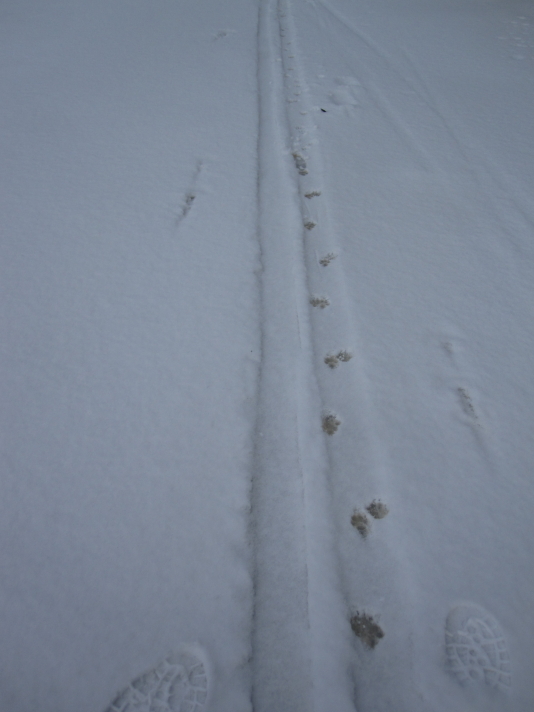
Showing posts with label Fox tracks. Show all posts

Sunday, January 30, 2022

January 30, 2022: Woodpecker Week

The last week of January brought out the woodpeckers, though this red-bellied woodpecker has been frequenting our feeder all winter.

Red-bellied woodpecker, our most recent addition to the Lakes Region woodpecker family.

I saw my first red-bellied woodpecker in late 2020 and learned that it has only recently moved this far north from its traditional territory south of Massachusetts (See the December 20, 2020 journal entry for more about this woodpecker) and I'm hearing lots of reports of them being seen all around central New Hampshire now.  This bird is larger than our long-resident hairy woodpecker and second in size only to the pileated woodpecker - which also made an appearance this week.

A female pileated woodpecker, identifed by the black versus red mustache.

Pileated woodpeckers rarely visit feeders, even suet, unless it's in a large woodpecker-friendly holder; these imposing, active birds feed mostly on insects and are uniquely adapted to extracting them from deep within trees.  They have very strong necks and beaks which they use to excavate holes, but the really fascinating aspect is their tongue.  The pileated woodpecker's tongue is attached to the end of a long flexible bone that extends from the tip of its beak, continues along the bottom of its head, then wraps up and around the back and top of its head and terminates at its forehead in front of its eyes.  Picture a flexible bone shaped like a question mark (?) rotated 90 degrees clockwise.   Attached to this bone is a muscle that can push this movable bone far out of its beak to probe into cracks and ant tunnels deep inside a tree.  The tongue itself is barbed and sticky so its prey gets stuck to the tongue and pulled back into the birds mouth.  [Ref:  Sibley, 2020, What it's like to be a Bird, Knopf, pg 91.]  

I watched this bird start at the base of a dead branch on an oak tree, exploring every hole, rotten spot, and crack as it made its way to the end of the branch.

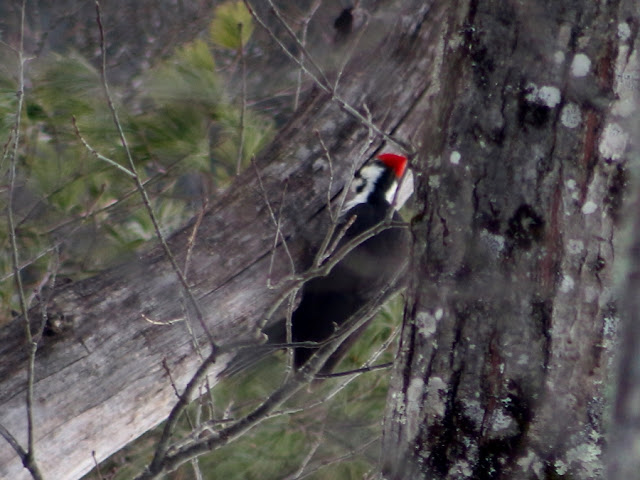
A truly remarkable bird.

I noted last week the dearth of soft snow for tracking, but on a trip up Mt. Roberts in the Ossipee Mountains I found plenty of animal tracks at higher elevations where there had been less rain and a bit of fresh snow to reveal the animals' travels.  First I saw a very conspicuous statement by a fox claiming its territory.

Fox use well exposed rocks and logs to leave their calling card for other foxes to see and smell.

Lots of mouse tracks at this marking stone.

I'd think the mice running between that rock and that tree might decide it's not a great neighborhood, but it explains why the fox wants to keep that corner for itself.

Next were lots of deer tracks and many more occurrences of deer hunting for acorns under the snow. 

A large area turned up by deer gleaning acorns.

Then I came across this strange mark in the snow which I can't figure out.


The tracks beside it look like coyote prints.


And it starts at a disturbed area in the snow.


One guess is a coyote dug something out of the snow and dragged it away.  But what?  A branch?  A long bone?  Another less interesting but more likely possibility considering this is right beside the trail is that a domestic dog picked up a stick hoping its owner would throw it!

Higher up on the ledges on the western flank of Mt. Roberts I had a good look at Lake Winnipesaukee, and yes it's all frozen over, even the broads.

Looking over Winnipesaukee toward the Belknap Range.

And looking north from the summit of Mt. Roberts, there was Mt. Washington, standing proud, displaying the countenance that gives the White Mountains their name.

A clear view of Mt. Washington and the Southern Presidentials.

For those who experienced the brunt of yesterday's Nor'easter I hope everything's ok.  We had just a glancing blow here at the Lakes with a few inches of snow, though it was hard to measure due to gusty winds blowing it around.


Sunday, January 10, 2021

January 10, 2021: Remembering Peter Miller

If you have ever walked the trails of the Hamlin-Eames conservation area, you have walked in the path of Peter Miller.  If you have enjoyed the produce of Picnic Rock (Longridge Farm) you have reaped the benefits of Peter's work.  Peter Miller was a tireless conservationist who, among his many conservation projects, wrote the grants that secured the funding to conserve Picnic Rock and the Eames Wildlife Area, and he personally spent hundreds of hours in the Hamlin forest searching out the best views, the most interesting features, and the best way to route trails to experience them all.  I believe it was Peter who discovered the 450 year old black gum tree high up on the ridge near the White Mountain Ledge.  Peter Passed away on January 2nd from complications related to COVID; he will be greatly missed.  You can read his obituary here.

Peter Miller, 1942 - 2021

Of course, the impact of conservation efforts is to ensure there will be wild spaces for the generations that will come after us.  We can't imagine what central New Hampshire will look like in 50 or 500 years, but we can trust that protected land will provide at least some green space for wildlife and humans alike.  And even today we can enjoy experiencing nature.  Several people sent me photos of their own observations of wildlife this week, including this very nice example of a fox track on Lake Wicwas (thank you NC!).

Fox tracks in the snow.  Photo by Neil Crimins.

This is a beautiful example of what's called a c-gallop, created when a fox is moving along at a pretty good clip - a gallop, but not full speed.  

When a fox trots, it leaves a precise, linear track, with each hind foot falling exactly on top of where its front foot landed, a trait known as "direct registering".  Fox are so precise in their travel that I have followed a track, for a long distance, only to suddenly have it split into two tracks, and then return to one.  The explanation is that two foxes, most certainly a mating pair, were traveling together, with the second animal stepping exactly in the tracks of the lead fox.  

A linear fox trot.

As a fox increases its rate of travel this line will change into sets of four diagonal prints; faster still, into a lope which creates the curved set of four tracks.  At yet higher rates, it becomes a gallop where the hind feet land in front of the front feet within each set of four prints.  

The larger prints below are from the front feet, the smaller rear prints are above.

The front paws are larger than the rear due to the fact that a fox carries most of its weight on its front legs.  

Eventually, at a full speed gallop, the tracks again return to a straight line.  But the fox is a very efficient animal, and most often I see the energy-efficient track of a trot.  Efficiency also explains why they place one foot directly in the print of another, and why two foxes will follow exactly in the other's footprints.  Here's another example of efficiency:  It never fails that when a fox comes upon a ski track, it will jump right in and take advantage of easier travel.

Following along in a ski track.

Someone else sent me a picture of a bobcat print (thank you LH!).

A very nice bobcat print.  Photo by Linda Hammill.

Fox and bobcat prints can be hard to differentiate, but in this clear print you can see the distinguishing features:  a round print versus the elongated print of a fox, and a lack of toenail imprints, as cats can retract their claws.  You may have noticed this print has too many toes.  Why?  The bobcat is also a direct registering animal!

On the subject of differentiating prints, I saw a nice example of fox versus coyote tracks on the lake this week as both animals passed through the marsh behind Sheep Island.  

Coyote on left, fox on right.

The larger size of the coyote print is evident, as are the toenail imprints in both animals' tracks.

Here's a foot for scale.

We are so fortunate to have the wild spaces that let us experience these animals.  When you're exploring the forests, fields, and lakes in Meredith and you see the signs of fox, moose, fisher, mink, and the many other animals that find comfort there - including humans - remember Peter.

Sunrise on Crockett's Ledge, Hamlin Conservation Area.


Sunday, December 2, 2012

December 2, 2012

December is here, and Old Man Winter is tightening his grasp on Lake Wicwas.  As the temperature drops the ice is spreading out farther and farther from the edges of the lake.  These pictures are from December first;  today it was too foggy to see what was happening out there, but early in the morning, it appeared as though the ice had covered much of the lake.


With warm weather forecast this week, it probably will reopen again.  The little bit of snow that fell helped the ice along, as it made a thin layer of slush on the surface.

I saw nice healthy gray squirrel hopping along the ice, taking advantage of a fast and direct route, and I also found fox tracks crossing over the thin ice in a marsh.

Brave animals, these first pioneers out on the ice.

There wasn't much snow - less than an inch - but it set a pretty picture around the lake, and and did allow looking for tracks to see what's been visiting the lake.

On shore, I tracked this same pair of foxes trotting a long distance on one of the trails around the lake.  They went right across the path of moose, though the moose passed before the snow fell.  It left a different clue of its presence.
Moose Scat
This scattering of scat was deposited over a five foot diameter!

The diet of the moose has changed from the water-loaded diet of aquatic vegetation to a much drier diet of land based plants, as clearly seen in the individual pellets.


Looking back at these pictures, I realized that there wasn't much color around Lake Wicwas this week!

Sunday, January 30, 2011

January 30, 2011

What a winter so far - lots of snow, cold temperatures, and no rain!  Sunday night we had the coldest weather Lake Wicwas has seen in a couple of years:  13.4 degrees below zero.  It hasn't been that cold since 2009, when it got down to -21.6 degrees on January 17th.  That, by the way, is the coldest temperature I've recorded since I started keeping records in 2002.
Snow Shoeing on Lake Wicwas

The storms have been coming mid-week this winter, which isn't great for the school schedules or commuters, but it's great for weekend sports, with fresh snow and good weather for the weekend.  This weekend was beautiful - partly sunny and warm (near freezing) temperatures.  Today there was a group out ice fishing, complete with gas grill for their lunch.  They had only caught a couple of perch when I went by in the late morning.  They used an interesting technique to pick their fishing spot - they drove out on the lake until their ATV got stuck in the slush, and that's where they fished!
Ice fishing off Loon Point
Stuck in the Slush

I still don't understand exactly why there is so much slush under the snow even when it's been so cold.  Between the top 6" of snow and the firm ice, there's a good 6" of slush.  I know snow is good insulator, but where does the heat come from when there's cold ice below, and cold air above?  My best guess is that IR radiation from the sun penetrates the snow until it hits the dark ice where it gets absorbed, melting the bottom layer of the snow.  Any better ideas?

I skied around the marshes and swamps on the west side of the lake looking for signs of otter, but I didn't see any.  I did see tracks of smaller weasels on and around Sheep Island.  It was likely a mink, as the tracks frequently went down into the lake at holes along the shore line.
Mink Hole under the Ice


Weasel Tracks

Weasel's leave a tell-tale two by two track, and this one followed my ski trail for a while, enjoying the easier going in the deep snow.  It then took a pretty straight path up into the woods away from the lake.


There are also lots of fox trails all around the lake with the weekend's warmer temperatures.  I found what seems to be a fox super-highway, with lots of tracks all leading into and out of this stream.  All these tracks were made since the last snow on Thursday.
Fox Tracks Leading onto a Stream

The house construction on the north side of the lake is coming along nicely - people who come back in the spring may never know it's been rebuilt.


And I was quite surprised to see that the docks on Byrant Island have been removed!

There are two more storms projected for this week - there may be new snow yet again next weekend!

Sunday, January 2, 2011

January 2, 2010

Mouse Tracks in Fresh Snow
New England weather - where else can you have a whole season's worth of weather in just one week?  After the snow on Sunday night, there were a couple of days of cold, windy weather that were very much like the depth of winter.  Most of the animals around Lake Wicwas were hiding safely in their home; the only signs of life for a couple of days after the snow were a few mouse tracks, one set of porcupine tracks, and a couple of fox tracks.


Fox Tracks near Bryant Island


But then the weather warmed up, and the activity increased greatly.  On an early morning ski I found some some perfect fox tracks going right across the middle of the lake. Each toe pad was imprinted, as well as even the toenails.  This pattern clearly shows the different size of the front (larger, on the left) and rear (smaller) paw.


The low, early morning sun provided good contrast for animal tracks, as well as the patterns made in the snow by the wind, and reflections off the ice where the snow was blown away.
December 30, 2010 Sunrise
 
The warm weather also brought out lots of deer activity, with many sets of tracks along the usual deer paths.  By Friday and Saturday it felt like spring with temperatures up into the 40s, warm sunshine, and the chickadees singing like it was late March.  The squirrels were very active, running up and down the trees and all over the ground collecting food in the warmer weather.  I sometimes think they they're in cahoots with the birds when I watch the nuthatches shoveling seeds from the feeder to the ground!

Temperatures today were bit cooler, but with a warm front bringing more humidity, and with the lake still cold, fog formed right on the surface so thick we couldn't see across the cove.