Sunday, October 14, 2012

October 14, 2012

Frost on the pumpkin!  Lake Wicwas had its first freeze on Saturday morning, though only in open areas that were exposed to the cold sky and the effects radiational cooling - anyplace protected by a cover of trees remained frost-free.  I didn't see any pumpkins around the lake, but there was frost on the leaves that had fallen into open fields.


With a clear day upon us, we had a beautiful walk up to the White Mountain Ledge on the Hamlin trails, and found some nice views to the north.  We got one glimpse of a snow covered Mount Lafayette when it cleared from its cloud blanket, but all the other mountains are still green.
From the White Mountain Ledge
Mt. Chocorua

There were beautiful views around the lake as well, with the dark blue water sparkling in the brisk north wind.  Here is the scene looking northeast towards the Lakeland School.  Old timers around the lake will remember when this was the Wicwas Lodge - maybe even some who remember the Lake Wicwas House?  There is a great history of the site on Dean Dexter's New Hampshire Commentary, "Smith Corner, Lake Wicwas, Meredith NH"   (Click Here).
Lakeland School

We also visited Crockett's Ledge, where there are still many yellow trees looking looking over towards Lake Winnisquam.  
Lake Winnisquam

This large structure - visible with binoculars - on the hilltop looking east towards Winnipesaukee was built in the last few years.  Could it be just a private residence?  


On our hike we saw lots of old tree stumps that are decomposing, and becoming hosts for moss, lichen, fungus, and now even small trees.  These new residents will accelerate the rate of the stump's decay.  Some of them have the appearance of tiny fairy yards. 

Lichen:  Reindeer and British Soldier
There were lots of animals out enjoying the pleasant day, collecting food for the winter.  Perhaps the first frost got them thinking about the long season ahead.  Or, more likely, it is just that we put the bird feeders back out.  (Risking the bears as well!)  In addition to the usual visitors, we saw the first Snow Bird, and a Purple Finch.
Purple Finch


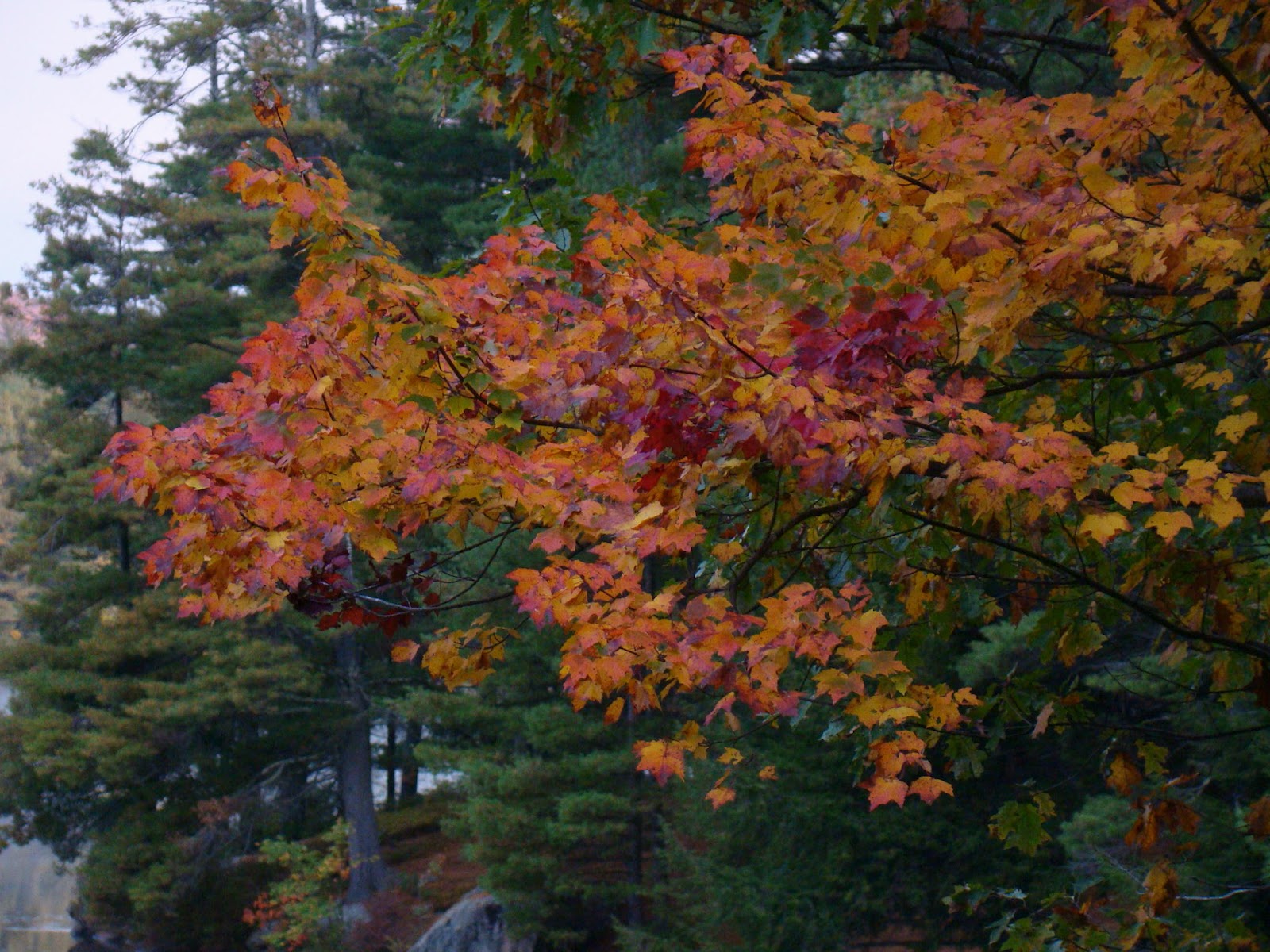
There is still plenty of color around the lake to enjoy!

From Crockett's Ledge

Sunday, October 7, 2012

October 7, 2012

After a beautiful late-summer day on Friday, the weather at Lake Wicwas turned back to fall.  I did not see a lot of activity around the lake, but I did see an Osprey, which surprized me, since I thought they had all started their migration by now.  Perhaps this one was coming down from a summer in Canada.  Dave T. told me about the Squam Science Center's project that is tracking osprey with RF transmitters, and it's fascinating to watch their journey.  They have tracked osprey that had their nest right here in Tilton and spent the summer in the neighboring lakes (but they weren't the birds that were at Lake Wicwas this summer according to their maps).  You can follow their migration here:  Project Osprey.  One of the new chicks (Jill) left Tilton on September 11 and arrived at the Amazon River three days ago - including a 24 hour flight from Cuba to South America - a trip of 3900 miles in 25 days!

Back closer to home, the fall colors are near peak in the Lakes Region, and the weather allowed some good leaf peeping.  We took a nice walk along the Winnipesaukee River Trail from Tilton to Franklin;  the water is flowing rapidly in the river, probably due to a combination of last week's rain fall and lowering the lake level in Winnipesaukee.

But the foliage is better right here - these are some of the sights you'll find right on the shores of Lake Wicwas: 


There are still a few brave fishermen out enjoying their trade in the beautiful surroundings.


The Partridge Berries and Wintergreen are ripening now, trying to attract some of the attention from the trees above, and providing some bright color right at our feet.
Partridge Berry
Wintergreen
Nodding Ladies' Tresses
There is also a lovely fall flower blooming now - a tiny orchid with the name Nodding Ladies' Tresses:


And on a morning walk, the moon was trying its best to draw my attention up above the trees.


It is amazing to think there is NASA equipment that has been up there for over 40 years now.

I did see a pheasant dart out of a thicket, but there's little chance to get a picture of that bird.  Here's one (sort-of) wild creature I did capture.

If you've ever wondered if evergreens lose their needles as the deciduous trees do, there's plenty of evidence in the lake  right now.  These are white pine needles that have been shed.

They are also forming a soft, quiet carpet in the forest at the moment.

Enjoy the autumn splendor while it lasts!


Sunday, September 30, 2012

September 30,2012

No turtles were sunbathing this weekend - or people either for that matter.  Three days of cool, damp, rainy, drizzly weather prevented that activity!  At least it makes for deep color in the foliage as the filtered, indirect light brings brings out high saturation in their colors.  But no blue skies in the background!


Last week I noticed the red maples turning in the wetlands of Lake Wicwas.  This week, with more color in the leaves and the cloudy lighting, they really stood out, causing me to notice just how many trees are growing back into the large wetland along the east side of Chemung road.

The tall dead trees in the swamp indicate it was once a forest.  I expect many years ago beavers dammed a stream to flood the area, killing the trees in the process.  Beavers are the only animal other than man that make major changes to the environment for their own purposes.  They build dams to form the ponds they use for food (aquatic vegetation that grows there), for their homes, and for protection from predators.

We can be pretty certain the dead snags are all pine and hemlock, as those are the two trees beavers really don't like;  they would have taken down all the other trees in and around their pond.  But quite some time ago they abandoned their self-made pond.  This is another way beaver are like humans:  once they have depleted all the resources in an area, they just abandon it and move on to take over another forest for their home.  Over time the pond has drained, and filled in as the wetland plants grew and died each year.  At this point, it is dry enough that Red Maple is starting to reclaim the area.  Red maple is also known as "swamp" maple due to its ability to grow in very wet ground.

As these trees grow, their leaves will deposit more organic material on the ground and their roots will pull more moisture from the soil, creating conditions suitable for more tree species, and the forest will reestablish itself.  At which point, the beaver may come back to harvest the trees again, and the cycle might repeat.  Until then, different animals will enjoy the wet habitat, and we'll enjoy the bright red maples.


On a morning walk, a large flock of Blue Jays came by, making quite a ruckus, with a large variety of sounds, from their usual harsh calls to more musical notes, to loud clicking sounds.  Lang Elliott has two great recordings of Blue Jays on his website - the second of his two recordings more closely reflects what I experienced this morning.  (His recordings were made in Ithaca New York.)


The jays were mostly high up in the trees, especially the pines, flitting from branch to branch, though one came down low enough for me to see it had a large red berry in its beak.  Blue Jays, like Gray Jays, will cache food to use later, but this flock appeared to be migrating.  There were perhaps two dozen of them, and they moved slowly across the area over a period of five or ten minutes. 

By next week we should see many of the trees in the lakes region approaching their peak colors.

Sunday, September 23, 2012

September 23, 2012

The autumnal equinox has passed, which means we, the residents of the northern hemisphere, have passed the sun back to our friends down under.  For the next three months our days will get shorter and cooler as the sun sinks lower in the sky.  But this week was still warm enough for many people to be out enjoying Lake Wicwas.  And not only people.  On a late afternoon paddle I saw many turtles sunning themselves on logs as they soak up the last of the summer sunshine.  There were four of them lined up perfectly on this sunning spot, but two of them were camera shy and slipped under the water before they could captured by the paparazzi.

Other animals I saw on the trip included heron, a hawk, and lots of geese.  I did not see the osprey or the loons, but I did hear the latter.  I also heard a barred owl hooting early one morning before dawn. The same morning there were two deer in the yard.

I came across this large mound of weeds and aquatic foliage on the shore of the lake.  I'm not sure what creature is building it, or what the purpose is.  My best guess is either a muskrat or a beaver, perhaps starting a new lodge?  I'll have to keep an eye on it and see what happens.

I did not see a lot of other activity this week, but here's a sampling of some of the more interesting mushrooms I've seen over the past couple of weeks.

A New Crop
Emerging from the Forest Floor

Destroying Angel


Indian Pipe


Emerging Fly Amanita
Fully Open, 7 inches Across
 
 
Lunch for Chipmunks

With just a touch of fall color starting in the lakes region, the brightest foliage is found in the red maples that grow in the low wetlands and marshes around the lake.  The blueberries are also starting to turn.
Every day now they're turning a bit more....

Sunday, September 16, 2012

September 16, 2012

More signs that summer is fading fast - we're losing about three minutes of day light every day now.  Cool, dry, fall weather blew over Lake Wicwas this weekend, allowing the atmosphere to cool quickly once the sun set, bringing the coolest temperatures since May.  The dense, cool air mass flowed down the slopes around the lake, promoting a visceral mist as it encountered the warm surface of Lake Wicwas.

The birds are noticing it too, as the first flocks of Canada Geese are heading on their way southward - but not our flock yet.
Canada Geese

We are beginning to see more of the impatient members of the plant world too.

Our loon chick has matured noticeably in the last two weeks.  Compare these pictures to August 28.


It has lost almost all of its baby fuzz, it has adult markings now, and is gaining in size.

Its wings are developing, and it is starting to investigate what they are all about.

Look at how it folds them all up to put them back into storage.  It looks like one of those hard-top convertible cars with an automated roof.

It will be ready to use those new appendages in a couple of months.

I also saw the osprey again.

It fooled me by perching high up in the top of a tree - from a distance I thought it was an eagle, as that is an eagle's usual observation post.

More mammal activity is also evident; they are all fattening up for the winter.  I heard deer in the woods, though didn't see any, other than one right on the road as I drove in.  I found a three foot long branch lying on a trail, with most of its leaves nibbled off.

But it wasn't a deer, as it was cut off cleanly right at the ground rather than ripped from up high (I had to search a bit to find from where it was cut).


This perfect 45 degree cut, which looks like it was made with pruning shears, is the sure sign of a rabbit.  It cut off the young sapling so it could acquire the tender leaves that were out of its reach.

There is more scat on the trails too - I'm pretty sure this is coyote scat based on its diameter of 3/4".

He's probably delighted that the rabbits and deer are eating well!

We took a trip up to Ossipee and walked a couple of very nice trails there.  The first was in the Ossipee Pine Barrens which is a rare and very unique habitat in New Hampshire.  The second was around White Lake at White Lake State Park.  There we found a vivid, almost psychedelic fungus growing all along a downed tree.  Although it's not Lake Wicwas, it is too fascinating to not share it.
I think it's a polypore, and I'm guessing the orange pigment is being pulled from the host tree.  Remember the red wood under the fallen tree after the storm on July 4th?  It had bright red color just under its bark.  Perhaps this is the same kind of tree, and the fungus is drawing on that coloring.  (Note:  I have since learned this is called chicken-of-the-woods, also known as sulphur spore.)

Back to Lake Wicwas, here's another look at the coming season.