Showing posts with label Dragonfly. Show all posts

Sunday, August 31, 2025

August 31, 2025: Late Summer Flowers

Last week I mentioned late summer wildflowers; they may not be as showy as spring trilliums and lady's slippers, but they are more plentiful, easier to find, and tend to bloom for a longer period.  A favorite of mine, and one that often grows near water, is the Turtlehead.

Turtlehead, a relative of snapdragons

While looking at them this week I thought they resembled snapdragons, and sure enough, both plants are in the Plantaginaceae family.  Snapdragons are native to the Mediterranean and cultivated as annuals in New England, while turtleheads are hardy perennials native to New Hampshire.  Look for them near shorelines and other wetland areas.

Next up are a couple of blue/purple flowers.  From a distance this Purple False-foxglove looked like it might be Purple Loosestrife, but it's not.

Purple False-Foxglove

This native flower is not closely related to the cultivated foxglove which comes from Europe; they share a common name because their flowers are similar in shape.

I found the next flower growing right along a roadside:

Common Bellflower

The Common Bellflower is native to Europe, and though not classified as invasive in New Hampshire, it needs to be managed carefully as it spreads aggressively, often escaping from gardens as the ones I saw beside the road had done.

Queen Anne's Lace must be a drought-resistant plant as it really is having a good year.  

Fresh blooms continue to emerge even with the lack of rain.

Queen Anne's Lace putting out a new flower.

Flowers aren't the only thing catching my eye in late August.  Dragonflies are still buzzing around wildflower fields as well as shorelines.

Clubtail dragonfly
A pair of Slaty Skimmers mating.  

Note how the female (behind) is grasping the male's tail.


But there's no denying that summer is waning fast.  The lake temperature took a tumble this week with cool nights followed by shorter days which provide less energy to warm it back up.  
Fog wells up from the lake on a chilly August morning.

And this sight is hard to ignore:
The first maples start to turn.

But fear not, September will bring plenty of great weather for outdoor activities.  

Happy Labor Day!


Sunday, September 22, 2024

September 22, 2024: Spring Peeping into Fall

This confused little Spring Peeper was climbing up the side of our house one evening right at supper time.

Look at the little suction cup pads on its toes.

Does our house look like a tree?  

Spring Peepers are the smallest frogs we have in New Hampshire, less than an inch in length, and have a distinguishing X-mark on their back.  They make up for their small size with a large voice - these are the frogs that create the loud peeping sound that keep you awake on early spring nights.  According to NH Audubon, a large group of them can make enough noise to be heard two and a half miles away!  [Ref:  NH Audubon]  Spring Peepers are similar to Wood Frogs in many ways including being able to climb trees, breeding only in vernal pools, and synthesizing antifreeze which allows them to survive subfreezing temperatures over the winter.  This feature lets them hibernate near the surface so they can emerge early in spring to get to vernal pools in time for their offspring to mature and leave the pool before it dries up in summer.


Walking along the White Trail in the Smyth Easement on one of these fine falls mornings I saw a spider web reflecting a sunbeam that found its way through the forest canopy.  

The owner was home and right at the center of its web.


I don't know what kind of spider it is other than it's in the orb-weaver family, and it's a pretty tiny spider to have created such a large web.  It likely means I was the first one on the trail that day, though because it was so visible in the sunbeam, I was able see it and leave it undisturbed for the next hiker to find.


There's been a cormorant hanging around the lake recently, taking advantage of the good fishing in Wicwas to fuel up during its migration south.  
Double-crested Cormorant

Keep your eye out for them this time of year on any of our lakes.  They can look like a loon from a distance, but they typically ride lower in the water.  They may look dark and plain, but up close they are actually quite pretty.


On the subject of birds, the NH Audubon Society has just established a bird tracking station on the Lakes Region Conservation Trust fire tower atop Red Hill in Moultonborough.  This joins a network of stations used to track birds across the country.  The Red Hill station already tagged its first bird, a Wood Thrush passing through New Hampshire on its way south.  Two days later the same bird was in Pennsylvania!  


Since then the station has detected two migrating Eastern Whip-poor-wills.  Birds are tracked using miniature transmitters attached to them.  The stations pick up the signal from the transmitter when the bird flies near a station, much like the ez-pass system on our car.  You can learn more about the system here.  With fall migration in full swing now, there should be many more birds detected over the coming weeks.  You can monitor the station's observations and track the birds' travels on-line at this link.  


It may be hard to believe, but the transmitters are so small that they can also be attached to bats and even insects, including dragonflies.  I don't know if any dragonflies have been tagged in our area, but they are very active right now especially in the marshes around the lake.  I watched male dragonflies hovering over their claimed territory until another one entered its air space. 

Then it zipped after it to chase the intruder away before returning to its sentry post.


Dragonflies have amazing joints and muscles that allow their wings to rotate in a figure eight pattern, providing the ability to hover as well as enabling high speed flight and rapid maneuvering to capture insects on the wing.
Four wings that move independently give dragonflies great acrobatic abilities.


Those marshes around the lake are starting to age into their soft golden hues of fall now.


Autumn marshes and Red Maple trees in wet areas are early signs of the coming season.

One of the prettiest times of year in the Lakes Region is almost here.


P.S.  For you historians, the Meredith Historical Society will be featuring our own Dean Dexter next Tuesday when he presents "The Smiths of Wicwas Lodge".  The event is at the Meredith Community Center on Tuesday, Oct 1st.  Doors open with snacks at 6:30pm and the presentation starts at 7:00.  I hope to see you there!


Sunday, September 17, 2023

September 17, 2023: Nature's Hovercraft

Most of nature's flying creatures have evolved with a bias towards fast, efficient flight, but there are a few animals which in addition to being very quick and maneuverable, have the ability to hover in place like a helicopter.  Hummingbirds achieve this feat through unusual shoulders that give their wings a large range of rotation rather than a simple up and down motion with limited rotation.  


A hummingbird rotates its wings in a figure-eight pattern, which provides lift on both the forward and backward wing stroke, a most valuable ability when drinking nectar from a flower who's stalk won't support even the one-tenth of an ounce weight of a ruby-throated hummingbird.  


The dragonfly is even more advanced in its flight surfaces.  Dragonflies have four wings, each of which can move independently of the others.  This gives it the ability to fly forward, backward, up and down, even sideways - important features when hunting down other agile flying insects on the wing.  Though dragonflies have the ability to hover, and use it regularly, they don't hover in one place for long.  I watched a group of them hunting over a marsh this week, devouring insects, and though they would hover for a moment, by the time I pointed the camera, they had zoomed away.  And it's not easy focusing on a small, fast moving object.  I took dozens of pictures to get one decent shot that shows all four wings.


On this same paddle I saw a bird that uses a different technique to remain stationary while hunting for food.


This osprey was perched in a tree often used by an eagle, which is what I thought it was from a distance.  Osprey migrate south starting in September, so maybe they'll head off with the strong northwest winds from hurricane Lee, but they've been very visible and audible the past few weeks.  I've heard them crash into the lake when they've targeted a fish from their high perch, then fly up and away with dinner in its talons.  If you want to see a fantastic video of an osprey diving for a fish, watch this video from Mark Smith Photography.  (I think it's better with the sound turned off.)  Osprey are the only birds I'm aware of that dive well under water to catch their prey.

In June (June 11, "Fern Weather") I noted a Jack-in-the-Pulpit growing along the side of the road.  Now, three months later, the Jack-in-the-Pulpit are showing the world their snappy red berries.  

Jack-in-the-Pulpit (Arisaema triphyllum)

Birds consume these berries, including turkey and wood thrush.  

Another plant sporting red berries now is the False Soloman's Seal, which was also mentioned in the same June post - they must have the same game plan.

False Soloman's Seal (Maianthemum racemosum)

These not quite as showy berries are food for mice as well as many birds, including grouse.


LuLu and Checkers are really getting independent.  We sometimes see them with no adults anywhere in sight.  It makes me wonder if the parents occasionally head off to force the juveniles to learn to fend for themselves, as well as to get some peace and quiet - the kids constantly whine at them for food when they're together.  One afternoon I took a picture of a parent and a kid, only to find out later I was photobombed once again.


The heron posed a few days later for a private sitting, for which which Linda did the honors.

Great Blue Heron.  Photo by Linda Powell

The fall wildflowers continue to shine.  Asters now call our attention in walks through fields and along roadsides.

Purple-stemmed aster (Symphyotrichum puniceum)

Hurricane Lee was kind to New Hampshire, staying well offshore and sending us only a moderate northwest wind with a bit of rain.  The night before it went by, Lee even gave us a brilliant sunset.  

Pre-Lee Sunset


Fall officially arrives next Saturday.


Sunday, July 2, 2023

July 2, 2023: Dating Dragons

A few weeks ago I mentioned that dragonflies and damselflies have some interesting mating techniques, and with lots of these mythical creatures now emerging from the depths, July is a good time to observe them in action. 

A male (blue) and female (tan) bluet damselfly in their mating configuration.

As I mentioned previously (May 28, 2023) dragonflies and damselflies are considered aquatic animals because they spend most of their lives as nymphs living in the water.  After a number of months - or even years - they emerge from the water and transform into the flying creatures we usually see.  They climb up out of the lake on plants and docks where they extricate themselves from their final aquatic shell as almost-flying creatures.  

A newly hatched damselfly next to a shed larva shell.

Before they can fly they need to bake in the sun while they pump up and dry out their wings.  You may find their old exoskeletons left behind with a small hole in the top where they climbed out,

Here I could see the hole through which it escaped its juvenile prison.  It's rather amazing that the adult was packed into that small skin, let alone being able slide out its fragile legs.

Out in a marsh, this next dragonfly climbed up a reed, escaped from its skin, then climbed up another inch to dry itself in the sun, hoping it could become airborne before it was gobbled up by a predator:

A freshly metamorphosed dragonfly and its exoskelteon.

After emerging, the adult dragonfly's (and damselfly's) primary mission is to find a mate and reproduce. This is where it gets really interesting. The male and female dragonfly have their reproductive organs on opposite ends of their body which results in a heart-shaped mating position, with the female holding onto the male while it deposits sperm from near its thorax into the female's receptacle near its tail. 

The male is blue, the female green.

The process takes a few minutes so you often see Odonata (the order that includes dragonflies and damselflies) flying in their mating position.  As in many species, the female is the one that selects a mate.  Males will demonstrate their acrobatic abilities, and the female will select one of her choosing.  After mating, the female will do its best to avoid any other interested males, going so far as to fall to the ground and play dead in some species when approached by another male.  The reason for this is that male dragonflies have the ability to remove any existing sperm in a female before depositing its own.  This would mean the female's chosen mate's genes would be eliminated from her offspring.

After mating, the female will place the fertilized eggs either on a plant or directly into the water.  Perhaps you've seen a dragonfly in a touch-and-go flight pattern, dropping down to touch the surface of the lake and then taking off again.  Each time it touches the water it is depositing one egg in the lake from the end of its body.  Thus a new cycle begins, as the egg will hatch into a new dragonfly larva, consuming microscopic organisms as it grows though multiple molts as a larva.  Different species of  Odanata (there are over 7000 species) have differences in their anatomy and behavior, but most of them have similar traits.

Lakes, streams, wetlands - they truly are the fountain of life.  This week I was up in the mountains, hiking on Mt. Cardigan and Firescrew.  There on the open ledges of Firescrew is a small alpine lake.

An alpine lake on the Firescrew ledges.

As we approached the lake my hiking partner heard something familiar, and we had to stop and listen to believe what what were hearing.  There was no doubt; here, in the alpine zone, at an elevation over 3000 feet, was a frog.  We didn't leave the trail in this fragile habitat to look for it, but it sounded like a green frog.

I've always seen green frogs near the lakes, where this one was hunting for insects.

I never expected to find a frog in this adverse environment.  Then, my hiking companion posed the astute question "how did it get here?"  There are streams nearby, but none that flowed out of this isolated pond in a depression in the granite.  I suppose frogs migrate up streams, and in a dry summer, when a stream dries up, they may go in search of the water a frog needs to survive.  

There's always some new wonder to discover in nature.

We also saw quite a few pretty alpine flowers on the hike, including three-toothed cinquefoil:

Three-toothed cinquefoil on the high Firescrew ledges.

By the way, Firescrew supposedly got its name from the smoke of a wildfire on the mountain that was twisted up into the sky by swirling winds into a large vertical corkscrew shape. 

On our hike, it was smoke from wildfires in Canada that made for the hazy sky, but it was a great hike with my sister - thanks for the adventure!

The summit of Mt. Cardigan from Firescrew.

Back at Lake Wicwas all is well with the loons.  LuLu and Checkers have been protected from all threats and are doing well, and the second pair is still tending to their eggs on the nest in Harris Cove.  They should be hatching about one week from now.  

I hope you have a great Fourth of July, enjoying some fireworks, whether man-made or nature-made!
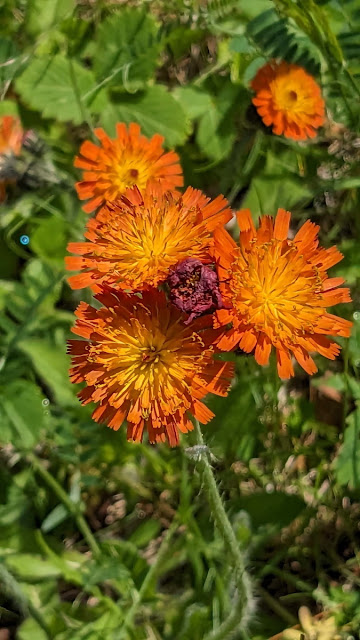
Orange hawkweed, Nature's fireworks.

Happy Fourth of July!  


Sunday, October 18, 2020

October 18, 2020: Micro-monsters

I recently came across an article about dragonflies that reminded me of a green-eyed monster I saw this past August.

The business end of a dragonfly.

What struck me in the article was the reference to dragonflies as "micro-monsters" based on the fact that they will eat anything they can get their teeth on.

OK, they don't really have teeth, but they do have very strong mandibles.

The main content of the article however, is about how dragonflies are being used for research into environmental health, in particular, mercury levels.  Because dragonflies are found on every continent except Antarctica, are physiolgocially similar around the world, and are relatively easy to catch (the article focuses on a high school in Vermont that does much of the field work) they provide a good baseline for studying mercury levels throughout the world.  [Ref: Nicolas Brulliard, "Mercury Rising?", National Parks Conservation Association, Spring 2017]


Mercury is a heavy metal found naturally in rocks and is toxic to wildlife and humans.  The burning of coal is one of the main contributors to mercury content in lakes and oceans as wind and rain distribute the released mercury around the planet.  That's why we need to limit consumption of fish such as swordfish and yes, even the fish from lakes in New Hampshire, because fish accumulate mercury in their flesh.  Dragonflies also accumulate mercury in their bodies, so by collecting samples of dragonfly larva for analysis these student-scientists are helping us better understand mercury levels in the environment.  The good news is that due to smoke stack scrubbers and reduced coal burning in the United States, mercury emissions have decreased over the past 30 years, though this has not yet impacted mercury levels in our fish.  [Ref:  David Neils and Kirsten Nelson, "Status and trends of mercury in fish tissue in New Hampshire waterbodies", 1992–201 6,  NH DES, Nov 2018]

It's been a couple of weeks since I've seen a dragonfly, but they are still around.  The latest I remember seeing one is November 4th, this pretty Meadowhawk that sought shelter in our house.

A Meadowhawk still active in November.

It also appears that all four members of the loon family are still here, at least part of the time.  It's getting more difficult every day to tell the chicks apart from their parents as the parents get more and more gray and the chicks gain darker coloring on their wings. 

Harold or Betty.  Note the light colored beak.

The most obvious difference is that the juveniles don't have the distinctive neck band that the parents have.

Striped neck ring and dark beak on the adult.

I'm still unable to tell the two chicks apart as they are quite similar in size and appearance.

Harold and Betty in a quiet moment.

As I went on my way one of the two waved goodbye to me.  They sure have huge feet already!

That's one big propeller.

Maybe the family is lingering at the lake to enjoy the last of the fall foliage - like many of us are doing!


Much of the color has now moved down to a lower elevation now, especially the maples leaves.


But you can still find color in the Lakes Region if you look for it.
The shore of Turtle Island glows crimson with blueberry bushes on a bright fall day.

Early today:  Fog and frost add to the splendor of morning.