Showing posts with label Rock Tripe. Show all posts

Sunday, March 1, 2020

March 1, 2020: The World is Falling Apart

We've been on another one of those New England weather roller coasters lately - cold, warm; windy, calm; rain, snow - you name it, we had it.  Of course, my preference (in winter) is the cold and snowy part.  Add in calm when the snow drifts down gently, and that's just about perfect.

Even the chick-a-dees agree with me.


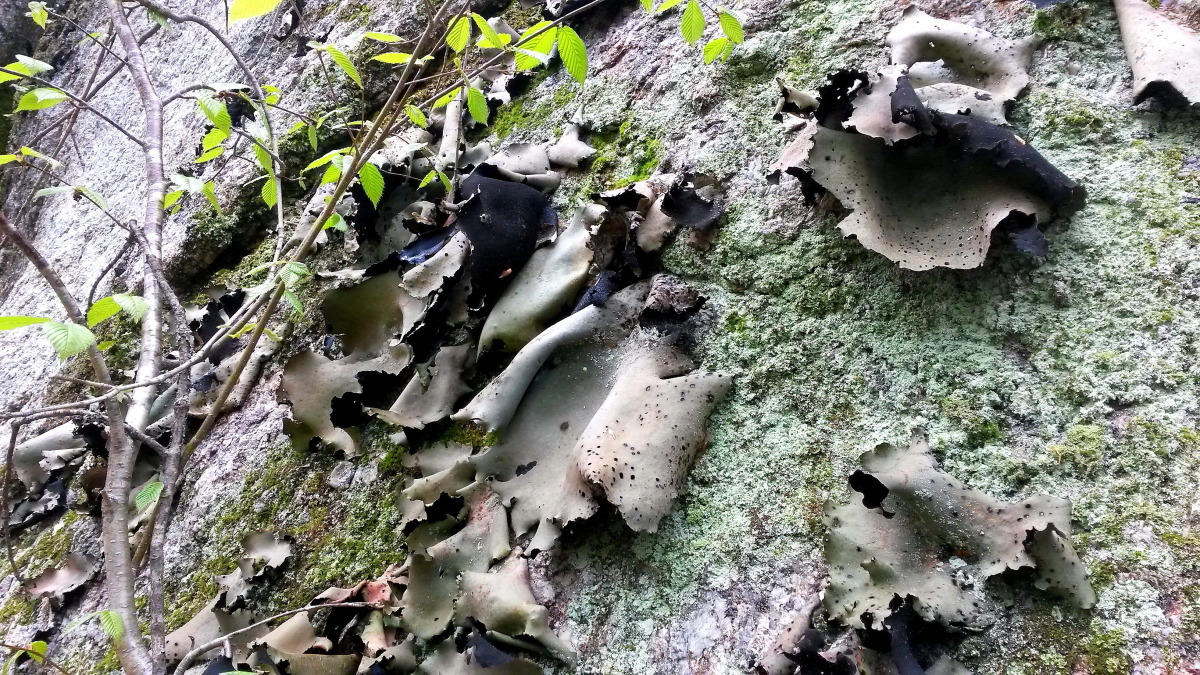
Snowshoeing on one of the warm (50 degree!) misty days this week I came across a thriving community of rock tripe lichen on an exposed ledge of granite.
A wall of rock tripe lichen (Umbilicaria mammulata)

Lichen need no soil to exist - they pull all the nutrients they need directly from the air and from the rock to which they are attached.  The Latin word umbilicus means navel, which makes sense since each lichen draws sustenance through its single attachment point to the mother rock.
Lichen are a unique lifeform that can attach themselves directly to granite.

Rock tripe lichen are edible, and being one of the largest lichens in the world, can provide emergency food if stranded in the wilderness.  (The website NH Garden Solutions claims the soldiers at Valley Forge used rock tripe to survive the winter of 1777.)
That would make a hearty salad.

Not requiring soil, lichen are the very first life forms to take hold on a barren habitat.  After they attach themselves to minute depressions in the granite they start to take minerals from the rock, and through chemical erosion due to substances the lichen produces, they accelerate its decay.  [Bulletin of the American Bureau of Geology, Volume 2, pg 172]  As cracks and depressions enlarge, decomposing parts of the lichen collect with other debris, and soon there is a deposit of suitable soil for higher forms of life, allowing seeds from plants to find a toe hold.  Now the world really starts to fall apart:  Roots expand making cracks bigger, letting in even larger plants and soon enough, trees.
Over time, trees take over the granite landscape.

Water flows in as well, and when it freezes it splits the rock further.  As the bedrock falls apart it opens caves for animal shelter.
Comfy accommodations for bear, fox, porcupine.


So yes, the world is literally falling apart.  Fortunately, these tectonic plates on which we reside continue to float around on the liquid magnum below, and when they crash into each other they push up into the sky and give us new rock to replenish that which we lose.  It's the ultimate recycling machine.

And since all our animal life ultimately depends on  plants, it this these rocks and lichens that make all life possible, including the top level predators such as the bobcat.  I still haven't seen one this winter, but a friend saw one over on the shores of Meredith Bay just last week.
A sunset dinner cruise on Meredith Bay.

This pretty feline was walking along the shoreline in the late afternoon, probably starting out on its evening dinner run.  Cats aren't fond of liquid water, but they're happy to walk along on the ice at the shoreline looking for squirrels or mice feeding on seeds exposed on the banks.  This particular bobcat turned and stared right at the photographer for a time, evidently not startled by why it saw and didn't run off to find cover.
I see you, but you're too big to eat.

Thanks for sharing TW!

Before this latest blast of warm weather the skiing and snowshoeing was fabulous.  On one ski out on the lake the wind had blow a thin layer of snow over the snowmobile trails which gave away the fact that the foxes have been taking advantage of the packed trails for easy travel across the lake.
Fox prints in the snowmobile track.

There were miles of tracks where the fox followed the snowmobiles and some of the prints they left were beautifully precise.  This track showed two neat toenail depressions on each foot.
A bobcat with its retractable claws wouldn't leave claw marks.

The track pattern shows the foxes were in a gallop, moving along pretty quickly over the open lake:
Two sets of fox tracks here.

If it were trotting the tracks would all be in a straight line which is what I usually see in protected woods, or even trotting up the road after a snowfall.  Remember that a fox carries most its weight on its front legs, so the larger prints are from its front feet.
Front feet on the right, hind feet on the left.

The fox (and I of course) weren't the only ones taking advantage of the packed trails.  It's hard to see, so I circled them, but there were bird tracks in places as well.
These seem too small for turkey - I'm thinking crow.

I'll end with a couple of unnerving sights in February - I know today is March now, but it's still too early to be seeing these!
Roads posted on February 26.


Snowdrops are already pushing up their buds.

The maple sap will be flowing soon if this keeps up.  But we are skating again!
Traces of snow from those gray squall clouds dot the rain-smoothed ice.

Sunday, September 24, 2017

September 24, 2017 - Rock Tripe

Last week we saw a wide array of fungi, organisms that tend to grow in damp, rich environments - just where you'd expect to find life thriving.  But there are other organisms that somehow defy logic and have adapted to grow in places where they have no right to live.  If you have walked around in some of the darker forests in New Hampshire, particularly near ledges or large boulder fields, you have probably seen this prime example, the Rock Tripe.
Rock Tripe (genus Umbilicaria) growing in the Smyth Conservation Easement

Rock Tripe is a lichen, which are composite organisms made up of at least two, and sometimes three, very different organisms.  One component of lichen is always a fungus, and the second is usually an algae.  The algae lives inside the fungus and the two organisms exchange nutrients - not unlike what a fungus does for a tree. And since algae can photosynthesize using sunlight, CO2, and a few nutrients, [REF: http://allaboutalgae.com/what-are-algae/] it can provide energy to the fungus, which in turn, provides a home for the otherwise structure-less algae.  It's a pretty nice arrangement, and can produce some really large Rock Tripe.

These are nice and green, but in a dry season or on a sunny ledge they can be brown, dry, and stiff.

In case you're ever hungry in the woods, these are edible.  The recommendation is to soften them by boiling, though I can't say I've ever tried it.

We were up in New Brunswick, Canada this week and saw another great example of lichen that grows in an amazing location.
Beard Lichen (Usnea subfloridana)
This is called Beard Lichen, and it's common in the Lakes Region of New Hampshire where I usually see it on the ground after it has been dislodged the tree branches above.  This lichen pulls most of its nutrients right out of the air and it is a great indicator of air quality; it can't live in polluted air, and the better the air quality, the larger it grows.
Beard Lichen on the ground back in Meredith, New Hampshire
Ferns are another plant that often grow on granite, though these use a more conventional approach: they take root in the rotted debris that has collected on the tops of boulders over many years.

They can find the smallest nook to set roots into.
Or they can take over an entire boulder.
Christmas ferns (Polystichum acrostichoides) crowd out all others on this boulder

Christmas ferns got their name because they stay green well into winter, often being seen still bright green when covered with snow.

There are also large plants that manage to take up residence where they have no right to.  White pine and hemlock are both good at this, and all it seems to take is a small crack or depression in the rock which captures both water and a seed, and a tree can take root.
A white pine establishes a toe-hold on Sheep Island in Lake Wicwas

This relationship is more damaging to the host (though even lichen will eventually degrade the rock), as over time, as the root grows, it will slowly pry a granite boulder apart, accelerating the demise of the rock, but helping to create sandy beaches for us (in a few millions years).

Here is a white pine farther along in this process:
This pine has been growing for 10-20 years

During which time it has pried up a large piece of the bedrock
Next is an example of an oak tree that started out trying to grow on top of a boulder, but it didn't work out well for it.  At one point it got toppled over, bringing up some bits of mother earth with it.

But that didn't slow it down much.  It just took a 90 degree turn back up towards the sky and kept right on growing.
Very adaptive in its quest to find the sun

Nature can be both resilient and persistent.  It can also be tolerant.  Take a look at these two trees:
Two different trees with an intimate relationship.  (Credit goes to Jim G. for discovering this.)
The branch of one tree grew right across the trunk of the other, and over the years, the two have grown together.  Even more interesting is that it is an interracial marriage - they are different species. The one on the left with the branch sticking out is an oak, while the receiving tree is a maple. Notice how the oak has grown its bark out, wrapping right around the maple tree.

These trees are in the soon-to-be-conserved extension of the Page Pond Town Forest.  A planned trail will go right by this, so when the property is open I'll provide directions so you can see this natural anomaly for yourself. Until then, be on the outlook for plants growing in unique ways as you travel around the Lakes Region, and let me know what you find growing where it has no right to.