Sunday, June 18, 2023

June 18, 2023: Introducing LuLu and Checkers

We spent the past week in southern Maine, exploring the coast from Ogunquit to Cape Elizabeth, but that is going to have to wait until after the loon news, because, while we were away we received news that the first pair of loons hatched two chicks!  This was well before we had expected, meaning the pair had nested almost two weeks before we discovered the nest - that was one well chosen nesting sight.  The chicks were first spotted on Wednesday by Lois Crane, so she earned the naming rights.  This years chicks (so far) are LuLu and Checkers!

Introducing Checkers and LuLu, offspring of the northern pair.  Photo by Amy Wilson.

Quite a few people have been treated to seeing them up-close as the family slowly paddles along the shore line, the parents diving for tiny fish to feed the chicks. 


Finding the right size fish isn't always easy.  When the family came by our house I watched mom catch a minnow and then spend a good five minutes trying to get either of the chicks to eat it. 
"It's kinda big mom"  

It's so big it tipped the little chick's tail right out of the water when it picked it up in its beak.
"I'm trying!"


That minnow may weight more than the chicks!  They would take it, try to swallow it, but gag and drop in the lake.  Mom would catch it again and re-offer it, swimming back and forth between them.  

At first both chicks refused to even try, but eventually each made a gallant effort, but it was just too large to get down their little throats. 
"OK, I'll try again."

Nope.  Back to Checkers.

After a while dad came over to see what was going on. 
"What's taking so long over here?"

But eventually mom gave up and ate it herself.  These pictures were all taken from the deck which facilitated seeing their leg bands under the water.  I also took some video during part of the long ordeal.


If you hear the family approaching - they make the most gentle cooing sound - sit perfectly still at the shoreline and you may get a good show.  They keep to the northern end of the lake, but the southern pair has yet to produce chicks; if they do, the rest of the lake might have their opportunity to observe chick rearing in action.  Just be respectful - they need to be undisturbed to be comfortable fishing for enough food to nourish all of four of them.

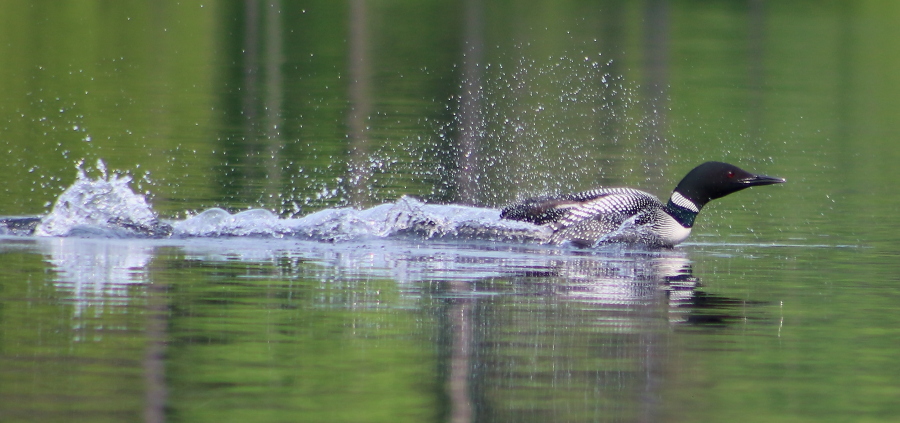
Unfortunately, not all is calm and serene.  There is a rogue loon that has been harassing the family multiple times a day.  I heard wild yelling off in the distance and knew something traumatic was happening.  Then later the action unfolded within my view.  The rogue loon came into the cove where the family was fishing.  They moved away from it the best they could, but when they were backed into the end of the cove, they had no choice but to defend their offspring - a loon will kill other loons' offspring whenever it can.

Mom's on the left covering up the chicks, the rogue is on the right, with dad in between.

Close enough.  Time to go on the attack.
There are two loons in that scrum.

Mom mostly protected the chicks (again, love the bands) but there were a couple of worrying moments when she abandoned Checkers and LuLu to join in the battle.  After a lengthy, violent battle, our large male - he weighed 14.5 pounds in 2019 when he was banded - was able to repel the intruder. 
The rogue in high speed retreat.

With dad in hot pursuit.

After driving the rogue well out of the cove, dad came back to check on the family.  
And all is well - for now.

This is a good moment to remember our own fathers, and all they did for us in our lives.  Thank you dad, and happy Father's Day!  

I was able to get some shaky video from the altercation and their battle calls are clearly heard:

Yet another attack occurred again later in the day with the same result.  It could be a long, stressful summer on the lake.


Now on to Maine.  


Of course we enjoyed the beautiful rocky coast of southern Maine, but also sought out some other unique habitats including the Wells Barren Preserve, about six miles inland.  It's an unusual habitat which supports several rare birds and continues to be maintained via controlled burns.  One area appears to have been burned very recently as it was just emerging with new growth.  
Recent burn area at the Wells Barren Preserve.

We identified 15 birds while we were there, but they were hiding out in the trees and I didn't get a single good picture.  The best was this Brown Thrasher, which I've seen in South Carolina but not previousluy in New England.
Brown Thrasher

Back near the coast at a very small and quiet state park on Cape Elizabeth called Kettle Cove, I came across another bird I see only occasionally, a cedar waxwing.
Cedar waxwing in Kettle Cove.

This park is overgrown with a very aggressive invasive species, Morrow's honeysuckle.  

Morrow's Honeysuckle (Lonicera morrowii)

It has a pretty flower and it grows vigorously which is probably why it was introduced to North America, but that's also why it's so detrimental.  It crowds out every other plant, including even early, shade-tolerant flowers like the trillium, because it leafs out early, before the native plants have a chance to receive any sunlight.  It also produces lots of fruit, which is good for birds, but that too is changing nature.  A diet of Morrow's honeysuckle will change the color of the cedar waxwing's tail from the usual yellow to orange due to pigment in the honeysuckle berries.  This change has occurred in just the last 35 years. [REF:  1,  2]  I wasn't aware of this when I saw the birds in the large honeysuckle stand so I didn't know to look for an orange tail - you can decide.

To me the tip looks half yellow and half orange.

We also visited the Rachel Carson Wildlife Refuge in Kittery at Cutt's Island.  I hadn't been there before but the Carson refuges are always beautiful.  This section of the 9000 acres refuge has a 1.8 mile trail that goes along the intertidal water of Chauncey Creek behind Cutt's Island.  It was a bird paradise and I identified 29 unique species - the most I've ever seen at one location - including a new bird for me:  a Glossy Ibis!

Glossy Ibis (Plegadis falcinellus)

This odd but handsome bird was poking down deep into the marsh with its long, curved beak, probing for food.  They have a very broad diet that includes mollusks, snakes, fish, and grain.

Another new bird for me was seen at Nubble Light.  There were two female Common Eiders paddling along with a brood of 11 chicks.


Female Common Eider  (Somateria mollissima)


Walking along the Marginal Way between Ogunquit and Perkins is must-do whenever we're in the area.  In June there are lots of bright flower beside the path, though most of them are cultivated.  


Most wide-spread and in its glory right now is the beach rose.  

Beach rose (Rosa rugosa)

Beach rose grows extensively along the entire New England Coast so I always assumed it was a native plant.

Cape Porpoise in Kennebunkport.


What a surprise to learn that it, like so many other invasive species, was introduced to North America from Asia.  Beach rose has been designated as invasive in several states, though it has such valuable properties in stabilizing sand dunes and other shoreline soils that it's generally not removed.  In Maine it's on the "Advisory List of Invasive Plants".

One last image of Maine before I end this long post.  This was a picture I didn't know I took.  It must have been an erroneous click of the shutter, but it's one of my favorites of the entire trip.


There was much more nature to be seen at the lake this week, but this post is long enough.  I'll try to fit them next week.


Sunday, June 11, 2023

June 11, 2023: Fern Weather

A stretch of cool, damp weather is just what ferns and other wetland-dwelling plants love, so they were in their element this week.

Cinnamon Fern (Osmundastrum cinnamomeum)

The cinnamon fern is identifiable by its distinctive cinnamon-colored central fronds that grow straight up, surrounded by large green fronds, both of which can grow up to five feet high in fertile wetlands.  When these ferns emerge in spring as fiddleheads they resemble the edible ostrich fern, but cinnamon fiddleheads have a white, fuzzy covering over them.

Don't eat fiddleheads that have this white, fuzzy covering.

In comparison, ostrich ferns have a thin, brown, papery covering.  Even the edible ostrich fern can contain toxins, but not enough to cause problems.  The cinnamon fern has sufficient toxins that if eaten can cause nausea and other symptoms.  

The Jack-in-the-Pulpit is often found in cultivated gardens, but it also grows wild in the Lakes Region.  I found this one at the edge of a drainage ditch along a dirt road.  It took me a minute to figure out why it didn't look quite right:  its leaves had been chomped off by a deer.

Jack-in-the-pulpit (Arisaema triphyllum)
Note the bare stalks where the leaves have been eaten off the top.

Another plant that favors cool and damp is the false Soloman's seal.

False Soloman's Seal (Maianthemum racemosum)

Later in the summer the pretty white flowers will produce deep-red berries which are edible, but with a large pit and little flesh, they're not worth much more than a sample of one or two as you pass them by.


One more spring flower blooming now is the bluebead lily.


These will have large, blue berries in mid-summer, but they are not edible.

Thanks to Amy Wilson's good eye, we finally confirmed that the female of the loon pair that nests in Harris Cove has returned.  Reports are that the pair continues to poke around the islands looking for a safe place to build a nest but still hasn't settled on a site.  The Loon Preservation Committee biologist visited Wicwas again this week and confirmed that all is well on the northern nest.  

One of the Harris Cove loons caught itself a really nice meal one morning.

A fish this size might be a whole meal.

It had to spend several minutes beating it up enough to dare to swallow it.

A loon doesn't want a fish this large flailing around in its gullet.

It looks to me like the fish was a black crappie.


That's a favorite pan fish for humans too!


Sunday, June 4, 2023

June 4, 2023: We have a Loon Nest

The pair of loons we identified several weeks ago, the "northern" pair, has nested! 

Photo by Marge and Dave Thorpe

It's in a rather remote part of the lake that will have minimal impact from motor boat traffic, and probably not a lot of kayak traffic either, so at this point it won't be marked with signs in an attempt to minimize disturbances.  The nest is so well hidden that it was only discovered when someone paddled so close that the loon not on the nest started to act up and gave away the location.  Many thanks to Shayne Duggan for being aware of the loon's behavior and knowing what it meant.  The Loon Preservation Committee has a description of loon behaviors on their website that will help you understand what different behavior means.  You can find it here:  Loon Watching the Responsible Way:  A Guide to Understanding Loon Behaviors.

And now a second pair of loons is starting to exhibit nest-building activities.  I was able to see bands on one of them - it's the male that was banded here last year, and raised the chick Maddie.


We haven't been able to see whether there are bands on his mate, so we're still waiting to confirm if last year's banded female is back.  

Something that is back are eagles.  There were multiple sightings of an immature bald eagle soaring over and divebombing the loons.  Adult loons should be fine, but loon chicks are quite vulnerable to eagles as well as to hawks.  I'd much rather have the eagles go after this critter I saw swimming in the lake on one of my paddles this week:

Northern Water Snake

Northern water snakes are harmless and don't bother me one bit, but they are much more plentiful than loon chicks!

As always, the geese are well ahead of loons in their breeding; I saw three geese families on another paddle, two swimming in the lake, and one up on an island foraging for food.

A family with four goslings on Sheep Island.

The little chicks are awful cute when they are so small and fluffy.


When the parents on the island saw me they encouraged the chicks to move along into the bushes for safety, which they did only reluctantly and with significant prodding - they clearly wanted to continue to find food in the warmth of the sun.

In need of a little prodding.
"Move along junior!"

What amazed me was that the parents were perfectly silent the whole time - you know how loud they usually are when they feel threatened, but not when there are chicks to hide.  A second family with four goslings, and a third family with six, were side-by-side, out for their morning swim.


That makes 14 new geese on the lake this summer!

The late frost we had a couple of weeks ago killed the leaves on quite a few of the beech and oak trees that were exposed to open sky.

One of many oak trees damaged by the late freeze.

I've been watching to see if they would put out a second set of leaves, and this week they started to do that.  

I'll keep an eye on them as the season progresses to see how they do.

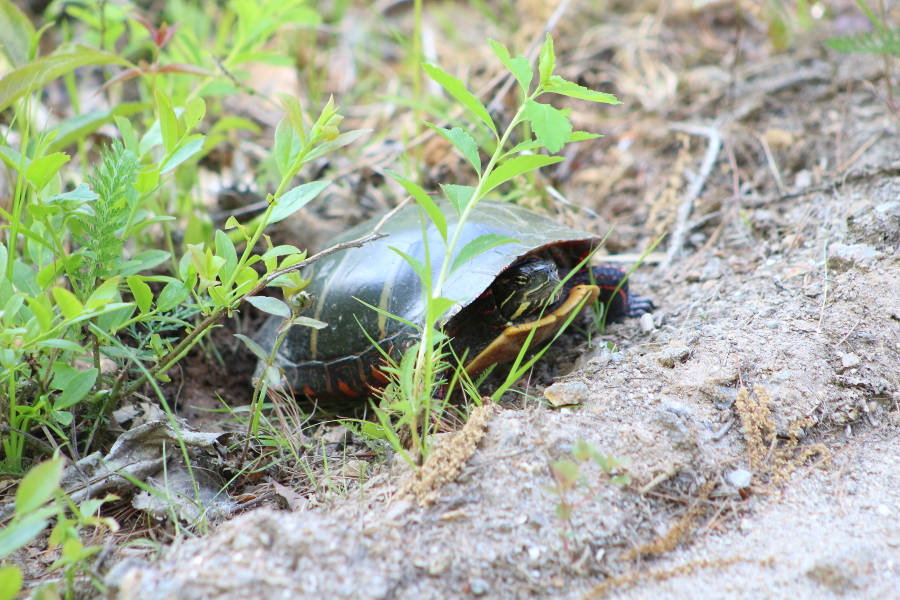
Finally, birds aren't the only animals working on nests right now.  Watch out for turtles crossing roads to get from water to the perfect site to lay their eggs!

Momma Painted Turtle laying her eggs on the shoulder of the road.

It's almost peak time for new life on the lakes!