Sunday, August 22, 2021

August 22, 2021: Curious Bambi

This week provided two entertaining wildlife interactions for me, both on Friday morning.  First, on my morning walk, a deer dashed out of a thicket and ran down the trail right in front of me - it was gone in a flash.  Seconds later a second deer leaped out, and this time I was ready.

Deer number two.

Then, right behind that came a third deer - a little guy!

Bambi needs to eat more - look at the rib cage!

I had seen the fawn earlier this summer when it was small and spotted, and I'm sure this is the same one.  But this Bambi was curious.  Rather than following mom down the trail, Bambi stopped to see what was causing the disruption in the family's breakfast.

Deer are inherently inquisitive, and as I stood motionless, the deer just couldn't resist investigating the situation.  It turned to face me.

It stomped its hoof a few times trying to elicit a reaction from the intruder.


I stood my ground, so it gave a loud snort and bounded off to join the rest of the family.  


I always enjoy watching the young animals grow and learn about the world around them, and I was about to get another opportunity.

A few hours later during a paddle on the lake around lunch time I found our loon family out having a picnic on a beautiful summer day.  It had been so long since I'd seen the father that I thought maybe he had already left for the year, but there he was.  I don't know who brought up the first fish, but it went to Coco.  

It was lively one,

and Coco lost it,

but it was quickly caught again, and this time it was devoured.

The next fish was brought up by dad (I could tell by the bands), and back to his usual tricks, it was a good size sunfish.

It was presented to Coco a couple of times, 

but each time she passed on it.  So dad gave up, passed the fish off to mom and went to dive for more.
Jimmy, in the background, ignores the whole scene.
That's a big fish.

 
After tiring it out for over two minutes (determined from time stamps on the photos) mom brought it over it to Jimmy.  

Jimmy wasn't hesitant - he assessed it for just a moment, then decided he could manage it.


And somehow stretched out his neck enough to get it down.  

Or least get it stuck in his neck.

That ought to hold him over until dinner time.


With a healthy, high protein seafood diet they sure are growing up fast.


I'll end this lengthy post with a gorgeous green dragon fly called a pondhawk.  
Eastern Pondhawk  (Erythemis simplicicollis)


There's a story here too, but that's for another day.

Sunday, August 15, 2021

August 15: The Dog Days of Summer

Two weeks ago I mentioned the fruit of the black cherry trees was starting to ripen and they would turn from red to black if the birds and the bears didn't eat them all first.  Well, they better get busy because the chipmunks are after them too.

A chipmunk's cheeks stuffed full with black cherries.

A chipmunk's cheeks stuffed full with black cherries.

I was a bit surprised to see a chipmunk climbing around in the branches a good 15 feet above the ground, but evidently it has nothing to worry about because at one point when I startled it, it just let go and dropped to the ground bouncing gently off a couple of branches on the way down.  Their acrobatics in the cherry tree rival those of the gray squirrels on their winter feeder.

Representing Team Chipmunk in the Wildlife Olympics


I wonder if they eat the flesh of the fruit now and store the pits away in their dens for winter consumption.  And they're not just after the cherries but are harvesting blueberries as well; my brother took this picture of a chippy in the blueberry bushes in Canterbury.
Collecting blueberries in Canterbury.  Photo by Glen Powell.

I haven't seen the chipmunks in the hobblebushes, but something is eating that fruit as there are very few making it to the fully ripe black stage.

A few black hobblebush viburnum berries have survived long enough to turn black.

Another week of fishing and growing has seen our loon chicks molt all but a few remnants of their prior feathers.  With these new, denser feathers they're now able to compress the air out of them, allowing deeper and faster dives.  They almost look like small, pale versions of an adult at this point.

Jimmy has a just few tufts of baby feathers left on his tail.


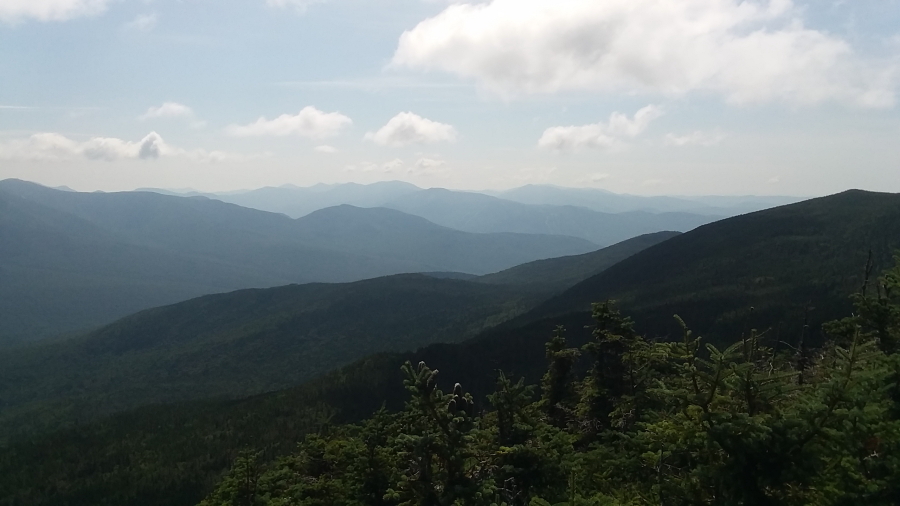
After plentiful rain in July the weather has turned to classic New England summer:  hot, hazy, and humid.  This week was the pick of the summer so far for vacationing.  It's the kind of weather where you can spend all day in the lake and when you get out you're not cold even without drying off.  But all that moisture in the atmosphere makes for some hazy skies.  We went for a hike in Franconia Notch on Friday and with visibility only about 20 miles, the mountain ranges were looking like the Blueridge Mountains.

Hazy skies from the summit of South Kinsman.

On our way down from the Kinsmans we went by Lonesome Lake where lots of people were cooling off in the high altitude pond with Mount Lafayette in the background.

Lonesome Lake with the Franconia Range looming in the background.


Sunsets are like snowflakes - no two are ever the same - and with all that water in the atmosphere great sunsets keep coming.  


Even on a hot day of hiking, there are plenty of smiles in New Hampshire.

Summit of South Kinsman

The top of a mountain must have been the coolest spot in all of New England this week.

Sunday, August 8, 2021

August 8, 2021: Arrows in the Lake

All the lake levels sure are high right now, up at levels more typical of April than August with recent readings in Lake Wicwas a good foot above full lake level.   This high level in midsummer can pose a problem with erosion from boat waves, so be aware of your wake when boating; many docks around the lake are just about under water.


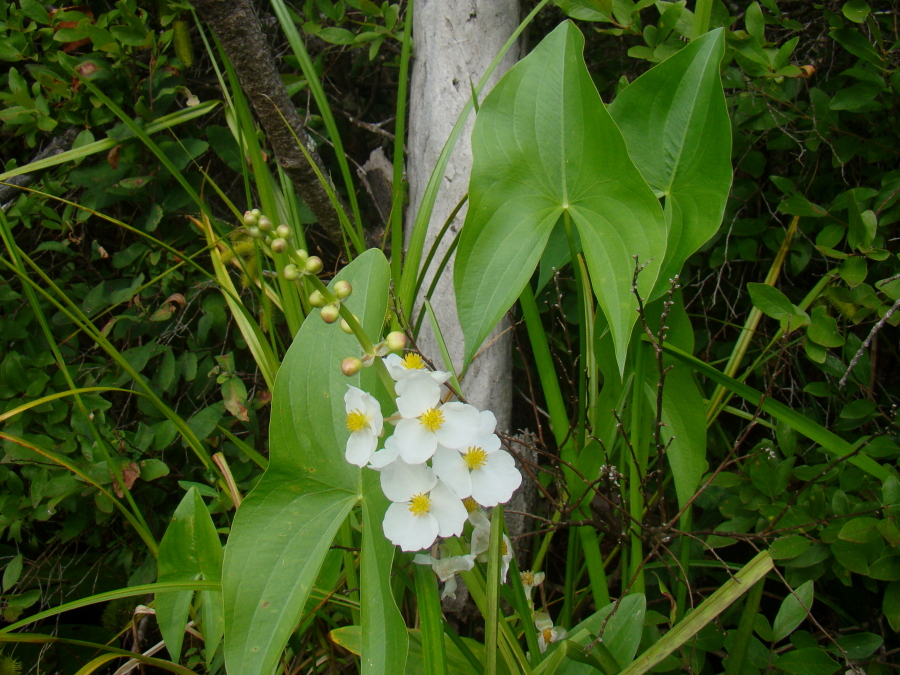
On the other hand, the high water allows kayak access to parts of the lake that aren't usually accessible in mid summer.   If you explore any of the shallow marshy areas in the next week or two look for a pretty white flower with large arrow-shaped leaves near the water's edge.
Broadleaf Arrowhead (Sagittaria latifolia)

This is called broadleaf arrowhead due to the shape of its leaves, but is also known as Indian potato as it has edible tubers that can grow over three feet long.   These long roots enable the plant to survive in areas of widely variable water levels.  In addition to the native Americans digging up and consuming the tubers, the entire plants are eaten by beavers and muskrats.  
Large arrow-shaped leaves give this aquatic plant its common name.


Right now the arrowheads - as well as every other other plant in the Lakes Region - doesn't need deep roots to find water.  Due to the robust flow in the rivers I went looking for a waterfall hike on Tuesday and chose the Brook Trail along Shannon Brook at Castle in the Clouds, as this one mile trail passes by seven cascades of various shapes and sizes.  
The last of the seven cascades on the Brook Trail.

The water was flowing like the spring freshets.
Shannon Brook in spring-like glory.


The Lake Wicwas Association held their annual meeting yesterday at the Wicwas Grange and it was well attended after missing last year's in-person meeting.  Social time with coffee and snacks was held outdoors under sunny skies after which we enjoyed an informative presentation by Emma Erler from the UNH Extension Service about waterfront landscaping and how it can benefit water quality in our lakes.  Good water flow management is especially important for heavy rain events such as we've had this summer and which are expected to become ever more frequent.  I'll share a link to the presentation when it's available.  

We're fortunate the heavy rains came after loon nesting season.  Our two loon chicks began an important development step this week, starting to molt their light brown feathers for some adolescent attire.
Coco and Jimmy are starting their second molt.


One chick - I expect it's Coco - is further along in this process than the other.  At first I thought Jimmy was holding a wing up in the air, but later decided it was just a clump of feathers in the process of being shed.


The chicks are also displaying bright white chest feathers, especially when they reach up out of the water to stretch their wings.  

They're such a handsome family.  


Next time we see them the chicks may be wearing their complete teenager outfits.  Until then, Jimmy waves good bye.
That foot's almost as big as Jimmy's body!

I'll finish the week with a couple of the many summer sunsets we experienced this week. 
A summer evening on the lake.


 It was great to see so many of you yesterday!


Sunday, August 1, 2021

August 1, 2021: Plundering Spiders

Working around Linda's gardens last week I came across an interesting thread-covered orange ball that instantly piqued my curiosity - what is that?

This strange object was about 3/8" in diameter.

It was attached securely to the underside of a surface where it was protected from the elements as well as from predators.  It took a little digging to figure out what it was because I had no idea what animal created it to give me a hint as to where to start looking.  My first thought was a moth or butterfly as it looked like a cocoon or pupae, but all those searches didn't reveal anything.  So I broadened my aperture and eventually was able to identify it as an egg sac, and was then able to narrow it down to a spider egg sac, and finally to that of a Pirate Spider.  Ever heard of them?  I hadn't.  But wow, what a cool creature.

Pirate spider, of the family Mimetidae.  Photo by Project Noah

Pirate spiders get their name from their method of hunting:  they attack other spiders' webs and plunder their treasure.  Pirates belong to the orb-weaving family of spiders, but over time they have lost their ability to make webs, though they still produce silk and glue to form their egg sacs and attach them to something.  Their hunting technique today involves invading another spider's web and using its front legs to lightly vibrate the web which attracts the homeowner.  

There are a couple of theories as to why this works.  One holds that the host spider thinks there's an insect struggling in its web so it goes to out collect it's catch.  Another theory is that the occupant thinks there's an intruding spider on its web so it heads out to defend its castle.  Either way, when the web-owner gets within range of the pirate's pair of very long, barbed front legs (see photo above) the plunderer grabs hold of it and quickly sinks its fangs in to inject a poison that is specifically engineered to kill spiders - it's in fact harmless to most other animals.  [Most of this information was derived from an article written by Zoe Cormier and published in BBC news.  If you're intrigued about these pillaging spiders you can explore more here.]

After I saw a photo of the pirate spider I realized that I had just recently seen one - it had hitchhiked home in my blueberry bucket and I found it when sorting out the blueberries from the detritus that always gets in the blueberry pail:  pine needles, stems, ants, and yes, plenty of spiders.  Usually those are jumping spiders, but now I know to watch for pirates.  Sadly, I didn't know what it was at the time and released it back to the land of buccaneers without getting a mugshot.  

This week's bizarre loon report comes to us courtesy of Michael Marion and Debby Crowley.  First, Michael saw the loon chicks up on his beach - literally on the beach - while the parents were out fishing nearby.  I do hope they're teaching the chicks to watch out behind them.  Then Deb Crowley saw what she thought was a duck on shore, but when looking closely realized it was one of the loon chicks.  While she watched, she saw it do a "poop shoot" right in the air!

Jimmy or Coco returning from a bathroom break.  Those legs sure are big and strong already. 
Photo by Debby Crowley.

I've seen hawks and eagles do that from a tree, but never a loon, probably because they're always in the water.  So it was off to the Loon Preservation Committee to ask if this was unusual.  The response from our local field biologist Jayden Jech and senior biologist John Cooley came quickly.  From Jayden: "After speaking with John, he shared with me that this behavior is quite normal for both loon chicks and adult loons to defecate on shorelines.  Definitely an interesting observation!"

So there it is, another "normal" but bizarre trait of the common loon.

Coco and Jimmy are just over four weeks old now and are subject to fewer dangers, but they're far from safe as we have lost chicks as late as August 23rd in prior years, sometimes to raptors, sometimes to other loons, and we still have many other loons frequenting Lake Wicwas.  Yesterday morning I saw a pair of loons fly onto the lake from the south, skimming in for a landing, followed shortly by a second pair.


The second pair landed just past the first;  I'm guessing they are travelling together.  There was a fifth loon in the water just to the left of these four.

Two flying, two in the water, barely discernable on the left.

And then there was this raft of 12 loons that Keith Duggan saw on the lake.
A large asylum of loons.  Photo by Keith Duggan.

Coco and Jimmy's parents will have to be diligent for weeks to come.


As we move towards the latter half of summer the later-season fruits are starting to mature.  This is the hobblebush viburnmum that was decimated by the deer in the spring (May 2, 2021) but it bounced back enough to put out a good amount of fruit, at least on the higher branches above the deer's' reach:


The black cherries are also starting to ripen.

Like the hobblebush, this fruit will turn black - if the birds and the bears don't eat them all first.


The cherries are ripening just in time to supplant the dwindling blueberries - I've probably picked my last batch of pirate-laden Wicwas blueberries for the year.