Sunday, August 1, 2021

August 1, 2021: Plundering Spiders

Working around Linda's gardens last week I came across an interesting thread-covered orange ball that instantly piqued my curiosity - what is that?

This strange object was about 3/8" in diameter.

It was attached securely to the underside of a surface where it was protected from the elements as well as from predators.  It took a little digging to figure out what it was because I had no idea what animal created it to give me a hint as to where to start looking.  My first thought was a moth or butterfly as it looked like a cocoon or pupae, but all those searches didn't reveal anything.  So I broadened my aperture and eventually was able to identify it as an egg sac, and was then able to narrow it down to a spider egg sac, and finally to that of a Pirate Spider.  Ever heard of them?  I hadn't.  But wow, what a cool creature.

Pirate spider, of the family Mimetidae.  Photo by Project Noah

Pirate spiders get their name from their method of hunting:  they attack other spiders' webs and plunder their treasure.  Pirates belong to the orb-weaving family of spiders, but over time they have lost their ability to make webs, though they still produce silk and glue to form their egg sacs and attach them to something.  Their hunting technique today involves invading another spider's web and using its front legs to lightly vibrate the web which attracts the homeowner.  

There are a couple of theories as to why this works.  One holds that the host spider thinks there's an insect struggling in its web so it goes to out collect it's catch.  Another theory is that the occupant thinks there's an intruding spider on its web so it heads out to defend its castle.  Either way, when the web-owner gets within range of the pirate's pair of very long, barbed front legs (see photo above) the plunderer grabs hold of it and quickly sinks its fangs in to inject a poison that is specifically engineered to kill spiders - it's in fact harmless to most other animals.  [Most of this information was derived from an article written by Zoe Cormier and published in BBC news.  If you're intrigued about these pillaging spiders you can explore more here.]

After I saw a photo of the pirate spider I realized that I had just recently seen one - it had hitchhiked home in my blueberry bucket and I found it when sorting out the blueberries from the detritus that always gets in the blueberry pail:  pine needles, stems, ants, and yes, plenty of spiders.  Usually those are jumping spiders, but now I know to watch for pirates.  Sadly, I didn't know what it was at the time and released it back to the land of buccaneers without getting a mugshot.  

This week's bizarre loon report comes to us courtesy of Michael Marion and Debby Crowley.  First, Michael saw the loon chicks up on his beach - literally on the beach - while the parents were out fishing nearby.  I do hope they're teaching the chicks to watch out behind them.  Then Deb Crowley saw what she thought was a duck on shore, but when looking closely realized it was one of the loon chicks.  While she watched, she saw it do a "poop shoot" right in the air!

Jimmy or Coco returning from a bathroom break.  Those legs sure are big and strong already. 
Photo by Debby Crowley.

I've seen hawks and eagles do that from a tree, but never a loon, probably because they're always in the water.  So it was off to the Loon Preservation Committee to ask if this was unusual.  The response from our local field biologist Jayden Jech and senior biologist John Cooley came quickly.  From Jayden: "After speaking with John, he shared with me that this behavior is quite normal for both loon chicks and adult loons to defecate on shorelines.  Definitely an interesting observation!"

So there it is, another "normal" but bizarre trait of the common loon.

Coco and Jimmy are just over four weeks old now and are subject to fewer dangers, but they're far from safe as we have lost chicks as late as August 23rd in prior years, sometimes to raptors, sometimes to other loons, and we still have many other loons frequenting Lake Wicwas.  Yesterday morning I saw a pair of loons fly onto the lake from the south, skimming in for a landing, followed shortly by a second pair.


The second pair landed just past the first;  I'm guessing they are travelling together.  There was a fifth loon in the water just to the left of these four.

Two flying, two in the water, barely discernable on the left.

And then there was this raft of 12 loons that Keith Duggan saw on the lake.
A large asylum of loons.  Photo by Keith Duggan.

Coco and Jimmy's parents will have to be diligent for weeks to come.


As we move towards the latter half of summer the later-season fruits are starting to mature.  This is the hobblebush viburnmum that was decimated by the deer in the spring (May 2, 2021) but it bounced back enough to put out a good amount of fruit, at least on the higher branches above the deer's' reach:


The black cherries are also starting to ripen.

Like the hobblebush, this fruit will turn black - if the birds and the bears don't eat them all first.


The cherries are ripening just in time to supplant the dwindling blueberries - I've probably picked my last batch of pirate-laden Wicwas blueberries for the year.


Sunday, July 25, 2021

July 25, 2021: Towering Summer Flowers

It's late July and the world has become lush and green with an abundance of rain.  It's interesting to watch the transition of wildflowers over the summer growing season as each species finds a place in the ecosystem to make its stand.  Early in the spring before larger plants have grown leaves the small plants living right at ground level take advantage of the short window when they receive nature's life-giving energy through bare branches above.  That's when plants like goldthread, trailing arbutus, and trillium do their thing.  As spring moves towards summer the taller plants such as hawkweed and daiseys rise up higher to find the sun, robbing it from the lower tier of plants.  Now in late July it's time for the tallest flowers, which have jostled they way up all year, to rise above the middle-tier and display their colors.
Common mullein (Verbascum thapsus)


This mullien was growing along the multi-use trail in the Page Pond Community Forest in Meredith.  Not recognizing this plant I had to look it up and found that it is yet another invasive species.  This one is not as fiendish as the worst invasives such as knotweed and bittersweet because it's shade intolerant - it will die off as other plants grow around it.  But it can be a problem if it grows to large populations as it will readily do if left unchecked - note huge number of seed-producing blossoms.

There were already a few of these along that trail; I've recommended the land stewards remove them.  If you're at Page Pond this week be sure to explore the field at the Barnard Ridge Road trailhead which is now packed with mid-summer wildflowers attracting a potpourri of birds and insects because it will be mowed soon now that the birds have nested and fledged their young.

Many of the taller summer flowers don't have the showy blossoms of the early plants, perhaps because with the abundance of pollinators at this point in the season they don't have to advertise as much to attract customers.  Overall, yellow seems to be the predominant color of the season, and this will continue into late fall as the goldenrod bloom high and tall above all else in the field until frost strikes them down.  But there are other colors to be found including this aquatic plant that doesn't need rain so it always blooms - unless the geese eat all its leaves first.
Pickerel weed (Pontederia cordata) gets pollinated.


Two plants with pale pink flowers also grow along the shores of the lakes, though their feet are planted on dry land right at the brink of water and earth.
Meadowsweet (Spiraea latifolia) - look for the tiny honey bee at the bottom of the tallest blossom.

Steeplebush (Spiraea tomentoas), appropriately named.


Sometimes plants that take advantage of the water and sun that the lake provides them end up spending their final days in that very water, but even in death they bring new life.  
A young kingfisher peers over the edge of its nest as it awaits a meal to be delivered via airmail.


This fallen white pine has been the birthplace of many broods of Eastern Kingfishers since it fell into the lake a few years ago.

The weekly status on the loon family shows all is well as Coco and Jimmy continue to thrive and grow under the care of their attentive parents who are now introducing them to new foods, and not without the typical rejection.
Mom comes up with a crawfish.


Mom went back and forth between the two siblings trying to get either of them to sample crawfish.
Jimmy says no thank you.

Coco seems equally unimpressed.


It often takes youngsters a while to learn to love shellfish.
Still a no.


Eventually mom convinced someone to try their first downeast lobster dinner.
I think it was Coco that got her courage up.


So far it's been a happy year for loons on Lake Wicwas, if not an easy one for the parents as there is still a number of other loons on the lake that dad spends a lot of time keeping away from the chicks.  But at this point all is well; the chicks are still light brown and fluffy with their downy feathers but soon these will begin to molt and a second set of adolescent feathers will appear.  
See you next week.

Sunday, July 18, 2021

July 18, 2021: Annual Wicwas BBQ

The Lake Wicwas Association held their annual Paddle Regatta and Barbeque yesterday, once again graciously hosted by the Blakes, and the weather was kind enough to allow both events to take place without anyone getting wet.

The regatta departs from Wedding Island under the expert guidance of Dean Cascadden.

Navigating Blake Brook.
Exploring the beaver dam.
Photos by Dean Cascadden.

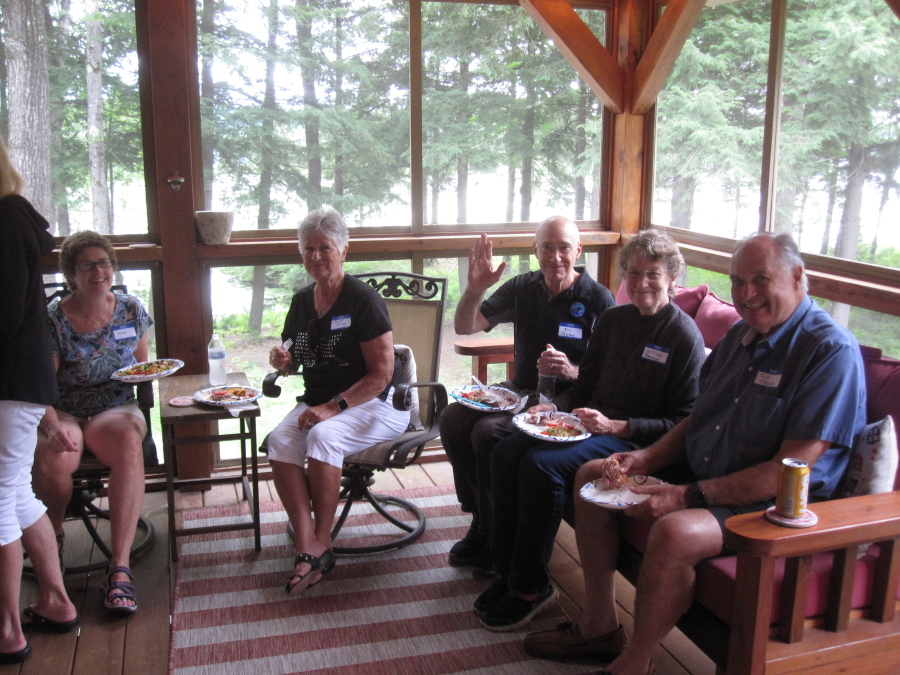
Later at the barbeque, food and conversation were great as always and it was wonderful to catch up with everyone after missing out last year.


Always great food!
That's Master Chef Wayne under the tent cooking up those perfect burgers.


Second only to seeing everyone was getting a demonstration of Wayne's sawmill.
Wayne Saws a 1938 hurricane log.

He gave a demonstration by sawing one of the Hurricane of  '38 logs that was retrieved from the lake and dried out for weeks.  This particular log had an "S" stamped in it;  there was discussion of whether this stood for the US Forest Service or logger Joseph Smith.  (My money is on Smith!)  Wayne has a number of boards he has sawn from these ancient logs and has a few he would offer to someone who wants one for a project - contact me if you're interested.  For more of the history on these sunken logs, see this prior post.  

A warm welcome to the new members of the association, and a huge thank you to the Blakes!

Earlier in the day the Loon Preservation Committee held their state-wide loon census from 8:00 to 9:00 and Lake Wicwas had four people combing the lake for loons.  Dave and Marge Thorpe found a group of six loons carousing together in the southern portion of the lake, while Michael Marion and I found the family of mom, dad, Coco, and Jimmy, for a total of ten loons on our small lake - that may be record for our census day.

The Wicwas Navy steams up the lake.

While we watched the family of four, mom came up with a large fish - we know it was mom because we saw her red band.

Mom brings home the bacon this morning.

She first brought it to one chick who wanted nothing to do with it.


Usually when a parent comes up with a fish both chicks go rushing over to get it first, but not for this monster fish (from a chicks' perspective).  Mom went back and forth between the two of them several times, but each time the chick turned up their nose. 


 Or should I say, stuck its head in the water.


Eventually mom gave up and swallowed it herself - it was pretty big even for her.

Look at that bulge in her neck.

While she was trying to convince someone to eat it dad came up with a chick-size minnow, and sure enough, Jimmy dashed right over and gobbled it down!

Dad motors off in search of more.

Here's yet another surprising nature report from Lake Wicwas.  First you need to know that the Thorpes have a statue of heron on their property.  They've long wondered if they'd ever see a real heron come to visit it.  Well earlier this summer it actually happened.

Henry and Henrietta.  Photo by Dave Thorpe.

The statue is Henry, and they named its friend Henrietta.  Once Henrietta found a companion she decided to come back and visit again, but on the most recent visit the Thorpes witnessed something extraordinary:  Henrietta caught a chipmunk!  They watched as the heron thrashed it around for a while, either killing it or at least wearing it down; Henrietta then took off with it in her beak, presumably to feed it to her chicks back in the nest.  [That's a correction from the original post.]  But the crazy heron stories don't end there.  

On another day Debby Crowley was watching a loon on the lake when she saw another bird land.  When she zoomed in on it she saw it was a heron.  Have you ever seen a heron land on the water?  She then saw it had a fish in it's beak - it's unknow if the heron caught it or saw it floating on the water and came down to get it.  Either way it decided to leave it there as its neck was already pretty full - heron will catch food and store it in their neck to bring it to the chicks in the nest for feeding.  

I asked Debby if the heron was able to fly away from deep water and she said yes, actually rather gracefully, and even sent some photos of the takeoff.

Flaps out.

Gaining air speed.

Almost there.

Airborne - retract landing gear.
Photos by Debby Crowley.

Nature never ceases to surprise me with its unexpected events.  Thank you for those great nature reports Dave and Debby!

One thing that has come to be expected this July is rain.  One evening after a rather wet day the sky cleared enough to go out for a quiet evening paddle, and like most days, even rainy ones, there's always something beautiful to see in the world.

Rain drops on lily pads.

Mist rises from the hills beyond Wicwas.


Sunday, July 11, 2021

July 11, 2021: Big Moths and Big Snakes

I need to go back and catch up with some items that were neglected the past few weeks due to all the loon news on the lake.  First, the appearance of Luna Moths occurred quite some time ago and several people told me of their sightings including this one by Dotty Treisner who found two of them resting on the red siding of her house.

Luna Moth (Actius Luna).   Photo by Dotty Treisner.


Though jealous of these sightings because I haven't seen one myself in many years I'm always excited to know these beautiful, huge moths are still present in the Lakes Region.  A big reason they're not often seen is that they only live for about a week in their adult, moth form, during which time they mate but they don't eat - they don't even have a mouth or a digestive tract.  All their food consumption occurs while they are a caterpillar, munching on tree leaves such as birch.

Another overdue observation dates all the way back to the rained-out bird walk that was to be led by UNH Extension Service biologist Mart Tarr at the Page Pond Community Forest.  As we were all waiting at the trailhead to see if the thunderstorm would pass quickly (it didn't) he mentioned there had been a lot of Baltimore Orioles in new Hampshire this summer.  Since I hadn't seen one of these bright orange birds yet this year I went out the next morning in the kayak to peruse likely oriole habitats, and sure enough I found one right away.
A Baltimore Oriole (Icterus galbula) sings from the highest branch of a white pine.   


They are such impressive birds and their loud, repeated song carries a long way over the water to lead you to them.  You can listen to their songs here.

Another impressive bird is the great blue heron which even standing three feet tall is often hidden among the weeds and bushes of the shoreline.  So it was an uncommon sight when Cindy Desmond saw one perched completely exposed on a raft.
A great blue heron (Ardea herodias) standing tall.  Photo by Cindy Desmond.


Wild creatures aren't ashamed to take advantage of human alterations to the environment when they suit their needs, sometimes to their benefit, sometimes to their demise.  Running along the side of the road one day I saw a bright green snake sunning itself on the edge of road, soaking up the heat from the pavement.   I stopped to encourage it to move farther from the road lest it become a participant of the old "Frogger" video game, but I was too late.  Though still alive and wriggling from what looked like a minor injury I'm pretty sure it wasn't going to survive the trauma it had endured.  And that wasn't the only snake-on-human-structure moment this week.  One morning I found this large northern water snake sunning itself on our dock when I went out for a paddle.
One warm, happy, water snake.

Like all snakes it wanted nothing to do with me and immediately slithered off the dock as I approached, but I was ready.  You probably shouldn't watch this video if you don't like snakes and ever want to swim in a lake again.


There's been plenty of stormy weather lately including the most recent heavy rains from tropical storm Elsa; the lake right now is a good six inches above full pond.  Did you catch the sunset as one of the recent storms departed?


I think our drought conditions have been largely remedied at this point.

I can't close without an update on the loons.  Coco and Jimmy were both doing fine at my last check on Saturday.  I don't see them as often now that they are widening their circle of travel all the way out to the area between Sheep and Bryant Islands.  Keep an eye out for them on your lake trips as they may be most anywhere on the northern portion of the lake in the coming weeks - they are still pretty small and vulnerable.
"Move your head dad, I can't see!"


My counterparts who report on the nature scene at Pleasant Lake in New London have been following an interesting loon story that mirrors our experience with a mate change.  But the female loons battling each other on Pleasant Lake have not given up the fight and it's taking a toll on everyone.  Their reporting implies that male loons fight over territory while female loons fight over males.  This week's report is dramatic, violent, and heart wrenching, but it's worth reading to better understand these complex animals.  You can find their report here; it will make you appreciate how fortunate we are to be having a peaceful year on Wicwas.

Nap time on Lake Wicwas.