Showing posts with label Round-leaved Sundew. Show all posts

Sunday, June 25, 2023

June 25, 2023: The Lakes Region Consveration Trust Visits the Lake

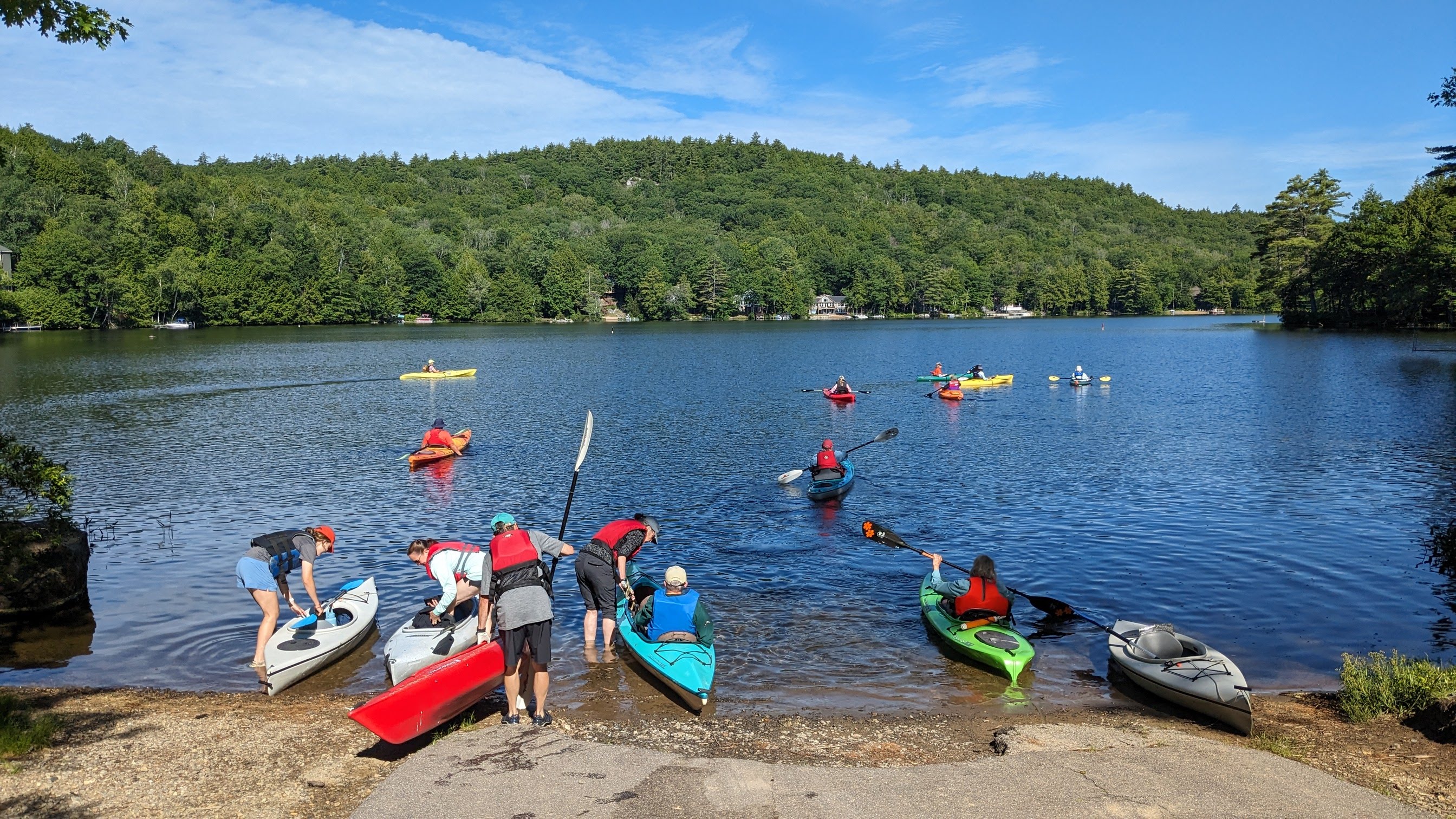
On Friday the Lakes Region Conservation Trust (LRCT) sponsored a guided paddle on Lake Wicwas.

Setting off from the boat launch.

The trust stewards protected land and conservation easements on eight properties around Lake Wicwas, protecting the second largest land mass in the watershed after the Town of Meredith.  The LRCT has been an invaluable partner in protecting the Lake Wicwas watershed and the quality of water in Wicwas as well as Winnisquam and other water bodies downstream.  In the Lakes Region, they have protected almost 29,000 acres of land, including popular properties such as Red Hill, Castle in the Clouds, and several islands in Winnipesaukee - even an island in Wicwas.  Their properties include 90 miles of maintained trails.  You can find detailed information about their properties including trail maps here.

Friday's excursion was attended by an enthusiastic group of paddlers that explored much of the lake, learning about conserved lands dating from the 1930s up until very recently when four generous land owners donated additional land, all of which has provided the setting for the healthy habitats we viewed.  One of my favorite wetland flowers, the Rose Pagonia, was on display for us.

Rose Pagonia (Pogonia ophioglossoides) flowers are only 3/4" across.

This small, delicate member of the orchid family can be seen in many of the marshes around the lake.  We also saw a carnivorous plant, the round-leaved sundew, which catches insects on its many sticky hairs, and then digests them for food.

The meat-eating round-leaved sundew (Drosera rotundifolia)

The paddlers got to see an osprey, herons, lots of eastern kingbirds, as well as loons.  We talked about loon breeding habits and their territorial behavior.  The loon nest that is still occupied was viewed from a far distance, too far to see the nest so as not to disturb them, but the nest where Checkers and LuLu were incubated allowed an up-close examination of a loon nest.

The now-abandoned nest where LuLu and Checkers were incubated.

Loons leave their nest within a day or two of the chicks hatching so approaching a nest at this point is not harmful.  Shell fragments from their eggs are still visible in the nest.

Unfortunately for us, we didn't see the new chicks even from afar because they've been off avoiding the rogue loon.  My guess is now that the chicks are larger and able to travel to avoid the rogue, the parents have decided to stop fighting and save their energy for caring for the chicks.  Someone (thanks SD!) reported  that they saw a single loon take off from the lake, so maybe the rogue has departed.  On the other hand, I received another report - with pictures - that a rogue was over harassing the other loon pair in Harris Cove!  

The Harris pair is now defending their territory.  Photos by Debbie Crowley.

Both parents-to-be engaged in fighting off the rogue, leaving the nest unoccupied and the eggs exposed. 


But this gave an opportunity to see the eggs, and like the first nest, there are two of them. 
Two more potential chicks.  Photo by Debbie Crowley.

Debbie is a fabulous photographer.  

If you read the most recent Loon Preservation Committee newsletter you know that one third of the lakes they survey are suitable for loons but are currently unoccupied.  That means there are plenty of other places for loons to go.  But maybe Wicwas is just such a great place they all want to be here!

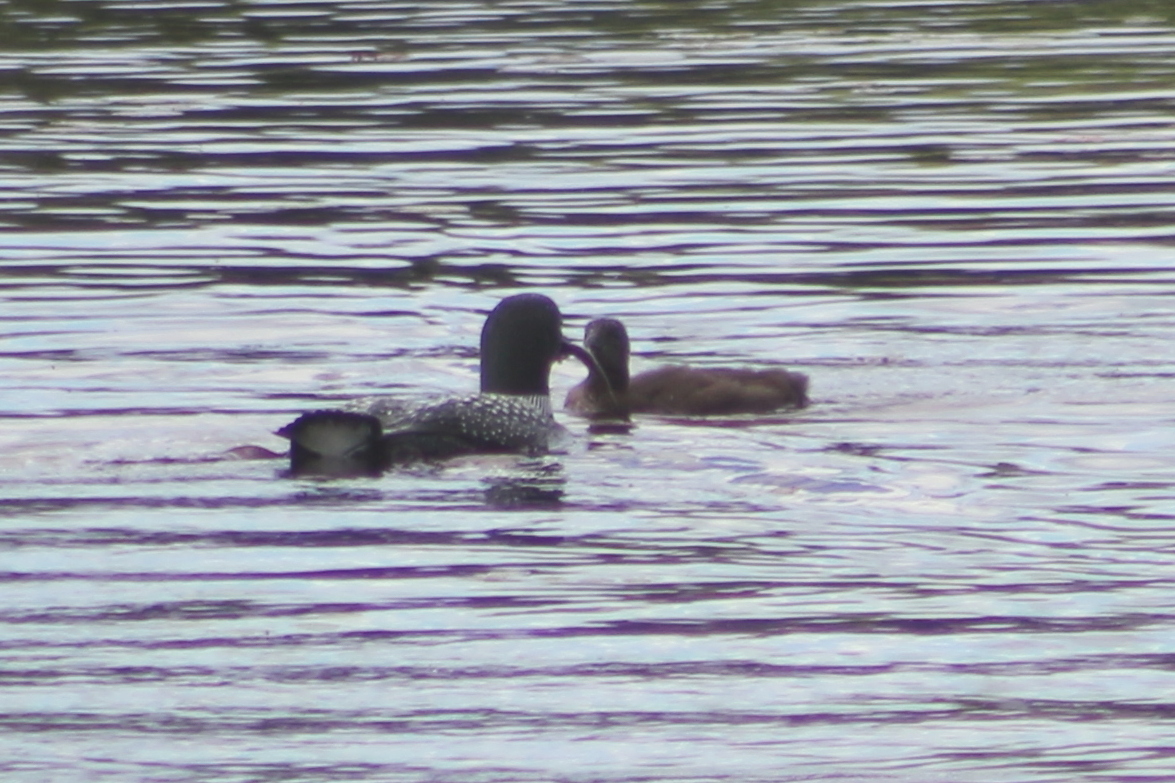
Whatever the cause, while the rogue was away the northern family was able to come back our way so we got to see how much LuLu and Checkers have grown.  We also witnessed a training session.  Dad came up with a fish from down in the weeds.  

"I'll take that, dad."

After clearing away the seaweed he was ready to hand it over to the chicks, but mom had other ideas. 

"It's time to start their lessons."

 She was able to convince dad to give her the minnow.

Which she brought to the chicks and dropped it in the lake for them to catch. 

"Here, you try."
"Where'd it go?"


Either they didn't catch it, or it was too big for them, but the the training session went on for some time as she recaptured and delivered the tired minnow to both LuLu and Checkers multiple times to help them learn the ropes of catching their own food.

When they tired of the game mom gobbled the fish up herself.  But the family returned in the afternoon for another training session.  We saw the chicks making small dives on their own when the parents dove, so they're already getting the hang of fishing. 


LuLu and Checkers seem to get along very well with no bickering or one picking (literally) on the other like we've seen in some years.  

Happy siblings.

I do enjoy watching them - I'll be fine if the rogue stays away for a while.


Sunday, July 10, 2022

July 10, 2022: Round-leaved Sundew

Last week I noted this really neat plant growing on a log that many years ago came to rest along the shoreline in a marsh.

Round-leaved Sundew (Drosera rotundifolia)

There are other plants growing on this old decaying tree including moss and some grasses.

A few other plants are taking up residence on this floating home.

But the round-leaved sundew is by far the most interesting in my opinion.  

I recognized the long thin hairs with drops of sticky liquid on them from plants such as the venus fly trap, which indicates it's a carnivorous plant.  It's an example of a plant that has adapted in unique ways to live in places where most plants can't survive.  It grows in highly acidic areas such as bogs and fens where the acidity precludes the growth of organisms (e.g. fungi) that usually generate the nitrogen plants need to survive.  So to live in this low-nitrogen environment, the round-leaved sundew adds animals to its diet - that is insects, mostly small flys and midges.  

The plant's prey is attracted to the round leaves and those eyelashes with thick tacky droplets on each one.

Does this look inviting to an insect?

When an insect lands and gets trapped the plant slowly closes up around it - though if the insect is struggling vigorously the plant speeds up its action.  Once it has enclosed its prey it secretes enzymes which digest the animal; it can even deliver an anesthetic that demobilizes its meal so it can't escape.  The plant uses the nitrogen in the animal to supplement the nitrogen that is lacking in the poor soil - or log - on which it lives.  Depending on the nitrogen level in the soil, nitrogen from animals makes up 25 to 50% of the sundew's nitrogen needs.  

These plants have tiny white blossoms that appear in July and August so I'll see if I can find their flowers later this summer.  Most of the information provided here came from an organization called Adirondacks Forever Wild; you can read their full report here.

In other news, both loon nests are still occupied, presumably getting closer to hatching out new chicks.  And I haven't seen any fawns yet, but this cute moment with a fawn and its mother was captured just south of the Lakes Region in Canterbury:

As soon as mom stops, junior goes looking for something to eat but mom seems to say, "not now, we have things to do."  Thank  you GP for sharing!

I've heard quite a few scarlet tanagers around the lake but haven't been able to see any - they sing loudly from high up in the tops of dense trees.  But I did catch a cedar waxwing on a morning paddle.

Cedar waxwing

It's a bird I don't see often.  

Lastly, it's time for the Evening Primrose to bloom.  

Evening Primrose


I wrote about this interesting biannual plant in my July 19th, 2020 post, including the many insects that live on it.  (As an interesting coincidence, that post also included a different carnivorous plant, the greater bladderwort.)  The only animal I found on this primrose was the aptly named Primrose Moth, a pretty, soft, pink and white insect.

Primrose Moth

The wonders and beauty of nature are endless.


Sunday, July 3, 2022

July 3, 2022: High Altitude Wildflowers

A beautiful stretch of fine weather graced a visit north of the notches this week.  Though it was cool at night the days were bright and clear with a rare cloud-free four days in a row at the summit of Mount Washington.

Looking north down Great Gulf with Mts. Jefferson, Adams, and Madison towering above.

On a hike in the northern Presidentials I spent a fair amount of time relishing the unique wildflowers growing in that harsh alpine ecosystem, and then even more time with the field guide trying to identify them.  Some, such as Diapensia I should have known.

Diapensia (Diapensia lapponica) at 5600' on Mt. Washington.

This alpine plant grows only a few inches high and was just starting to boom.  

Another alpine flower I saw was the mountain avens.  

Mountain avens (Geum peckii) at 5400' on Mt. Clay.  (Accompanied by bunchberry.)


This plant is found only in the White Mountains in New Hampshire and on a single tiny island off the cost of Nova Scotia, Brier Island.    Although the leaves remain close to the ground, the flowers are on stems a couple of inches high which allows them to track the sun as it traverses the summer sky.  There are eight other species of avens in North America but this is the only one that grows above the tree line.  [Ref:  US Forest Service]

Next is the Labrador tea, a member of the rhododendron family.

Labrador tea (Rhododendron tomentosum) at 5100' on Mt. Clay.

This low-growing shrub is found in many areas above and below tree line in the white mountains, and as its name suggests, it has been used by native Americans for centuries to make tea as well as medicines to treat a number of ailments.  [Ref:  Adirondacks Forever Wild]  According to Adirondacks Forever Wild:

Native Americans made extensive use of Labrador Tea to treat a wide variety of ailments, including asthma, rheumatism, burns, and diseases of the liver and kidney. For instance, the Algonquin reportedly used an infusion of the plant for headaches and colds. The Chippewa used a powder containing powdered root to apply to burns and ulcers. The Cree used an infusion of the flowers for insect sting pain and rheumatism; they used a poultice of leaves to apply to wounds. The Oweekeno used an infusion of leaves as a remedy for a sore throat.

There were also many bluets lining the path along the Gulfside Trail.

Bluets on the left and the much larger false hellebore on the right side of the Gulfside Trail.

Another excursion in the Mount Washington area took us along the Presidential Rail trail to Cherry Pond where we found, believe it or not, loons!   And this pair of loons is well ahead of our Wicwas pairs, already having a chick hatched which is old enough to have molted at least once, replacing its dark brown baby feathers with lighter-colored plumage.

The loon pair on Cherry Pond in Jefferson.

They apparently have only one chick so it's getting all the food the parents collect, fueling its rapid growth.


Back on Wicwas there's not much to report on our loons as they patiently wait for their eggs to hatch, sharing duty on the nest.  I did see the male of the northern nest off-duty at one point, and he kindly exposed his leg band to prove his identity.

"Yes, it's me."

I had to spend more time with the field books looking up plants I saw in the marshes around the lake, one of which I recognized as having the characteristics of a carnivorous plant;  I need to read more about this one for a future journal entry.  

Round-leaved Sundew (Drosera rotundifolia) -  a carnivorous plant worthy of further study.

While we were away I set my trail camera along the road to see who visited while we were gone and there were a couple of large creatures that passed by.

Papa bear in full daylight.  (Especially for you, Stephanie!)

And mama deer cruising the road at night.

Based on the appearance of this doe I wouldn't be surprised if there were a fawn following along behind her.  She had better keep a close eye out for last week's bobcat!

It's also turtle season - keep a watch out for mother turtles crossing the road to find a sandy spot to bury her eggs.

Mrs. Painted Turtle laying her eggs.

Loon chicks, fawns, turtle eggs - early summer is a time of birth.  I'll end with one more look at the Rock Pile on the birth of a new day.

Mount Washington greets a new day on July first.

Happy Fourth of July - I hope you enjoy a warm and safe weekend!