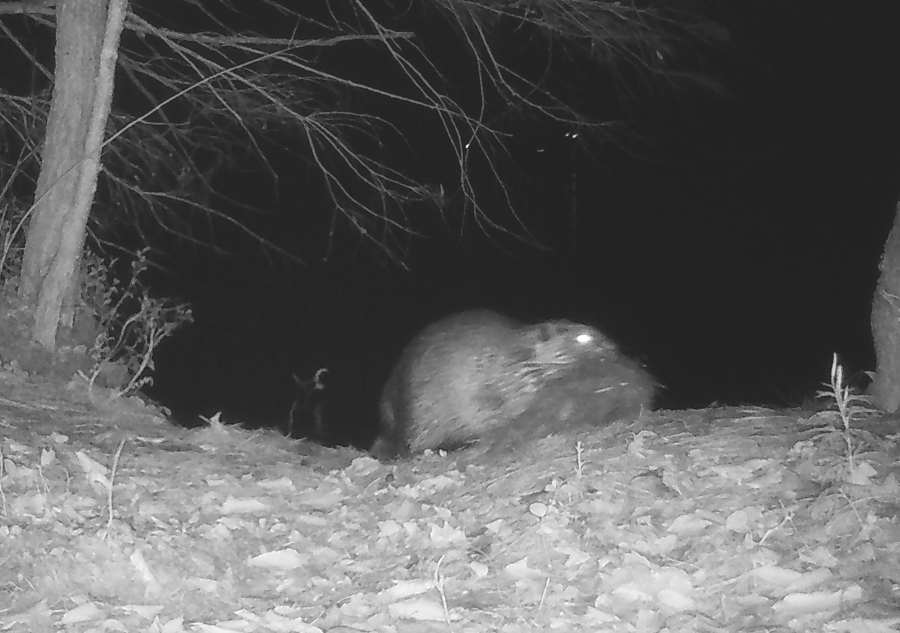
It's been a couple of years since I've seen a moose around Lake Wicwas, but I know they're still here.
 |
| Moose scat - much larger than deer scat. |
This week the Meredith Conservation Commission took a survey of a forestry project performed on the Leighton Town Forest far up in the Chemung area. The work was done in 2017-2018 and included thinning overcrowded and weak trees as well as a several-acre patch cut for habitat diversity. Much of the forest in New Hampshire is of a common age having regenerated after the state was largely cleared of forest in the nineteenth century. With few fires to clear areas of forest, there is now minimal habitat of the young trees that many species need to survive. One animal that takes advantage of early-growth trees is moose. In the summer moose feed on aquatic vegetation in ponds and wetlands, but in winter they need other food sources which includes twigs and bark of small trees. You can still see signs of bark scraped off red maple trees along the White Trail in the Hamlin Forest but they date from the early 2000s; there are few small trees left for them to feed on.
 |
| Look for old moose scrapes (this is from 2004) near the highest point on the Arbutus Hill Pond Trail. |
The photo of moose scat was one of half a dozen piles of scat we saw on our trip around the patch cut at Leighton, which indicates the cut was successful. The forestry plan for that property includes creating additional patch cuts every five to ten years so there will be a constant range of forest ages for animals to find their preferred habitat.
Here's what the cleared area looked like in 2018 shortly after in was cut.
.jpg)
And here's what it looks like from the same spot today.
 |
| That thick young forest is what many species need for food and shelter. |
It shows how quickly a forest can regenerate, though it will take 50 to 100 years to fully mature, and over 200 to become "old growth" forest. Forestry requires a long term outlook.
The forest can look pretty ugly right after logging, but in a few years they recover. Here's what the main logging path looked like right after the work was done.
.JPG)
And six years later, the same spot has filled in with thick growth of pioneer species such raspberry, birch, red maple, and white pine.

.JPG) |
| 2017 |
 |
| 2024 |
Another important aspect of forestry today is having a diverse forest to make it resilient to introduced animals, pathogens, and climate change. Imagine what would happen if many acres of forest consisted of a single species and that species was attacked by an invasive insect or disease like the ash trees and the elm trees before that. Or perhaps that species can't handle the droughts or very wet years climate change is causing. Careful forestry can open up areas around under-represented trees to allow them to thrive and maintain Forest diversity in case of species collapse. For example, around the Lakes Region we find monocultures of Eastern Hemlock which is now under attack by the hemlock woolly adelgid, an invasive insect that's a serious threat to the health of hemlock trees. American Beech is facing a similar threat from the Beech Leaf Disease.
 |
| A hemlock monoculture with a closed canopy blocking light from other plants. |
A knowledgeable forester also assesses soil conditions and sun exposure and will manage for species best suited to the immediate microclimate.
There's a lot to consider in the long-term management of our forests. If you're interested in learning more, keep an eye on the Commission's Facebook page as they will be having more public forestry tours in the future. There's also a good article in the Summer 2024 issue of the Forest Society's Forest Notes publication [Managing for Resilient Landscapes, Aldrich and Weisiger, Pg 14]
And yes, I used to see a lot of moose, and I know I will see them again.

I froze when this big bull walked right in front of me some ten years ago. I don't think it even noticed me, which is just the way you want it around a moose.
Back around the lake, ducks that spent the summer north of the Lakes Region have started to make their appearance on Wicwas as they return south for the winter.
 |
| Two pairs of Wood Ducks enjoy a rainy morning on the lake. |
All the migrating birds - and we - will soon be treated to the great New Hampshire foliage season.


Foggy mornings and changing leaves - Fall is in the air.