Sunday, July 2, 2023

July 2, 2023: Dating Dragons

A few weeks ago I mentioned that dragonflies and damselflies have some interesting mating techniques, and with lots of these mythical creatures now emerging from the depths, July is a good time to observe them in action. 

A male (blue) and female (tan) bluet damselfly in their mating configuration.

As I mentioned previously (May 28, 2023) dragonflies and damselflies are considered aquatic animals because they spend most of their lives as nymphs living in the water.  After a number of months - or even years - they emerge from the water and transform into the flying creatures we usually see.  They climb up out of the lake on plants and docks where they extricate themselves from their final aquatic shell as almost-flying creatures.  

A newly hatched damselfly next to a shed larva shell.

Before they can fly they need to bake in the sun while they pump up and dry out their wings.  You may find their old exoskeletons left behind with a small hole in the top where they climbed out,

Here I could see the hole through which it escaped its juvenile prison.  It's rather amazing that the adult was packed into that small skin, let alone being able slide out its fragile legs.

Out in a marsh, this next dragonfly climbed up a reed, escaped from its skin, then climbed up another inch to dry itself in the sun, hoping it could become airborne before it was gobbled up by a predator:

A freshly metamorphosed dragonfly and its exoskelteon.

After emerging, the adult dragonfly's (and damselfly's) primary mission is to find a mate and reproduce. This is where it gets really interesting. The male and female dragonfly have their reproductive organs on opposite ends of their body which results in a heart-shaped mating position, with the female holding onto the male while it deposits sperm from near its thorax into the female's receptacle near its tail. 

The male is blue, the female green.

The process takes a few minutes so you often see Odonata (the order that includes dragonflies and damselflies) flying in their mating position.  As in many species, the female is the one that selects a mate.  Males will demonstrate their acrobatic abilities, and the female will select one of her choosing.  After mating, the female will do its best to avoid any other interested males, going so far as to fall to the ground and play dead in some species when approached by another male.  The reason for this is that male dragonflies have the ability to remove any existing sperm in a female before depositing its own.  This would mean the female's chosen mate's genes would be eliminated from her offspring.

After mating, the female will place the fertilized eggs either on a plant or directly into the water.  Perhaps you've seen a dragonfly in a touch-and-go flight pattern, dropping down to touch the surface of the lake and then taking off again.  Each time it touches the water it is depositing one egg in the lake from the end of its body.  Thus a new cycle begins, as the egg will hatch into a new dragonfly larva, consuming microscopic organisms as it grows though multiple molts as a larva.  Different species of  Odanata (there are over 7000 species) have differences in their anatomy and behavior, but most of them have similar traits.

Lakes, streams, wetlands - they truly are the fountain of life.  This week I was up in the mountains, hiking on Mt. Cardigan and Firescrew.  There on the open ledges of Firescrew is a small alpine lake.

An alpine lake on the Firescrew ledges.

As we approached the lake my hiking partner heard something familiar, and we had to stop and listen to believe what what were hearing.  There was no doubt; here, in the alpine zone, at an elevation over 3000 feet, was a frog.  We didn't leave the trail in this fragile habitat to look for it, but it sounded like a green frog.

I've always seen green frogs near the lakes, where this one was hunting for insects.

I never expected to find a frog in this adverse environment.  Then, my hiking companion posed the astute question "how did it get here?"  There are streams nearby, but none that flowed out of this isolated pond in a depression in the granite.  I suppose frogs migrate up streams, and in a dry summer, when a stream dries up, they may go in search of the water a frog needs to survive.  

There's always some new wonder to discover in nature.

We also saw quite a few pretty alpine flowers on the hike, including three-toothed cinquefoil:

Three-toothed cinquefoil on the high Firescrew ledges.

By the way, Firescrew supposedly got its name from the smoke of a wildfire on the mountain that was twisted up into the sky by swirling winds into a large vertical corkscrew shape. 

On our hike, it was smoke from wildfires in Canada that made for the hazy sky, but it was a great hike with my sister - thanks for the adventure!

The summit of Mt. Cardigan from Firescrew.

Back at Lake Wicwas all is well with the loons.  LuLu and Checkers have been protected from all threats and are doing well, and the second pair is still tending to their eggs on the nest in Harris Cove.  They should be hatching about one week from now.  

I hope you have a great Fourth of July, enjoying some fireworks, whether man-made or nature-made!

Orange hawkweed, Nature's fireworks.

Happy Fourth of July!  


Sunday, June 25, 2023

June 25, 2023: The Lakes Region Consveration Trust Visits the Lake

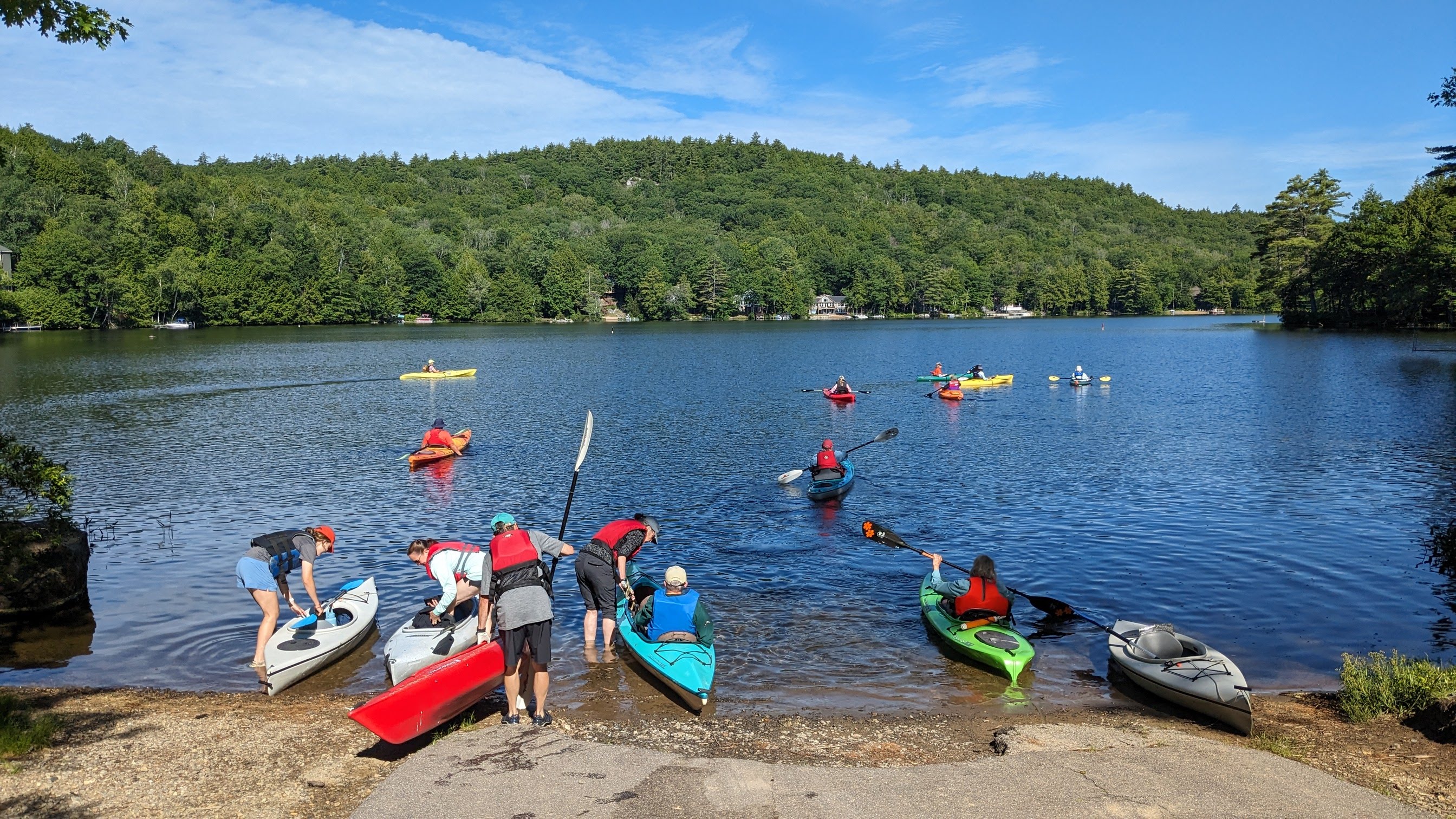
On Friday the Lakes Region Conservation Trust (LRCT) sponsored a guided paddle on Lake Wicwas.

Setting off from the boat launch.

The trust stewards protected land and conservation easements on eight properties around Lake Wicwas, protecting the second largest land mass in the watershed after the Town of Meredith.  The LRCT has been an invaluable partner in protecting the Lake Wicwas watershed and the quality of water in Wicwas as well as Winnisquam and other water bodies downstream.  In the Lakes Region, they have protected almost 29,000 acres of land, including popular properties such as Red Hill, Castle in the Clouds, and several islands in Winnipesaukee - even an island in Wicwas.  Their properties include 90 miles of maintained trails.  You can find detailed information about their properties including trail maps here.

Friday's excursion was attended by an enthusiastic group of paddlers that explored much of the lake, learning about conserved lands dating from the 1930s up until very recently when four generous land owners donated additional land, all of which has provided the setting for the healthy habitats we viewed.  One of my favorite wetland flowers, the Rose Pagonia, was on display for us.

Rose Pagonia (Pogonia ophioglossoides) flowers are only 3/4" across.

This small, delicate member of the orchid family can be seen in many of the marshes around the lake.  We also saw a carnivorous plant, the round-leaved sundew, which catches insects on its many sticky hairs, and then digests them for food.

The meat-eating round-leaved sundew (Drosera rotundifolia)

The paddlers got to see an osprey, herons, lots of eastern kingbirds, as well as loons.  We talked about loon breeding habits and their territorial behavior.  The loon nest that is still occupied was viewed from a far distance, too far to see the nest so as not to disturb them, but the nest where Checkers and LuLu were incubated allowed an up-close examination of a loon nest.

The now-abandoned nest where LuLu and Checkers were incubated.

Loons leave their nest within a day or two of the chicks hatching so approaching a nest at this point is not harmful.  Shell fragments from their eggs are still visible in the nest.

Unfortunately for us, we didn't see the new chicks even from afar because they've been off avoiding the rogue loon.  My guess is now that the chicks are larger and able to travel to avoid the rogue, the parents have decided to stop fighting and save their energy for caring for the chicks.  Someone (thanks SD!) reported  that they saw a single loon take off from the lake, so maybe the rogue has departed.  On the other hand, I received another report - with pictures - that a rogue was over harassing the other loon pair in Harris Cove!  

The Harris pair is now defending their territory.  Photos by Debbie Crowley.

Both parents-to-be engaged in fighting off the rogue, leaving the nest unoccupied and the eggs exposed. 


But this gave an opportunity to see the eggs, and like the first nest, there are two of them. 
Two more potential chicks.  Photo by Debbie Crowley.

Debbie is a fabulous photographer.  

If you read the most recent Loon Preservation Committee newsletter you know that one third of the lakes they survey are suitable for loons but are currently unoccupied.  That means there are plenty of other places for loons to go.  But maybe Wicwas is just such a great place they all want to be here!

Whatever the cause, while the rogue was away the northern family was able to come back our way so we got to see how much LuLu and Checkers have grown.  We also witnessed a training session.  Dad came up with a fish from down in the weeds.  

"I'll take that, dad."

After clearing away the seaweed he was ready to hand it over to the chicks, but mom had other ideas. 

"It's time to start their lessons."

 She was able to convince dad to give her the minnow.

Which she brought to the chicks and dropped it in the lake for them to catch. 

"Here, you try."
"Where'd it go?"


Either they didn't catch it, or it was too big for them, but the the training session went on for some time as she recaptured and delivered the tired minnow to both LuLu and Checkers multiple times to help them learn the ropes of catching their own food.

When they tired of the game mom gobbled the fish up herself.  But the family returned in the afternoon for another training session.  We saw the chicks making small dives on their own when the parents dove, so they're already getting the hang of fishing. 


LuLu and Checkers seem to get along very well with no bickering or one picking (literally) on the other like we've seen in some years.  

Happy siblings.

I do enjoy watching them - I'll be fine if the rogue stays away for a while.


Sunday, June 18, 2023

June 18, 2023: Introducing LuLu and Checkers

We spent the past week in southern Maine, exploring the coast from Ogunquit to Cape Elizabeth, but that is going to have to wait until after the loon news, because, while we were away we received news that the first pair of loons hatched two chicks!  This was well before we had expected, meaning the pair had nested almost two weeks before we discovered the nest - that was one well chosen nesting sight.  The chicks were first spotted on Wednesday by Lois Crane, so she earned the naming rights.  This years chicks (so far) are LuLu and Checkers!

Introducing Checkers and LuLu, offspring of the northern pair.  Photo by Amy Wilson.

Quite a few people have been treated to seeing them up-close as the family slowly paddles along the shore line, the parents diving for tiny fish to feed the chicks. 


Finding the right size fish isn't always easy.  When the family came by our house I watched mom catch a minnow and then spend a good five minutes trying to get either of the chicks to eat it. 
"It's kinda big mom"  

It's so big it tipped the little chick's tail right out of the water when it picked it up in its beak.
"I'm trying!"


That minnow may weight more than the chicks!  They would take it, try to swallow it, but gag and drop in the lake.  Mom would catch it again and re-offer it, swimming back and forth between them.  

At first both chicks refused to even try, but eventually each made a gallant effort, but it was just too large to get down their little throats. 
"OK, I'll try again."

Nope.  Back to Checkers.

After a while dad came over to see what was going on. 
"What's taking so long over here?"

But eventually mom gave up and ate it herself.  These pictures were all taken from the deck which facilitated seeing their leg bands under the water.  I also took some video during part of the long ordeal.


If you hear the family approaching - they make the most gentle cooing sound - sit perfectly still at the shoreline and you may get a good show.  They keep to the northern end of the lake, but the southern pair has yet to produce chicks; if they do, the rest of the lake might have their opportunity to observe chick rearing in action.  Just be respectful - they need to be undisturbed to be comfortable fishing for enough food to nourish all of four of them.

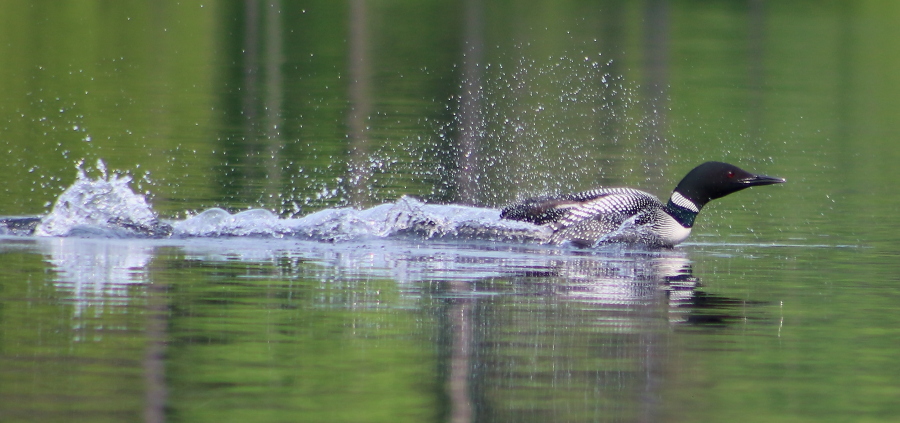
Unfortunately, not all is calm and serene.  There is a rogue loon that has been harassing the family multiple times a day.  I heard wild yelling off in the distance and knew something traumatic was happening.  Then later the action unfolded within my view.  The rogue loon came into the cove where the family was fishing.  They moved away from it the best they could, but when they were backed into the end of the cove, they had no choice but to defend their offspring - a loon will kill other loons' offspring whenever it can.

Mom's on the left covering up the chicks, the rogue is on the right, with dad in between.

Close enough.  Time to go on the attack.
There are two loons in that scrum.

Mom mostly protected the chicks (again, love the bands) but there were a couple of worrying moments when she abandoned Checkers and LuLu to join in the battle.  After a lengthy, violent battle, our large male - he weighed 14.5 pounds in 2019 when he was banded - was able to repel the intruder. 
The rogue in high speed retreat.

With dad in hot pursuit.

After driving the rogue well out of the cove, dad came back to check on the family.  
And all is well - for now.

This is a good moment to remember our own fathers, and all they did for us in our lives.  Thank you dad, and happy Father's Day!  

I was able to get some shaky video from the altercation and their battle calls are clearly heard:

Yet another attack occurred again later in the day with the same result.  It could be a long, stressful summer on the lake.


Now on to Maine.  


Of course we enjoyed the beautiful rocky coast of southern Maine, but also sought out some other unique habitats including the Wells Barren Preserve, about six miles inland.  It's an unusual habitat which supports several rare birds and continues to be maintained via controlled burns.  One area appears to have been burned very recently as it was just emerging with new growth.  
Recent burn area at the Wells Barren Preserve.

We identified 15 birds while we were there, but they were hiding out in the trees and I didn't get a single good picture.  The best was this Brown Thrasher, which I've seen in South Carolina but not previousluy in New England.
Brown Thrasher

Back near the coast at a very small and quiet state park on Cape Elizabeth called Kettle Cove, I came across another bird I see only occasionally, a cedar waxwing.
Cedar waxwing in Kettle Cove.

This park is overgrown with a very aggressive invasive species, Morrow's honeysuckle.  

Morrow's Honeysuckle (Lonicera morrowii)

It has a pretty flower and it grows vigorously which is probably why it was introduced to North America, but that's also why it's so detrimental.  It crowds out every other plant, including even early, shade-tolerant flowers like the trillium, because it leafs out early, before the native plants have a chance to receive any sunlight.  It also produces lots of fruit, which is good for birds, but that too is changing nature.  A diet of Morrow's honeysuckle will change the color of the cedar waxwing's tail from the usual yellow to orange due to pigment in the honeysuckle berries.  This change has occurred in just the last 35 years. [REF:  1,  2]  I wasn't aware of this when I saw the birds in the large honeysuckle stand so I didn't know to look for an orange tail - you can decide.

To me the tip looks half yellow and half orange.

We also visited the Rachel Carson Wildlife Refuge in Kittery at Cutt's Island.  I hadn't been there before but the Carson refuges are always beautiful.  This section of the 9000 acres refuge has a 1.8 mile trail that goes along the intertidal water of Chauncey Creek behind Cutt's Island.  It was a bird paradise and I identified 29 unique species - the most I've ever seen at one location - including a new bird for me:  a Glossy Ibis!

Glossy Ibis (Plegadis falcinellus)

This odd but handsome bird was poking down deep into the marsh with its long, curved beak, probing for food.  They have a very broad diet that includes mollusks, snakes, fish, and grain.

Another new bird for me was seen at Nubble Light.  There were two female Common Eiders paddling along with a brood of 11 chicks.


Female Common Eider  (Somateria mollissima)


Walking along the Marginal Way between Ogunquit and Perkins is must-do whenever we're in the area.  In June there are lots of bright flower beside the path, though most of them are cultivated.  


Most wide-spread and in its glory right now is the beach rose.  

Beach rose (Rosa rugosa)

Beach rose grows extensively along the entire New England Coast so I always assumed it was a native plant.

Cape Porpoise in Kennebunkport.


What a surprise to learn that it, like so many other invasive species, was introduced to North America from Asia.  Beach rose has been designated as invasive in several states, though it has such valuable properties in stabilizing sand dunes and other shoreline soils that it's generally not removed.  In Maine it's on the "Advisory List of Invasive Plants".

One last image of Maine before I end this long post.  This was a picture I didn't know I took.  It must have been an erroneous click of the shutter, but it's one of my favorites of the entire trip.


There was much more nature to be seen at the lake this week, but this post is long enough.  I'll try to fit them next week.