Showing posts with label LRCT Guided Paddle. Show all posts

Sunday, June 25, 2023

June 25, 2023: The Lakes Region Consveration Trust Visits the Lake

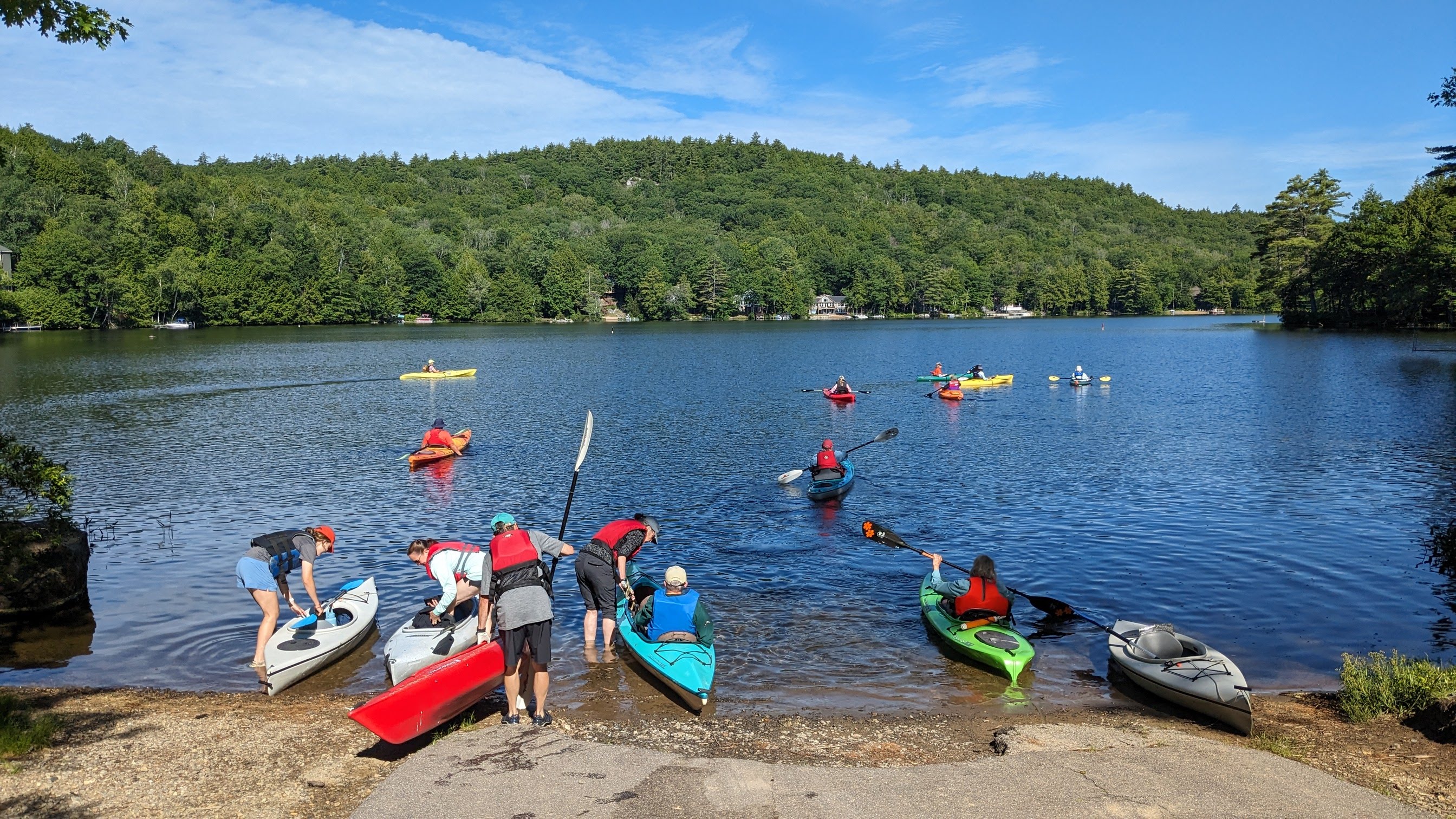
On Friday the Lakes Region Conservation Trust (LRCT) sponsored a guided paddle on Lake Wicwas.

Setting off from the boat launch.

The trust stewards protected land and conservation easements on eight properties around Lake Wicwas, protecting the second largest land mass in the watershed after the Town of Meredith.  The LRCT has been an invaluable partner in protecting the Lake Wicwas watershed and the quality of water in Wicwas as well as Winnisquam and other water bodies downstream.  In the Lakes Region, they have protected almost 29,000 acres of land, including popular properties such as Red Hill, Castle in the Clouds, and several islands in Winnipesaukee - even an island in Wicwas.  Their properties include 90 miles of maintained trails.  You can find detailed information about their properties including trail maps here.

Friday's excursion was attended by an enthusiastic group of paddlers that explored much of the lake, learning about conserved lands dating from the 1930s up until very recently when four generous land owners donated additional land, all of which has provided the setting for the healthy habitats we viewed.  One of my favorite wetland flowers, the Rose Pagonia, was on display for us.

Rose Pagonia (Pogonia ophioglossoides) flowers are only 3/4" across.

This small, delicate member of the orchid family can be seen in many of the marshes around the lake.  We also saw a carnivorous plant, the round-leaved sundew, which catches insects on its many sticky hairs, and then digests them for food.

The meat-eating round-leaved sundew (Drosera rotundifolia)

The paddlers got to see an osprey, herons, lots of eastern kingbirds, as well as loons.  We talked about loon breeding habits and their territorial behavior.  The loon nest that is still occupied was viewed from a far distance, too far to see the nest so as not to disturb them, but the nest where Checkers and LuLu were incubated allowed an up-close examination of a loon nest.

The now-abandoned nest where LuLu and Checkers were incubated.

Loons leave their nest within a day or two of the chicks hatching so approaching a nest at this point is not harmful.  Shell fragments from their eggs are still visible in the nest.

Unfortunately for us, we didn't see the new chicks even from afar because they've been off avoiding the rogue loon.  My guess is now that the chicks are larger and able to travel to avoid the rogue, the parents have decided to stop fighting and save their energy for caring for the chicks.  Someone (thanks SD!) reported  that they saw a single loon take off from the lake, so maybe the rogue has departed.  On the other hand, I received another report - with pictures - that a rogue was over harassing the other loon pair in Harris Cove!  

The Harris pair is now defending their territory.  Photos by Debbie Crowley.

Both parents-to-be engaged in fighting off the rogue, leaving the nest unoccupied and the eggs exposed. 


But this gave an opportunity to see the eggs, and like the first nest, there are two of them. 
Two more potential chicks.  Photo by Debbie Crowley.

Debbie is a fabulous photographer.  

If you read the most recent Loon Preservation Committee newsletter you know that one third of the lakes they survey are suitable for loons but are currently unoccupied.  That means there are plenty of other places for loons to go.  But maybe Wicwas is just such a great place they all want to be here!

Whatever the cause, while the rogue was away the northern family was able to come back our way so we got to see how much LuLu and Checkers have grown.  We also witnessed a training session.  Dad came up with a fish from down in the weeds.  

"I'll take that, dad."

After clearing away the seaweed he was ready to hand it over to the chicks, but mom had other ideas. 

"It's time to start their lessons."

 She was able to convince dad to give her the minnow.

Which she brought to the chicks and dropped it in the lake for them to catch. 

"Here, you try."
"Where'd it go?"


Either they didn't catch it, or it was too big for them, but the the training session went on for some time as she recaptured and delivered the tired minnow to both LuLu and Checkers multiple times to help them learn the ropes of catching their own food.

When they tired of the game mom gobbled the fish up herself.  But the family returned in the afternoon for another training session.  We saw the chicks making small dives on their own when the parents dove, so they're already getting the hang of fishing. 


LuLu and Checkers seem to get along very well with no bickering or one picking (literally) on the other like we've seen in some years.  

Happy siblings.

I do enjoy watching them - I'll be fine if the rogue stays away for a while.


Sunday, June 20, 2021

June 20, 2021: Rocky Mountain Pelicans

On our final hike in steamboat springs last week we went up to find an abandoned uranium mine just east of steamboat. We weren't far up the trail when a flock of large birds came soaring up the west flank of the mountain from the Yampa valley.

A flock of large birds over the Yampa Valley, the Flattop Mountains are in the distance.

In the distance it was clear they were large with some white visible so my mind went to bald eagles, but I'd never seen eagles in a flock, let alone in formation. I lost sight of them as they dipped below the tree line but a few minutes later they circled up nearer to the ridge we were hiking and I got a better look - they were pelicans! 
American White Pelicans (Pelecanus erythrorhynchos)

I remember reading somewhere about pelicans in Colorado but didn't really believe it, and certainly never expected to see them. But there they were, undisputable pelicans; I wouldn't have believed it if I hadn't seen them with my own eyes.  Turning to my favorite bird resource, the Cornell Lab of Ornithology, I find that they migrate across much of America west of the Mississippi river on their way to breeding grounds primarily in Canada, but also in pockets of Colorado, Wyoming, and the Dakotas. So much for me thinking they are purely ocean birds - though the brown pelicans I see in South Carolina are strictly seacoast dwellers.


Back in new Hampshire we've had some perfect summer weather, simply ideal for a guided paddle around Lake Wicwas on Friday.  The Lakes Region Conservation Trust organized the paddle which was attended by an enthusiastic group of twelve kayakers and canoers who toured eight LRCT-protected easements as well as four protected by the town of Meredith.
A colorful group prepares to depart on a two-hour tour.

The paddle was organized and led by LRCT Land and Stewardship Director Dave Mallard and me.


New Hampshire is incredibly fortunate to have so many generous, forward-looking people who have seen the importance of protecting our water and land resources.  On the trip we saw loons, kingbirds, painted turtles, yellow warblers, tree swallows and even got a glimpse of the loon nest.  In the marshes we saw blue flags (wild iris) and rose pogonia blooming.  
Rose Pogonia (Pogonia ophioglossoides)

Blue Flag (Iris versicolor)


The iris are almost gone-by but the small and delicate rose pogonia will be in bloom for a while - look for both in dense, boggy wetlands.

We're still waiting for definitive confirmation of the female nesting loon as she's been quite protective of her leg bands.  I did confirm there are two eggs still in the nest, though it was a little concerning that the nest was unoccupied with only one parent nearby, nonchalantly preening near the nest.
Two eggs sit unattended.

There were no boats in the area and no indication of where the other loon was or why it left the nest.  Hopefully it just needed a quick dip to cool off.

There was another large flying creature that landed on the lake when we were away, but the quick eye of Debby Crowley caught the renegade as it came in for a landing.  
Landing on Wicwas.  Photo by Debby Crowley.


Debby reported that the loons did not appreciate the stranger on the lake, but they also apparently didn't run off to hide - maybe they were curious about this large, noisy intruder too.
 A loon checks out the unusual beast.  Photo by Debby Crowley.


While I'm sharing stories from outside the Lakes Region I want to share this fabulous picture a friend took of a red-tailed hawk sitting in the top of tree along the Marginal Way in Ogunquit Maine.
Red-tailed hawk (Buteo jamaicensis).  Photo by John Windyka.

  
Red-tailed hawks are very large birds, and with a wing span of almost five feet they are often mistaken as immature bald eagles.  Keep an eye on the sky for both of them which are present in the Lakes Region.  This is one of the best photos I've seen of a red-tailed, with the sun illuminating the tail from above and those steely eyes staring right down at the camera.  Thanks for sharing John, and thanks also to PC for sharpening up the photo!

Finally, happy Father's Day to my dad and all fathers - this is your day to enjoy and remember what joy you've brought to the world.  Here's one many-times over dad, who's hopefully about to become a new father once again:
The soon-to-be father enjoying some personal time on the lake before his life gets very busy.


Now this late breaking news:  Claranne B. just reported a moose swimming along the shore of Lake Wicwas!  It the stomped right up onto land and walked across Loon Point.  It's a rare treat to see a moose, and great to know they are roaming around the Lakes Region!

Sunday, July 14, 2019

July 14, 2019: Loon Overload

So many loons, and it is just too hard to ignore them when they come by every day and fish right in front of me.

The chicks are growing quickly now; the family must find the fishing quite productive where the little perch hide out under the dock and the boat as they spend lots of time diving there.  Even Harley and Davidson are working on their skills right under the boat.
Looking for fish hiding in the shadows.

Yesterday I saw the family coming along the shoreline across the cove so I went down to the dock and sat quietly waiting for them to come by, and I got a great look at them as they fished right off the dock. 
Side by side you can see one chick is slightly larger than the other.
Little bird, big foot.
Soon enough dinner time arrived.  A parent brought up a medium size perch and gave it to one chick.


Another time the fish dropped in the lake and the little guy re-caught it himself - they are learning.  I caught it on a video, though it's pretty shaky (click here to see it).

The parents seem to be very proficient this summer as the chicks are growing rapidly and there have been a lot of other loons on the lake from which to protect them.  One morning I saw a group of seven loons together, one of which was possibly one of the chicks' parents as it seemed to be herding the other six along.
Six visiting loons, with one more just outside this picture.


That same morning there was an altercation taking place at the entrance to the cove of the second nest with another set of loons.  This was perhaps the male of the second nest keeping a rogue away, and it was successful in driving it off.
The intruder on retreat.

But it didn't go far, just flying across the lake and setting down again, so the resident will have to maintain sentry at the mouth of the cove.
Coming in for a landing.

Splashdown!


And that morning the family was nowhere to be found, possibly being hidden away from all the intruders by a parent.  All told that morning I counted 11 loons on Lake Wicwas, and that didn't include any chicks and probably at least one of their parents.  And speaking of the second nest, as of yesterday there was still a loon sitting on the nest, refusing to give up.  It is highly improbable a chick will hatch from that nest at this point.

Even with loons getting all the attention there are other things going on around the lake.  On Saturday the Lakes Region Conservation Trust held a guided paddle on Lake Wicwas, and a group of intrepid paddlers kayaked all around the lake.

The LRCT has numerous events - paddles, hikes, work days - in which you can participate.  You can learn about them here.  Thank you to all who participated in the Wicwas Paddle.

A few interesting insects also made an appearance this week, including an unusual moth.
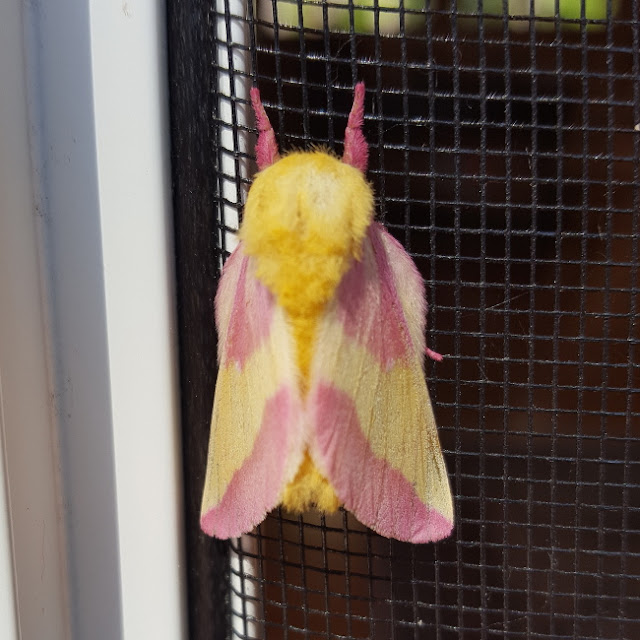
Rosy Maple Moth (Dryocampa rubicunda).   Photo by Nancy Marion.

With a few exceptions such as the tremendous Luna Moth, most moths are rather drab in appearance, being small, brown or gray, but the rosy maple moth is a nice exception.  Thank you for sharing Nancy!

Another neat insect that - in New Hampshire at least - always appears well after its name says it should, is the mayfly. 
Mayfly in July.

I often find these on the window in the morning and they hang out there for hours until their wings dry out enough to fly away, during which time the are very photogenic.

I'll end with one other amazing event that another reader sent me:
Garter snake versus toad.  Photo by John Windyka.
Talk about having eyes bigger than one's stomach.  I wonder if this garter snake was ever able to eventually get the toad into its mouth!  Thanks for the great photo John!

Sorry the post was so long this week, but how can you resist this?

Sunday, August 13, 2017

August 13, 2017 - Annual Paddle Regatta

It was another busy week on the lake with water testing, paddling, barbecuing, and loon raising.  On Monday our ever-reliable lake volunteers took two interns from the NH Department of Environmental Services (DES) out on the lake to collect water samples for the annual water quality assessment.
The crew with some of the collection equipment
The captain and first mate performing analysis
Samples were taken at four locations around the lake and at varying water depths, including the deepest spot of the lake at 38 feet.  Testing will include properties such as dissolved oxygen, phosphorous, acidity, e-coli, and turbidity (visibility).
Water samples collected for testing
It will take several weeks to analyze the samples, and the results will be posted on the Lake Wicwas website.  You can see last year's report here, and review ten year's worth of data on the website. There is a wealth of additional information available at the NH DES website.

Of course, even when doing the important business of collecting water samples, the highlight of the day was seeing the loons and their chick!
The water collection crew deeply engrossed in their duties


The subject of their attention
The combined Lake Wicwas Association Annual Paddle Regatta / Lakes Region Conservation Trust Guided Paddle was held on Saturday which provided near perfect weather for a paddle: calm, overcast skies, not too hot.  The group toured all four of the recently conserved properties, and we were even escorted by one of the generous property donors.
LRCT/Lake Wicwas Association Paddle
We were fortunate enough to see a Great Blue Heron on the Harris Conservation easement (near the Blue Heron Lodge no less), the loon family near Bryant Island, and a group of four loons congregating in the middle of the lake on the return trip.
Taking a nap on mom or dad's back
Three of the four loons having their own social event

 My thanks go to those who supported and participated with the tour!

Following the paddle was the annual Lake Wicwas Association barbecue, hosted again by the very generous Blake family.  It was another great event with many lake members enjoying the opportunity to catch up with friends old and new, along with devouring some great eats!  If you missed it, be sure to put it on your calendar for next year.  Many thanks go to Lavon and Wayne for hosting and being the star BBQ chef!

Now an update on Tardy:  At 12 days old all seems to be going well.  Both parents are spending a lot of time fishing for the little one.  On one occasion we saw father fishing while mother stayed close to Tardy, keeping her or him safe.
The family on a fishing trip
We could tell it was mom because she was preening and oiling her feathers while she supervised, occasionally showing us her bands.
Mon with Tardy
Once father brought up a fish that was just a bit too much for Tardy.
Dad!  Are you serious?
Fine then, I'll eat it myself!
The next offering was more to Tardy's liking.
Now that's more like it
Got it!
Tardy is still pretty little, but with all this attention, he/she is growing quickly.
Tardy and mom
It was just the second of what will be many busy weeks for this family.