Sunday, March 24, 2024

March 24, 2024: 115 Ring-necked Ducks

Advance notice, this is another long entry.  It was one of those weeks with so much going on - ducks, beavers, snow, timberdoodles - I don't know where to start.  I guess a couple of follow-ups should be first.  One or more Red Crossbills have been hanging around since my first sighting in early March, and one appears to have found itself a mate.  The two stay near each other but the female is less bold so I haven't gotten a picture, but I did get a good look at the male. 

A Red Crossbill in a Red Maple on Wednesday.  (Note the buds!)

Another follow-up goes all the way back to January 21st when I heard Pine Siskins and noted that NH Audubon predicted the pine siskin would be the finch of the year.  I can attest to the foresight of that prediction:  All winter long I heard these these loud and boisterous birds just about everywhere I went, and I'm still hearing them.  I was able to get a recording of both of their distinctive calls so when you're out and about you'll recognize it:

The highlight of my week was an evening visit to Page Pond to see if I could witness the strange mating practice of the American Woodcock, also known as the timberdoodle.  I've seen woodcock during the day on the wet trail just in from the field at Barnard Ridge Road, using its long pointed bill to probe around in wet soil in search of worms and other edibles.  But it's their nighttime courting behavior I was in search of this week, and I knew they might be in that area.

I arrived just after sunset and sat near the edge of the transitional forest between the field and the woods and waited.  It was almost dark when I heard the first nasal "peent" of the woodcock.  Soon I heard a couple more farther away in the field, and then a dark flying object sped right past me and landed in the field perhaps 30 yards away.  I knew it was a woodcock when it started to call:  peent... peent.... peent.  After a couple of minutes of this the bird took flight and I was able to watch it circle around in a large pattern over the field and the small trees gaining altitude higher and higher, emitting a musical burbling song from its wings, until I lost sight of it in the darkening night.  And that was a disappointment, because that's just when it was about to start its crazy decent back to earth.  Supposedly the male woodcock will drop in a twisting, almost deadfall decent, slowing his fall just before he hits the ground, right back where he started.  Apparently this wild behavior impresses the girls.  

I didn't see it land, but knew it had because soon it started again:  peent... peent... peent.  I saw him take flight one more time, but after that it was too dark to see.  But he continued this for another 15 or 20 minutes as indicated by the peenting and burbling that I heard.  I never saw him fly off, but when the music ended I knew he was done.  Did he get the girl?  

Another male was still at it somewhere off in the field, but I was cold and headed home.  I didn't get to witness the fall of the timberdoodle, but I got a pretty good taste of one of the more interesting mating rituals in the New Hampshire bird community.  Next time I'll try in the morning when the day is brightening rather than getting dimmer.  I don't have my own photo of the timberdoodle, but here's one from NH Audubon:
The American Woodcock.   Photo: David Nelson/Alamy


Another exciting event occurred on Friday - that cold, windy day before the storm arrived.  As the sun rose over the lake it revealed a huge flock of ducks all grouped up on the far side of Marion Cove, tucked in behind the lee of the land to get out of the brutal 20 mph wind.  The air temperature was 18 degrees.  It was too dark to see what kind of ducks they were but as the sun rose it became clear they were ring-necked ducks, and there was well over a hundred of them!  
This is only a portion of the flock.

On one count I got 115 and on another 117, but there were even more hidden behind a point of land that I couldn't count.  They must have flown in the day before and sought out the most protected part of the lake to spend the night, and they ended up staying all day.  

Linda observed there were two groups.  One consisted of apparent pairs, a hen and a drake staying close together and behaving calmly.  The other group was a jumble of males and females (more males than females though) that were much more active, especially the drakes.  Our hypothesis is that these birds had not yet paired up and the males were doing their best to convince a female to accept them as their mate.  As the day progressed, warmed, and calmed somewhat, the flock spread out and some came closer and gave us a better look at them. 

When a female or two took flight, many others in this sub-group would follow along after them. 

These ducks will soon continue on their way up to northern Maine and Canada to breed.

While the ring-necked ducks were here the much smaller group of Common Mergansers kept their distance - we saw them far away down the lake.  We also saw one pair of Hooded Mergansers in the cove before the ring-necked flock arrived.  
Male hooded merganser
And the female.


They are a pretty bird; these poor photographs don't due them justice, but the goal of the journal is to document what nature is present.  

We're having a lot of fun watching multiple beavers cruise by every night, sometimes giving us great shows with their tail slaps.   One sight that has not been seen however, is a loon.  None of our loon watchers has seen a single one, which is unusual as the loons usually arrive as soon as there are moderate-size areas of open water, often days before ice out.  Perhaps it's because ice out was so early this year.  We'll have to wait and see when they arrive.  Has anyone from other lakes seen their loons yet? 

My comment a couple of weeks ago that old man winter might not be done with us yet was on target and somehow those ring-necked ducks knew what was coming; we picked up almost two feet of snow yesterday which made for some of the best skiing of the year.
A good late winter snowstorm after a very long dry spell.


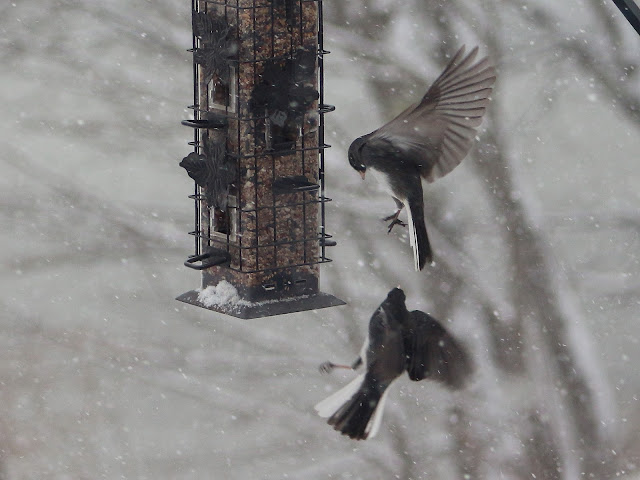
After having very few birds at the feeder recently, the Juncos - aka snowbirds - came out in force as soon as the snow started. 
Dark-eyed Juncos line up for their attempt at the feeder.

It may look like a blue-sky day, but this was before sunrise using artificial light.

These are not polite birds like the chickadees are; a dominant bird often jousts with the others to keep them away from the food.

Here they are in action:


I heard a pine siskin calling during a lull in the storm in the afternoon and looked out the window to see one perched on the feeder. I was impressed to see this little finch take on the flock of juncos for jurisdiction over the feeder. 

It confronted every junco that attempted to land including one persistent junco that wouldn't back down. 

Eventually the two of them came to a truce, each taking ownership of an opposite side of the feeder.


It was a busy week at the lake.  This morning, with almost two feet of new snow, the lake has filled up with frozen slush and the ring-necked ducks were nowhere to be seen.  I wonder if the timberdoodles' bills are long enough to probe down through a foot of snow to find their worms!
Sunday, March 23 - Winter's back.


Tuesday, March 19, 2024

March 17, 2024: Ice-Out

Ice out on Lake Wicwas was declared on Sunday March 17th when a boat could be launched at the ramp on Chemung Road and make its way through all the major passages and dock at each of the major coves in the lake.  The last area to clear was the channel southwest of Bryant Island, which is unusual.  Most often the last of the ice lingers in the protected end of Marion Cove or the south end of the lake near the boat ramp where the northwest wind tends to blow ice from the center of the lake.  

Ice-out on March 17th is one day later than the earliest ice-out date ever recorded, and combined with the late ice-in date of January 6th, gave us just 71 days of ice coverage.  Compared to the average ice cover over the past 20 years of 119 days, this doesn't bode well for water temperatures and cyanobacteria blooms this summer.  Ice-out on Lake Winnipesaukee was also called on March 17th.

View from Crockett's Ledge on March 16th.


Sunday, March 17, 2024

March 17: 2024: Mink on Thin Ice

It's a busy time of year with so much happening all at once as the world wakes up from its winter slumber.  One cold morning as I was enjoying the interesting patterns that formed on the lake over night, a flash of brown scooted onto the thin ice from shore and bounded across the lake right in front of me.  It was one of those lucky occasions when I had my camera in my hand.

Mink on the ice.
No problem with traction for those claws.

A mink doesn't worry about falling through thin ice - when it came to edge of the ice it just slipped into the water and continued on its way.


That was on Wednesday.  The day before was bright and windy and that took a big toll on the ice with the wind really breaking things up.  

The ice started breaking up on Monday.
Getting wider under the March sun on Tuesday.
The wind blew shreds of ice up over the transition point which glistened like diamonds in the sun.
By noon on Tuesday there were large expanses of open water.

By Saturday, most of winter's ice was gone with just one ice patch blocking the passage on the west site of Bryant Island.  It's possible ice-out will occur later today which would make it one of the earliest ice-out dates recorded.  

Many geese have now arrived and they're fighting over the best nesting sites in the marshes.  We've also seen bald eagles almost every day this week, both circling over the lake and sitting on the ice, perhaps feeding off things that were blown up onto the ice with the wind.

A couple of bald eagles survey the lake.  Are they looking for a nesting site?

In addition to annoying the Canada Geese endlessly, one afternoon an eagle flew right over me and landed in a tree, and had a heated argument with a red-bellied woodpecker that was not happy with its presence.  The two of them made quite the ruckus.  Here's a clip of the interaction - the eagle starts and ends, with the woodpecker calling out in the middle.  

This went on for quite some time.  Between the eagles, the geese, the mallards, and the red squirrels in the forest, it's been a noisy week.  Now we just need the wood frogs to join in.

The mergansers have also been plentiful this spring with a couple of different groups congregating on the lake.  I saw a few altercations of males chasing males, but mostly they seem well behaved as they figure out how to pair up for the mating season.

A couple of available female Common Mergansers.
And a male about to go...
under the ice for a fishing excursion.

I didn't realize that like Wood Ducks, Common Mergansers make their nests in tree cavities up to a mile away from water.  The female chooses the nesting site and builds the nest, and I believe the female also selects her mate, the one she finds most desirable after observing them all strut their stuff.  After mating, the male is done and leaves the child rearing to the mother.  I'd love to know how she gets a dozen little ducklings to travel a mile through a thick forest back to the lake.

The beavers also came around as soon as the ice opened up enough for them to swim along the shore line, and they are already building their scent mounds to mark their territory.  

I've also heard spring bird songs this week including the Song Sparrow and even a Carolina Wren (though that was a bit south of the Lakes Region, along the high banks of the Merrimack River in Concord) so the great migration is underway.  But this entry is long enough, so those will have to wait for another week.  

This is a great time to get outside to watch the world wake up and break into its triumphant return to life.  Just remember to wear your mud boots, and that tick season never ends - I've already found one deer tick - so take appropriate precautions.  

Mr. Mink won't be able to take short cuts across the lake any more, but for us, it's a time of renewal, rebirth, and rediscovery.

Blueberry buds, red and swelling with spring life.


Sunday, March 10, 2024

March 10, 2024: Weakening Winter

It's looking like Old Man Winter is getting tired early these days - I don't think he's going to hang on much longer.

Ice on Wicwas is deteriorating quickly.
Crockett's Ledge, March 8.

We had over an inch of rain on Wednesday night into Thursday which eroded all our snow except at higher elevations and well-shaded spots.  There are a few vestiges left over from ski season, but that's about it.

Just a couple of old ski tracks on the leaves.
It's a little better farther north in the mountains, but even there the snow is melting fast.  I went for a hike in Franconia Notch to see the streams in their late winter glory and there was snow, but the ice bridges across the streams had melted making stream crossings difficult, and in fact, I wasn't able to cross one of them and had to turn back, changing my plans for the hike.
Cascade Brook flowing down from Kinsman Pond and Lonesome Lake.

And that was Monday, before the rain and 50 degree temperatures.

I made my last ice thickness measurement on Wednesday morning after a cold night which firmed up the ice along the shore and allowed me to get out onto firm ice where I measured six inches of solid black ice under two and half inches of soft, porous ice you could cut with a spoon.  When the warm, moist air coming in with the rain hit the cold ice, the fog thickened.  

That white spot is where I cut a hole to measure the ice.

The rain puddled on the surface of the ice.

That would have made for some good skating.

On Friday I saw a fisherman at the boat ramp assessing the situation - he decided not to chance it, as by then the ice was starting to have that gray color that says it's really degrading.  

Looking pretty soft out there on Friday.

It's too early to predict ice out, but if this keeps up it will be another early one.  The earliest ice-out date we've recorded is March 18;  I doubt the ice will gone in just eight days, especially if we get more snow.  Fresh white snow lets the ice last longer as it insulates the ice and reflects the sun better than the darkening ice we have now.  Too bad the inch of wet snow that fell last night all melted into the wet, gray surface of the lake.

Not a very pretty Sunday morning.

Regarding the sun's rays, an interesting phenomenon observed this week was a sundog, where the sun's rays are refracted by ice crystals in the atmosphere, creating a rainbow effect.  The refraction at 22 degrees means sundogs always appear at a 22 degree angle from either side of the sun.  [Ref:  NOAA]  I always seem to see these right around the equinox which is less than two weeks away.

Sundog near sunset, March 8th.

I saw the first geese of the season on the lake this week as well as multiple flocks of ducks circling overhead looking for enough open water to land.  Snow is melting, ice is softening, tree buds are swelling, the snowdrops are blooming - all the signs of spring are here.  But as last night's snow reminds us, this is New England, and Old Man Winter has given us some surprises in the past, so I'm not counting him out just yet.

Snowdrops, March 3rd.


Sunday, March 3, 2024

March 3, 2024: While the Cat's Away

The squirrels will play. 


Our bobcat should have come by this week when the squirrels were here in abundance.  Focused on food and chasing each other away from their claimed food source, they might have been preoccupied enough to not notice a feline creeping up on them through the undergrowth.  

There seems to be a pecking order amongst gray squirrels.  The baddest dude gets to own the squirrel house where it can feast to its heart's content, protected from the elements.  

The king of the castle chases away anyone who attempts to breach the parapet.  


Meanwhile, the next biggest bully commandeers the hanging corn cob.

This number two in the chain of command thwarts all other lower-rung interlopers as well.
"Off you rascal!"

Lesser-ranked squirrels are left to scavenge from the dropped seeds under the feeders, which the white-breasted nuthatches ensure are plentiful, so no one actually goes hungry.

Even here, if one gets too close to the drop zone it gets chased away.


One new and interesting bird came briefly to the feeder this week:  a crossbill.  I didn't get a good look at it before it flew off to perch on a nearby tree, and from the backlit photos I can't tell which crossbill it is, but most likely it's a Red Crossbill.  


An expert ornithologist friend (thank you RB!) weighed in with some excellent guidance, but without a side view of its wings, it can't be positively identifed.  According the Cornell Lab of Ornithology, crossbills have evolved that peculiarly shaped bill to facilitate opening tightly closed cones: 

 "The Red Crossbill places the tips of its slightly open bill under a cone scale and bites down. The crossed tips of the bill push the scale up, exposing the seed inside." 

 Because of the crossed tips, biting down widens the gap between the tips.


Driving to the Page Pond Town Forest on Barnard Ridge Road, I saw that the pileated woodpeckers have been busy.

This woodpecker appears to be eating well.

You can't miss this tree if you approach the parking lot from the south.

The signs of frost season are everywhere now, including posted roads, tapped sugar maples, and frost-heaved ground such as on this trail at Page Pond.

Frost has heaved the ground up around this stone.

We are only three days into meteorological spring, but with so little cold this winter I expect the frost to come out early, as well as perhaps the ice in the lake.  Warm weather and rain this week may have done in the skiing, but it did create some great ice for skating.  I was able to make a complete circuit of the lake except for where the current flows down to the outlet.  There are still 11 inches of ice on the lake but there are many openings near shorelines with southern exposure or where water flows in, so be careful.  

On my skate I found Dean Cascadden on the lake sailing with his kitewing skate sail.

Dean with his Kitewing


He let me try it, and it's pretty neat.  It looks like a new toy will be on my wish list for next winter!


If we really get the warm stretch forecast for next week, those squirrels may be forced to find their own food as the feeders might need to come in for the season to avoid attracting bears.  It used to be the bears slept until April, but spring is coming early these days.  

Open water in February.