| Snowdrops, especially for you PP! |
| The geese are staking out their nesting sites. |
| The first wood duck of the year swims behind the geese. |
| Moss, green and photosynthesizing already. |
| Incoming! |
| Yellow! |
A somewhat random record of observations of what's happening around Lake Wicwas and the Lakes Region. I hope to post about once a week - your comments are welcomed.
| Snowdrops, especially for you PP! |
| The geese are staking out their nesting sites. |
| The first wood duck of the year swims behind the geese. |
| Moss, green and photosynthesizing already. |
| Incoming! |
| Yellow! |
I have been watching all winter for signs of river otters out playing in the snow and though I've seen some evidence of their presence around the lake, I didn't see the signs of them having fun out there until this week when a pair of them went across a marsh, all along the shoreline and up and down the banks of the shore where they could take a nice toboggan ride back down to the lake.
| Two sets of tracks show a pair of otters travelling together. |
They would take a few hops to get up some speed and then do a nice belly slide on the snow.
| Note the large tail dragging in the snow. |
The thin snow cover left some good imprints of their tracks.
Otters have partially webbed feet which helps their swimming abilities. They also have five well developed toes which can be seen in the prints above.In all I followed them for half a mile before they went out across the open lake where I lost the track on bare ice with the snow blown off.
| Travelling along the shore, |
| before heading to the open lake. |
Note the uniform 2 by 2 track pattern common to all members of the weasel family when they are moving along at a comfortable pace.
Several weeks ago someone sent me a link to a video of otters playing on a dock that was left in a lake last December. It's not our lake, but it sure could be and it's great example of just how much these animals love to play. You can watch it here.
Otters are rather secretive but I've had a few encounters with them in both summer and winter. Here, a group of four spent some time frolicking in the lake.
On another day a lone otter was as interested in me as I was in him.
They seem more curious than other members of the weasel family. A mink would be gone in a flash and a beaver would slap its tail and dive, though it then might swim back and forth at a safe distance waiting to access wherever it was going. Only an otter would stick its head up and watch me in my kayak.
It was a perfect late-winter day to be out tracking.
The somewhat erratic track pattern, far different from the precise track of a nimble predator like a fox or a bobcat, indicate this is a slower, more plodding type of animal; in this case, a skunk.
| Skunks, racoons, and porcupines don't have the perfect linear track of, for example, a fox. |
Like otters, skunks have fives toes, and if conditions are just right their toenails will leave a mark.
Skunks aren't true hibernators, but they do bed down for the winter, emerging from their dens in late winter to search for food and mates, and males can be quite aggressive fighting each other so they are rather bold this time of year - hikers and dog-walkers beware!
If you're looking for a nice spring excursion, the water is flowing strongly through the waterfalls in Shannon Brook at Castle in the Clouds.
| Two of the seven waterfalls on the Brook Walk Trail. |
I'll end with the moon setting behind a cloud bank on Thursday morning, three days before the equinox - spring starts today at 11:33am!
Well, it was revealed - for a couple of days anyway before yesterday's snow came along and buried it again, but still, it's another sign of spring coming.
I found this medium-size muskrat lodge in a marsh near Chemung Road after a few warm days melted away a lot of snow cover in areas exposed to the strong March sun - we're only a week away from the vernal equinox now. A muskrat family built this lodge over time in much the way beavers build a lodge, but they differ in their construction materials. Beaver lodges are built primarily of sticks and branches held together with mud from the bottom of the lake, while muskrats use mostly vegetation in their lodge. Both start as small mounds which are enlarged until they're well above the water level at which point they excavate their home from the inside. (Both beavers and muskrats are rodents.)
| Muskrat lodge in greener days. Lodges are built close to a plentiful supply of food sources. |
A muskrat lodge may start with only one or two rooms, but as the family grows the lodge is expanded and additional rooms added. The rooms are above the water level so they have dry living quarters, but the entrance is always under water to foil some predators, though mink are excellent swimmers and are the most tenacious predator of muskrats. Muskrats are active all year; their winter diet consists mostly of the roots of aquatic plants such at cattails, reeds, and arrowheads but they will also eat clams, mussels, snails, and other small animals. Maybe they'll find an appetite for Chinese mystery snails!
I don't often see muskrats but on occasion I'll find one swimming in the lake in the early morning. On one occasion, while riding my bike along the road, a startled muskrat ran in ditch beside me for a dozen yards before darting into the safety of a culvert. Unless there's a point of refence to judge its size - which is considerably smaller than a beaver - or I can clearly see its tail, I have a hard time discerning a muskrat from a beaver. But, as the name suggests, a muskrat has a thin, rat-like tail rather than the large paddle of a beaver's tail.
| The rat-like tail shows this is a muskrat. |
Poking around the muskrat lodge this week made it clear that the days of walking on the lake are coming to an end. There's open water at the shore line wherever the March sun warms a south-facing bank or where a stream runs into the lake.
| Anyone trekking onto the lakes now must know where the weak spots are. |
There's still 18" of ice in the center of the lake but that consists of only 8" of solid ice with 10" of soft, porous ice that's cut through with just 10 or 12 revolutions of the ice auger. The recent snowfall will make it even more treacherous to be on the ice - we already had one snowmobile go through the ice on Wicwas, requiring a rescue of the rider. (Thank you GP for the notification!) With a forecast of multiple days in the 40s and 50s for the coming week, my lake activities may be done until kayak season arrives.
| These gaps will soon enlarge enough to launch a kayak. |
| Turkey tracks at the freshly decorated muskrat lodge. |
We had been out in Steamboat Springs last week enjoying a week of Colorado snow, sun, and skiing. (Thanks for a great visit VP!)
| Plenty of snow at 10,000' in northwest Colorado. |
| A popular place along the Yampa River for Steamboat's predators. |
There's a wonderful boardwalk and Peace Pavilion built by the Steamboat Springs Rotary Club along the Yampa River. I'll close this week with an optimistic yet hopeful sign for today's world which stands at the pavilion.
Deep into a winter of not seeing many larger mammals out and about, this past Tuesday was an active day. First I caught a coyote running across the lake right at sunrise, taking the shortcut to its favorite hunting grounds - or perhaps returning to its den following an overnight mission of hunting mice.
| A coyote in the wide open at sunrise. |
It was pretty cold over night; if I were a coyote I would wait until the sun came up, but it's possible that father coyote is hunting both night and day now, as it's mating season. It's still a little early for giving birth, but the male coyote does all the hunting while the mother remains in the den during whelping and early raising of the new pups. I will add that I'm not 100 percent sure this was a coyote - it could have been a fox. I didn't have my telephoto lens on the camera so I didn't get a good picture of it as it trotted across the lake.
The fuzzy photo, thick winter fur, and pink morning sun affecting colors all add a degree of uncertainty, so I reached out to some of my colleagues (thank you!) and the consensus is coyote.
Two hours later, another furry quadruped took almost the exact same path across the lake.
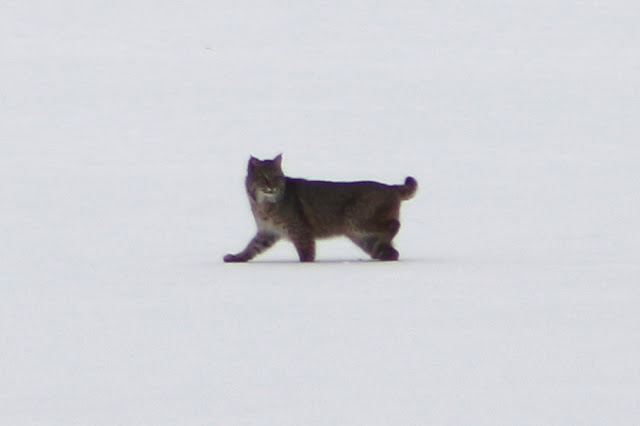
This time I was prepared, and was able to clearly see it was a bobcat.
I was able to watch it stride calmly across the lake for a while without it noting my presence.
But soon enough its keen senses picked up on the fact that it wasn't alone.| Caught me! |
Winter returned this week - after a brief glimpse of Spring on Monday when the temperatures rose to the mid 50s, climbing up to 58 on our thermometer. So that was the day I took a hike up Cannon Mountain in Franconia Notch, and while it was a beautiful day, sunny and calm, it still certainly looked like winter above 3500'.
| Kinsman Ridge Trail on Cannon Mountain. |
Even in that harsh environment there are a few hardy critters that eke out a living high above the notch. I found lots of tracks of snowshoe hares all along, even in the trail.
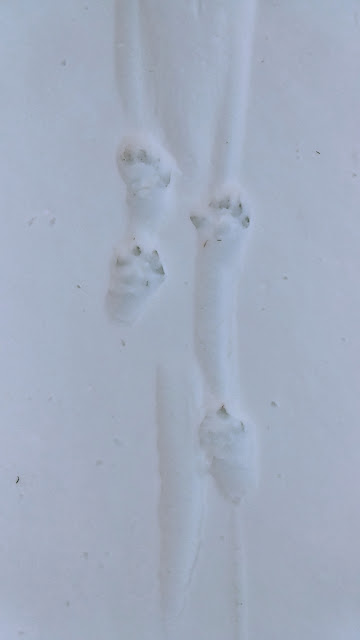
| Snowshoe Hare tracks dotted the landscape above 3700'. |
The snowshoe hare is a wonderfully adapted animal with large hind feet which let it hop along the snow giving it an advantage in escaping its pursuers which include fox, coyote, bobcat, and lynx. (I did see predator tracks near the hare tracks but I couldn't identify them.) These hares also have fur on the bottom of their feet to protect them from the cold. In the winter they sustain themselves by eating bark and twigs of trees. Another valuable trait, shared by other hares and rabbits, is having multiple litters per year, producing lots of offspring which balances their high attrition rate. Snowshoe hares are nocturnal, giving them an additional level of protection, though owls, another significant predator of hares, have also adapted to hunting in low light. And then there's the hare's heavy fur which changes color twice a year: white fur in the winter, mottled brown in the summer, both to blend in with their surroundings.
For all these reasons, I've never seen a snowshoe hare itself but have seen their tracks in many places, often near the summits of mountains including Cannon, Welch, Roberts, Whiteface, and Morgan. But they are present at lower elevations too, including around the lakes. I've seen their tracks in the Hamlin Forest on the Red and White Trails as well as right near downtown Meredith in Community Forest.
| Recent snowshoe hare tracks in Hamlin, February 5th. |
I also saw two bird species high up on the summit of Cannon: Common Redpolls, and a single Pine Grossbeak. I heard the redpolls before I saw them, just below the summit at an elevation of 3850'. I stopped to see what was chattering and soon saw a few redpolls in the stunted spruce trees. Then another group flew in. Then another dozen or so, starting to make quite a racket. They all took off together and circled around over me, and then another group joined in, and then another, and another joined the swirling flock, until there were at least 50 of them flying in ragged circles just above the tree tops before the entire flock spun off out of sight. I'm confident in my estimate of well over 50 based on my recent counting of goldfinches in the trees around our birdfeeders. I've counted up to 30, and when they took off, their flock was considerably smaller than this gang of redpolls.
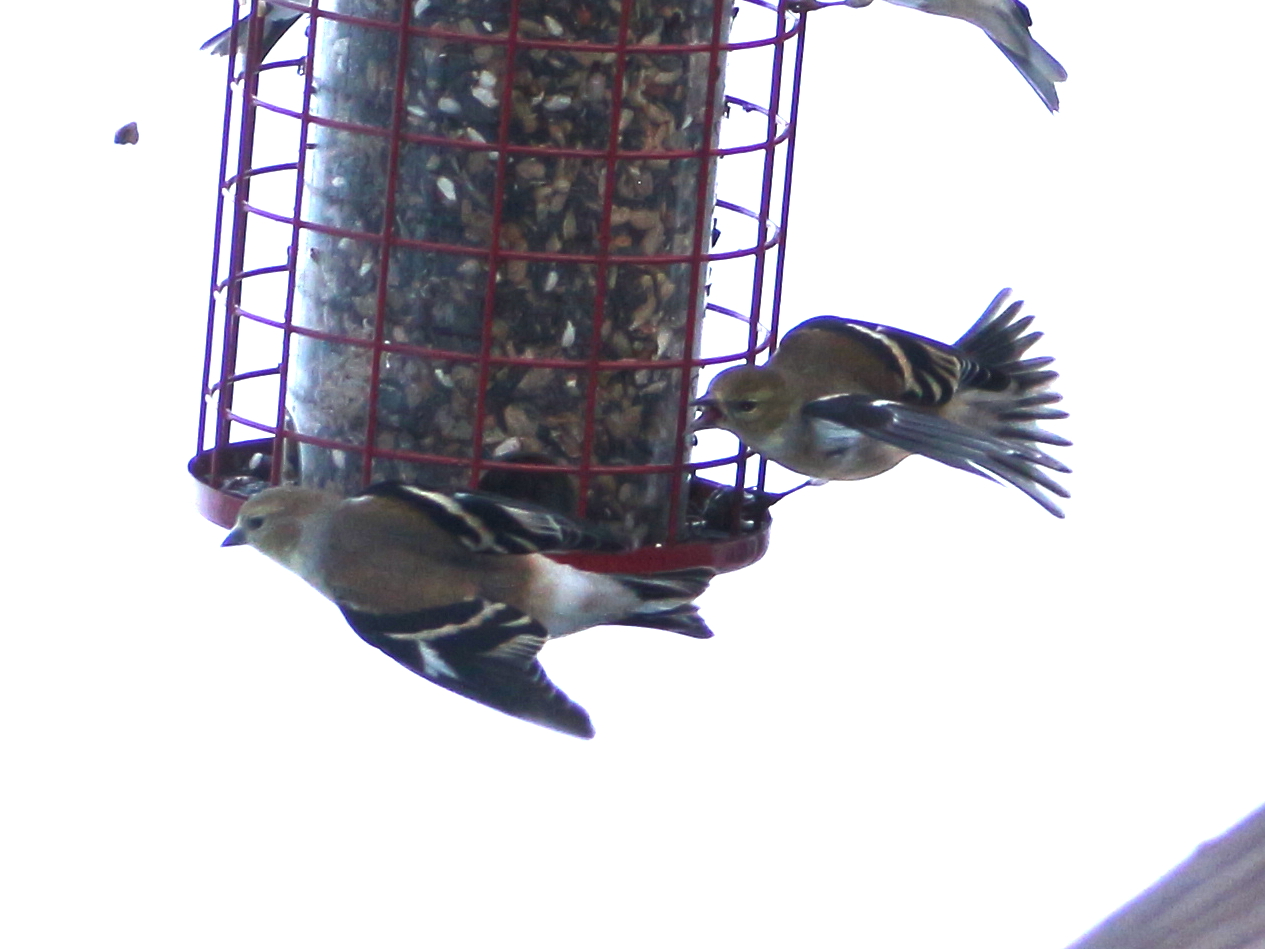
| Just a portion of our goldfinch flock, about 20 right there. Many more were perched in the branches of the oak trees. (Plus one dark-eyed junco waiting its turn on the feeder.) |
The single Pine Grossbeak I saw was even closer to the summit of the mountain, and acting so nonchalantly beside the trail that I first thought it was a Canada Jay looking for a handout. (Canada Jays are so bold they will come to land on your hand if you offer it with some trail mix.) But when I got a better look - and listen - I determined it was a pine grossbeak. I only had my phone with me, so this is the best picture I got (and no pictures of the fast moving redpolls).
| A pine grossbeak at 4000' on the summit of Cannon Mountain. |
It didn't have the rose or yellow coloring I would expect (leading me to the initial jay thought) but their coloration is quite variable and its distinctive song told me it was a grossbeak. I was also in the right habitat: subalpine spruce-fir forest.
We also had a different finch at our feeder this week, a house finch, our first of the year, but again, no pictures for you - it was here and gone in a minute. I have Linda's quick eye to thank for catching it.
On Superbowl Sunday I mentioned that owls were starting to mate, and the woodpeckers aren't far behind. I heard the back and forth rat-a-rat of two downy woodpeckers staking out their mating territory in the woods last week. One would bang away on a hard, dead, resonant snag to let all know he has claimed that piece of the woods, and as as soon as it stopped another bird far away answered back with its reply from his home turf. As long as the two birds keep their distance and each hears only a faint hammering, all will be well. But if one moves in too close to the other, there will be trouble.
| This downy woodpecker must be looking for food - I think he knows this is too small for a nest! |
With eight inches of sparkling light snow on Friday, winter is back. It's hard to remember that on Monday was 50 degrees with the streams flowing like spring.
| Spring melt runs into the Mill Brook on February 18th. |
| February 26th. Photo by Linda Powell. |
Scenery sure changes rapidly in a New Hampshire winter.