Sunday, July 4, 2021

July 4, 2021: Jimmy Gets his Dinner

Lots of loon stories to share this week.  As reported earlier, Coco hatched on June 26, probably early in the morning of National Chocolate Pudding day.  Linda thought she heard/saw something around the nest so we went out to take a peek, and sure enough, there was one little ball of coco floating on the lake.

Coco on June 26, probably just a few hours old.

And both parents were with her!

Who's watching the nest to keep those predators away?

  The second egg was left unguarded.


For much of the day both parents were out with Coco, enough so that we thought the second egg had been abandoned.  Dave Thorpe was keeping LPC biologist Jayden Jech appraised so on the following day she came out to mark the egg on one side.  The plan was to check the egg again after 24 hours and if the egg had not been repositioned it would mean it had in fact been abandoned.  Dave recounts what happed next:

I went out in the morning [of June 27th] with the expectation that the nest would still be empty and was very surprised to find an adult on the nest so left quickly.  When Jayden arrived we approached the nest from a significant distance.  As we were sitting there one chick came off the nest, soon followed by another.  They were will hidden in the grass so we had doubts about what we though we saw but this photo confirms it.

It's hard to see but there are two chicks right under the adult's beak.  Photo by Dave Thorpe.
 

The other adult was nearby and calling but did not come to the nest.  We left hoping that adult would come to the nest.  After a half hour or so we returned to find the nest empty, both adults together and both chicks with them, well out in the [cove].

Jimmy, just hatched on June 27, gets what may be his first meal.  Photo by Dave Thorpe.

Jayden collected all the egg fragments, some of which looked very fresh.  We think it is possible the second chick hatched while we were watching earlier in the day.


Dave and Jayden were kind enough to let Linda name the second chick as well, and she crowned him Jimmy, in honor of Ice Cream Cake day. (Do you detect a theme here?)

There had been a few glimpses of leg bands on the female that made us think it was the loon banded on Lake Pemigewasset in 2019, but Deb Crowley got the first positive confirmation that in fact, our long-standing female loon had been replaced.

These bands confirm this is the Pemi female.  Photo by Deb Crowley.

We consider ourselves most fortunate to have the nest so close that we see the family many times during the day.  Initially they stayed in the area of the nest, but each day they have explored a bit farther, coming right by our dock on Thursday.  On their trip by in the rain on Friday we experienced a feeding event, and with the drab sky reducing reflection off the water, both adults' leg bands were visible enough to know who was who, and Jimmy is enough smaller than Coco to be able tell the siblings apart when they're near each other.  Being able to see the bands under the water made this a really interesting experience.  I apologize if it hints at some sexist stereotypes, but I'm just reporting the facts!  Here's how the feeding unfolded:  First, dad brings home the bacon while Coco stretches his tiny wings.

The leg bands on both adults are visible under the water.


"Who's turn is it for this one?"

"It's Jimmy's"

"Here you are"


But Jimmy doesn't seem interested and lets it go.


Mom and dad search for it to collect it again.


But dad says "Hey, if you don't want it that's up to you", while mom tracks the fish down.

"I got it"

"Here Jimmy, try again"

He's still not interested.

"It's awful big mom"

But mom has more patience with the kids than dad and goes after the minnow a third time.


And presents it again.
"Come on Jimmy, you really need to eat your fish if you're going to grow big and strong."

"Open wide"

"OK mom"

Down the hatch head first, tail flapping in the rain.

"There you go Jimmy"

Mom watches carefully as he gags it down.


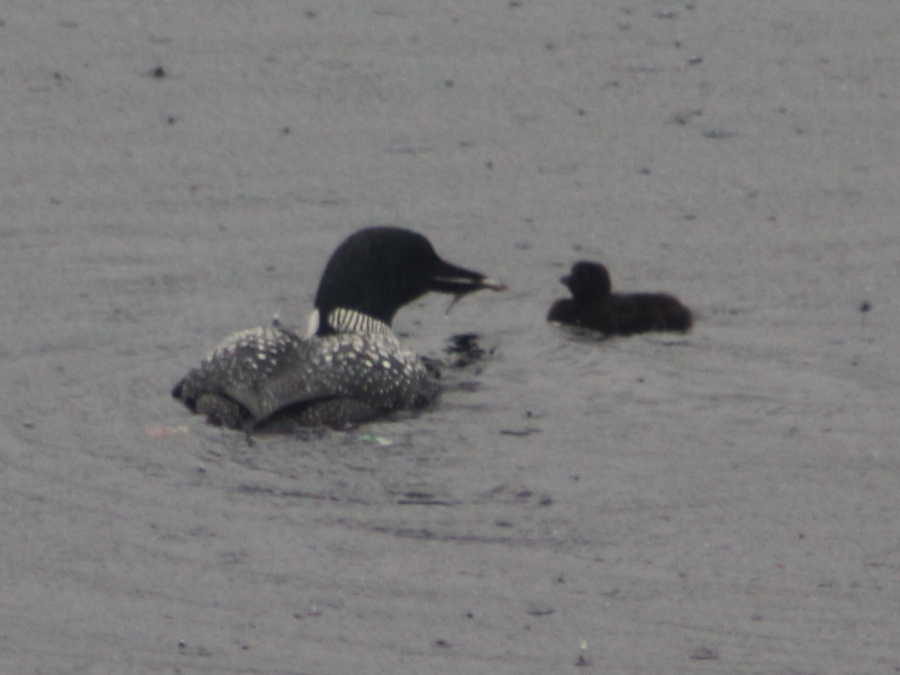
So through a team effort, little Jimmy ate his dinner.  Maybe it's just their agreed-to division of duties:  Mom supervises dinner while dad goes out to catch more food.  At any rate, the parents are keeping the kids very busy and Coco and Jimmy are are already watching their parents fish and are taking short dives of their own.

That's Coco going for a practice dive.

It's hard, tiring work being a loon chick.


Happy Independence Day!


Tuesday, June 29, 2021

June 29, 2021: Good News that can't Wait

This is too exciting to wait until the next regular entry, so here's a quick mid-week update:  We have a second chick!  After leaving the second egg alone on the nest for long periods of time, one of the parents returned and finished incubating it and it hatched on Sunday, June 26th, one day after the first chick hatched.  We now have two new members of Lake Wicwas, Coco and Jimmy:

Jimmy is on the left, Coco, just a bit larger, is on the right.

Possibly the first meal for little Jimmy.
Photo by Dave Thorpe.

More pictures and information to follow!

Sunday, June 27, 2021

June 27, 2021: A Moose in the Lake

Last week Claranne reported on a moose which, after swimming across the lake, climbed up onto land near Loon Point Road.  With her quick reaction she was able to get a picture for all of us to see it!

Our latest moose visitor after taking a dip in Lake Wicwas.
Photo by Claranne Bechtler.

Moose are such ungainly animals - look at the shape and angle of that hind leg - but what impressive creatures.  They are the largest animals in New Hampshire, easily weighing over 1000 pounds, and although the population in New England is suffering greatly due to the winter tics, they do still roam the Lakes Region.  

The warming climate means winter tics are not dying off in the winter and so are having a much greater impact on the moose.  Of course another huge factor in their decline is the loss of habitat.  Research has shown that moose can better survive winter tics when their population density is lower, but as their land is taken over by development they are forced into fewer and fewer tracts of land.  Moose need large areas of unfragmented land - they can't live in developed areas like deer - so deer have taken over from moose as the most common ungulate in the state.  According to NH Fish and Game, "prior to European settlement moose were more common than deer in New Hampshire".  You can learn more about moose on the NH Fish and Game website.

Over the years I've seen moose swimming in the lake, munching on aquatic vegetation in the marshes, and wandering among the young forest in the Eames Conservation Area.

A moose munches on aquatic vegetation in Harris Cove on Lake Wicwas early one morning.

Today I don't see as many signs of them as I used to, but if you hike on the White Trail (up to Arbutus Hill Pond in the Hamlin-Eames-Smyth Conservation Area) you can still find signs of moose having scraped bark off red maple trees - look for scars running up and down the trunk, about four to six feet above ground level.  

Healed-over scars from moose scraping trees near the White Trail in the Eames Conservation Area.

The Meredith Conservation Commission is currently working on a habitat cut along the White Trail, clearing an area that will allow young trees to grow back.  Moose consume leaves and aquatic vegetation during the summer but when the leaves are gone and the ponds and wetlands freeze over, moose use the tender bark of young trees as a food source to survive the winter.  The clearing will also provide habitat for a wide range of other animals that need young, successional forests to live, including many bird species such as the common yellowthroat and the chestnut-sided warbler.

Chestnut-sided warbler in a young maple forest.


While I'm on the subject of different habitats, the newly restored field at the Page Pond Conservation Area along Barnard Ridge Road appears to be the new nesting site of bobolinks.  

Bobolink in the field off Barnard Ridge Road.
Photo by Eileen Moore.

The bobolinks' arrival last week was noted by Squam Lakes Science Center Executive Director Iain MacLeod; he believes they were driven out of another field when it was mowed, destroying their nest.  They are displaying nesting behavior at Page Pond, so we're hoping they'll have a successful nesting here.  If you walk up the trail through the field you are likely to see them.  The field is a wonderfully different habitat than our many forests and is becoming home to a wide range of non-forest dwelling species.

Finally, our own nest of loons on Lake Wicwas is still being well tended to and we should be seeing new little chicks any day now - fingers are crossed!

Mom or dad loon heading back up for its shift on the nest.
Photo by Dave Thorpe.

Whether on land or water, large or small, there's always something to be seen around the lakes.


Just in, this late-breaking news:  We have a chick!

Introducing Coco.

She was first observed on June 26 by Linda Powell who has named our newest lake member Coco.  Sadly, it appears Coco isn't going to have a sibling as the second egg was left on the nest, intact, for reasons unknown.  Hopefully we'll have a long summer ahead of watching little Coco grow big and strong.  But please be extra careful on the lake for the next few weeks as Coco cannot dive to protect herself yet.  (No, we don't know that it's girl, but that's what Linda has decreed!  ; ) 
The proud new parents take Coca on its first tour of Lake Wicwas.

Sunday, June 20, 2021

June 20, 2021: Rocky Mountain Pelicans

On our final hike in steamboat springs last week we went up to find an abandoned uranium mine just east of steamboat. We weren't far up the trail when a flock of large birds came soaring up the west flank of the mountain from the Yampa valley.

A flock of large birds over the Yampa Valley, the Flattop Mountains are in the distance.

In the distance it was clear they were large with some white visible so my mind went to bald eagles, but I'd never seen eagles in a flock, let alone in formation. I lost sight of them as they dipped below the tree line but a few minutes later they circled up nearer to the ridge we were hiking and I got a better look - they were pelicans! 
American White Pelicans (Pelecanus erythrorhynchos)

I remember reading somewhere about pelicans in Colorado but didn't really believe it, and certainly never expected to see them. But there they were, undisputable pelicans; I wouldn't have believed it if I hadn't seen them with my own eyes.  Turning to my favorite bird resource, the Cornell Lab of Ornithology, I find that they migrate across much of America west of the Mississippi river on their way to breeding grounds primarily in Canada, but also in pockets of Colorado, Wyoming, and the Dakotas. So much for me thinking they are purely ocean birds - though the brown pelicans I see in South Carolina are strictly seacoast dwellers.


Back in new Hampshire we've had some perfect summer weather, simply ideal for a guided paddle around Lake Wicwas on Friday.  The Lakes Region Conservation Trust organized the paddle which was attended by an enthusiastic group of twelve kayakers and canoers who toured eight LRCT-protected easements as well as four protected by the town of Meredith.
A colorful group prepares to depart on a two-hour tour.

The paddle was organized and led by LRCT Land and Stewardship Director Dave Mallard and me.


New Hampshire is incredibly fortunate to have so many generous, forward-looking people who have seen the importance of protecting our water and land resources.  On the trip we saw loons, kingbirds, painted turtles, yellow warblers, tree swallows and even got a glimpse of the loon nest.  In the marshes we saw blue flags (wild iris) and rose pogonia blooming.  
Rose Pogonia (Pogonia ophioglossoides)

Blue Flag (Iris versicolor)


The iris are almost gone-by but the small and delicate rose pogonia will be in bloom for a while - look for both in dense, boggy wetlands.

We're still waiting for definitive confirmation of the female nesting loon as she's been quite protective of her leg bands.  I did confirm there are two eggs still in the nest, though it was a little concerning that the nest was unoccupied with only one parent nearby, nonchalantly preening near the nest.
Two eggs sit unattended.

There were no boats in the area and no indication of where the other loon was or why it left the nest.  Hopefully it just needed a quick dip to cool off.

There was another large flying creature that landed on the lake when we were away, but the quick eye of Debby Crowley caught the renegade as it came in for a landing.  
Landing on Wicwas.  Photo by Debby Crowley.


Debby reported that the loons did not appreciate the stranger on the lake, but they also apparently didn't run off to hide - maybe they were curious about this large, noisy intruder too.
 A loon checks out the unusual beast.  Photo by Debby Crowley.


While I'm sharing stories from outside the Lakes Region I want to share this fabulous picture a friend took of a red-tailed hawk sitting in the top of tree along the Marginal Way in Ogunquit Maine.
Red-tailed hawk (Buteo jamaicensis).  Photo by John Windyka.

  
Red-tailed hawks are very large birds, and with a wing span of almost five feet they are often mistaken as immature bald eagles.  Keep an eye on the sky for both of them which are present in the Lakes Region.  This is one of the best photos I've seen of a red-tailed, with the sun illuminating the tail from above and those steely eyes staring right down at the camera.  Thanks for sharing John, and thanks also to PC for sharpening up the photo!

Finally, happy Father's Day to my dad and all fathers - this is your day to enjoy and remember what joy you've brought to the world.  Here's one many-times over dad, who's hopefully about to become a new father once again:
The soon-to-be father enjoying some personal time on the lake before his life gets very busy.


Now this late breaking news:  Claranne B. just reported a moose swimming along the shore of Lake Wicwas!  It the stomped right up onto land and walked across Loon Point.  It's a rare treat to see a moose, and great to know they are roaming around the Lakes Region!

Sunday, June 13, 2021

June 13, 2021: Colorado Colors

I was away last week visiting family in Steamboat Springs, exploring the trails, lakes, flora and fauna of northwestern Colorado, marveling over the similarities and differences from New Hampshire.  Though the climate there is semi-arid and the elevation even in town is higher than the summit of Mount Washington, many of the same wildflowers we have in New Hampshire were blooming there, including lupine and columbine.  Then there are the different plants, some of which fascinate me by their ability to bloom with incredible beauty in such harsh environments.  My favorite on this trip's journeys was the glacier lily.

Glacier Lily (Erythronium Grandiflorum)

These flowers grow in the subalpine habitat and were first recorded in Idaho on June 16, 1806 by Meriwether Lewis during the Lewis and Clark expedition.  

Large fields of these delicate flowers were blooming at elevations of 10,000 feet in soil that was already extremely dry even though snow had only recently receded from their location and in fact was still present right beside them.

A field of glacier lilies - note the snow bank at the right side of the picture.

The sun is so intense and the air so dry that much of the snow sublimates before it can soak into the ground, and what does melt quickly evaporates, sometimes leaving interesting natural snow sculptures.  

A snow bridge across the trail.

It seems wherever I go I find myself drawn to a lake, even if I have to walk 13 miles to find it.  Long Lake is found at a elevation of 10,039' near the continental divide in the Routt National Forest in northwestern Colorado.  

Long Lake, Routt County, Colorado.

There was not much human activity here but people do hike all the way up to Long Lake to fish.  The lake, full from snow melt, was pouring out water into Fish Creek which was gushing and sending torrents over the falls farther down stream.

Lower Fish Creek Falls, only a few miles from its confluence with the Yampa River.

Full streams mean being creative at river crossings as they're deep and wide, requiring determination to forge ahead and attain your destination.  

A tight wire act across the upper reaches of Fish Creek.

It sure helps when you have an expert local guide!


Even though we were away from New Hampshire I was kept up to date on the loon activity here at Lake Wicwas as our faithful loon watchers made regular check-ins with the loon nest.  Dave Thorpe captured this great moment on the nest.

This loon may look upset, but it's just trying to cool off.  A nervous loon holds its head down, not up.

On another day Dave was able to get a picture which verified one of the pair is the banded male.  

That's our male on nest duty.  Photo by Dave Thorpe.

Just a reminder, these photos were taken from a far distance with a 400mm telephoto lens and then greatly enlarged.  Dave also got a glimpse of what may have been a green band which would indicate the original banded pair had rejoined after a tryst with the banded female from Lake Pemigewasset.  Perhaps that was the outcome from the lengthy loon battles we observed the prior week.  It might also explain why the other nest was abandoned:  the nest in that location was being built by the male when it was with the Pemi female.  Oh, the complicated, convoluted love life of loons.

At this point we're nearing the halfway point of incubation, and so far so good.  It's helpful that the temperature has moderated and the lake level has been stable - the Meredith Water Department has been proactive in managing the dam for us this year - many thanks to them.  

I'll bet they're relieved they don't have to hike up to 10,000 feet to manage the dam - yes Long Lake, even way up there, is controlled by a dam.

A couple of glacier lilies bloom in arid soil near the shore of Long Lake.