Sunday, November 21, 2010

November 21, 2010

The cold weather continues to bring winter closer, and with short days, the full moon set this week early in the morning.  This is a "blue moon" because it is the third full moon in a season that has four full moons, a relatively rare event.  Full moons this fall occurred on September 23, October 23, and will happen again on Dec 21, just before the winter solstice, thus fitting in four full moons between the equinox and the solstice.
Blue Moon Setting

Lake Wicwas north of Chemung Road
Last week ice was forming only in the most protected areas, but by this week there was ice in some of the smallest coves - the cove right beside Chemung Road had a skim of ice by Sunday morning.


Signs of the coming ski season are also visible.  From the White Mountain Ledge in the Hamlin area one can see the ski trails on Waterville Valley turning white.  In fact, if you look carefully you can make out the clouds of snow coming from the snow-making guns at the top of the Sunnyside Lift.  The curve of white is the top of the trail "True Grit" going down to the right and "Oblivion" down to the left.  With binoculars you can see the summit lift buildings, as well as the radio towers near the top of the High Country Lift on the summit to the left.  Mount Osceola is behind and to the right.
Mt. Tecumseh from the White Mountain Ledge

We saw more signs of rabbits around Lake Wicwas, (much to Linda's dismay).  This branch shows the tell-tale nibbling of a rabbit, cut clean at 45 degree angle, looking like it was cut by shears.  Deer make a more ragged cut, as they don't have upper and lower incisors to make a clean cut, so they tear and pull at the branches, leaving them ragged.
Rabbit Damage


On an afternoon walk I saw this large glacial erratic with a beautiful, healthy crop of lichen growing on its northwestern side.  If you're ever lost in the woods, this is supposed to be edible and somewhat nutritious.  I'm told is best to boil it to soften in up.
Glacial Erratic with Lichen


I haven't seen or heard any loons for a couple of weeks now, so they may have flown off for the winter.

Saturday, November 13, 2010

November 13, 2010

Lake Wicwas experienced both extremes of November this week:  cold, wet, windy weather early in the week, offset by fabulously warm, sunny, calm days with crystal blue skies on Friday and Saturday.  With very low humidity - dew points were in the teens - the temperature dropped into the twenties over night, and I saw the first skim of ice on Lake Wicwas in the protected marshes, with some wonderful shapes and patterns.
 As late as noontime the frost was still holding on in shaded areas even though the temperature was well into the fifties in the sun.  The combination of temperature and low humidity was just right to form ice crystals on the edges and the veins of dry leaves lying on the ground in a field that was exposed to radiational cooling.  Leaves just a few yards, leaves away under the cover of trees had no such crystals.

By early afternoon it was warm enough to go for a paddle.  It was so calm, and with not a single other boat on the lake, the entire lake was a mirror from shore to shore.   
I saw only a lone duck, and just one loon, though it took us some time to identify it, as it already had its winter colors.  All the boats are off the lake now, some shrink wrapped for their own form of winter hibernation.  All the docks have been pulled as well, excepting the three docks on the Henmor Properties….  The water is perfectly clear, and the lake level is back to within one or normal level;  the town has removed a board from the dam, and with water flowing rapidly the lake will soon be down to its winter level.
With not a lot of human activity around the lake this time of year, it is one of the best times to see uncommon animals, and on Friday we were treated to a visit by an ermine.  It spent several minutes searching all the holes around our yard where the mice, chipmunks, and squirrels might hide.  I was amazed at how quickly it could move; I thought a chipmunk or squirrel is fast, but this animal is in another league.  I’d be looking right at it, and it would just disappear, and reappear several yards away.  The ermine also had its winter coat on already – snow-white, with just a black tip on its tail, and a pink nose.  The long-tailed weasel has almost identical markings, but is quite a bit larger.  Based on its size, this was almost certainly an ermine.  It was far too quick and shy to get a good picture, but here are a couple of shots as evidence.
Ermine in Winter Coat
 I also saw a fair amount of new beaver cuts, mostly young saplings used for food more than construction.  They must be stepping up their activity to build their stores for the winter.

Sunday, November 7, 2010

November 7, 2010

Another sign that the cold weather is coming:  the animals are putting on their warm winter coats.  Here's a picture this week of the red fox, followed by what he (she?) looked like back in the middle of summer (August 8th):
Red Fox, October 30, 2010
Red Fox, August 8, 2010

In addition to lots of deer and moose droppings, there was this otter scat left right in the middle of a trail about 30 yards from Lake Wicwas.  Otter scat is distinguished by a very soft consistency, and a preponderance of fish scales.
River Otter Scat
Town of Meredith Ground Water Assessment Flag
If you've been on the trails around Lake Wicwas you may have noticed a lot of surveying flags.  According to Don Berry, president of the Lakes Region Conservation Trust, the town of Meredith is doing a ground water assessment, and these flags are part of the ongoing research.  They are going to be removed when the assessment is complete.


On the ridge on the red trail going towards the White Mountain Ledge in the Hamlin area, I saw pile of fresh wood chips on the ground, and looking up I saw the hole in a dead tree where the pileated woodpecker had been pursuing insects.  It wasn't the distinctive square hole one usually finds, but clearly the work of a pileated.  As I stopped to take a picture, I heard the bird hammering away at another tree nearby.  And then, a few minutes later while looking out over the White Mountain Ledge, I saw the bird take wing across the expanse to the north, flashing its distinctive white wing spots as it flew, and landed in white pine.

There has been lots of other bird activity this week, including Blue Jays, which have not been prevalent until the last couple of weeks.  I saw a group of seven migrating mallards, but I did not see any loons - has anyone seen them in the last week?


Finally, although the water is receding, it is still high and flooding lower lying areas around the lake.

Saturday, October 30, 2010

October 30, 2010


With another four inches of rain in the past week, Lake Wicwas is now higher than it was two weeks ago.  At the dam the water is four inches above the highest (12 inch) mark, a good 16 inches above full lake level.  All the low areas around the lake are flooded; the outlet is overflowing to its secondary paths.  It looks like spring, although it is still far from flooding Meredith Center Road, which is has done in the worst spring floods.


The few docks that are still in the lake are pretty much under water.

One of these docks lost one of its plastic floating devices, which I found in a marsh on the east side of the lake, and told the owner where to find it.  I had fun again exploring portions of the lake where one usually can't go, even in a kayak.  I flushed out a pair mallards and saw one loon on the lake.  Plus the two dozen geese....


The deer also reappeared this week, I saw them in the woods, as well as along the road eating acorns.  Although with deer season starting today (muzzle-loaders only - rifles starts Nov 10th) this may be last I see of them for a while.  We also found another sign of the fisher cat: a large scat, full of thick hair.  Much of the hair was still attached to the hide of the animal that gave up its life to this weasel.  It was a thick, sturdy hide that was not digested, evidence of a fairly large animal - perhaps a gray squirrel or a rabbit.
Fisher Cat Scat
Fur and Hide
 Walking near the lake we found the largest maple leaves (excluding the striped, or goosefoot maple) I've ever seen - this one is almost seven inches across, with a typical leave beside it.
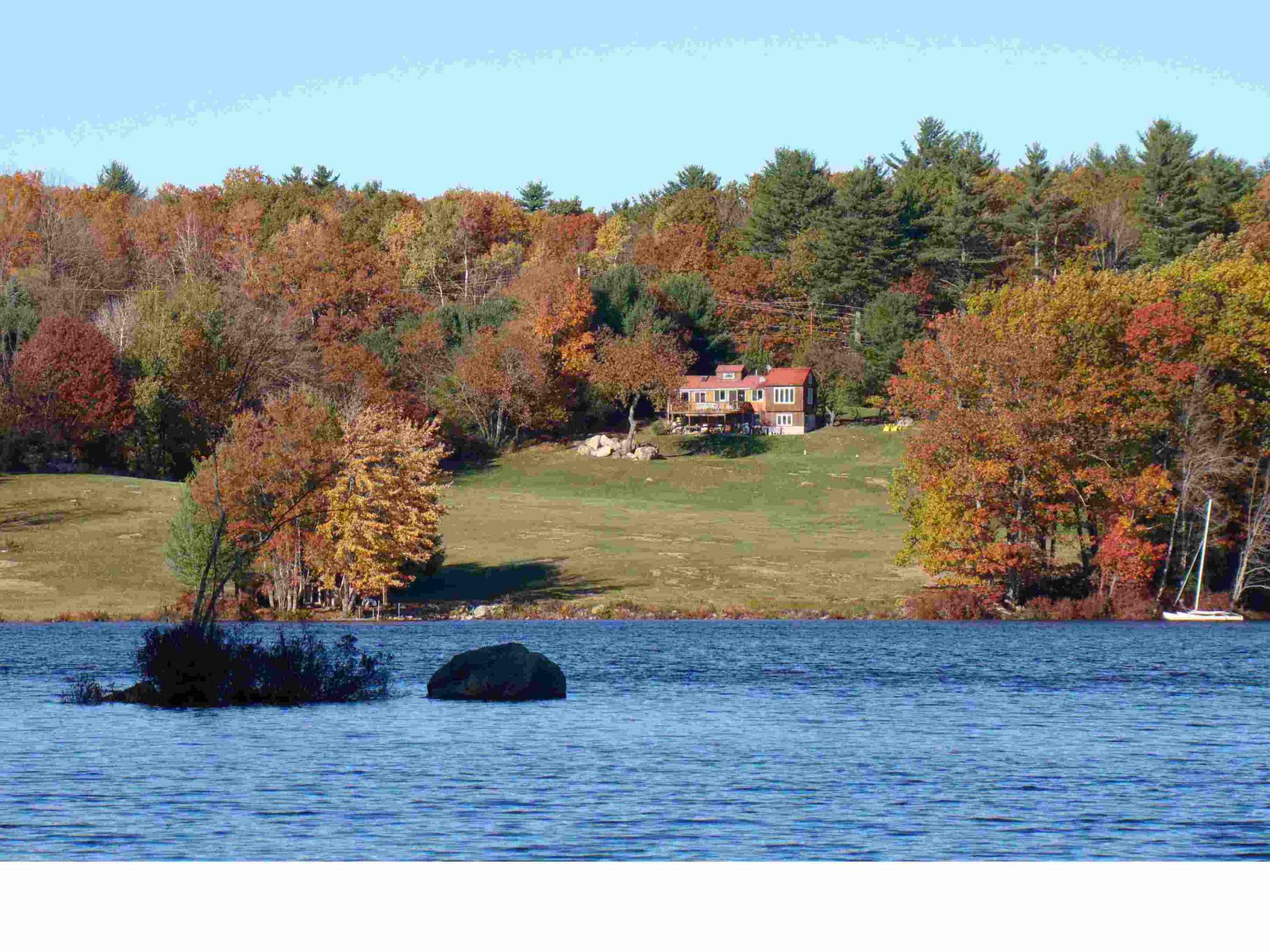
And foliage season is just about over in the lakes region.  There are still some nice burnt orange colors on the oaks, and a few yellows, but the end is near (Can you see the people on Crocket's Ledge?)

Sunday, October 24, 2010

October 24, 2010

 The big news on Lake Wicwas this week was a visit by a bald eagle.  At the start of the Lake Wicwas Association on Saturday morning, someone noticed a very large bird “swimming” across the lake just south of the inlet by Route 104.  It was using its wings to row itself towards shore.  When it reached shore and perched on a rock on the shoreline, it was clear it was an eagle – though an immature one, without the distinctive white head.

As it stood on the shore, water kept splashing up into the air around the bird.  We then realized it had a very large fish (sorry Chuck) in its talons.  The fish was large enough that its thrashing tail was hitting the lake and flipping streams of water into the air.  After few minutes, the eagle started to tear into its prey, enjoying its breakfast of fresh fish.  If anyone had other sightings of the eagle, please leave a comment.

There was also an immature eagle on the lake last fall, though a little earlier.  It visited for several weeks in early October.  I saw it on the lake several times, as well as once up on the White Mountain Ledge on the red trail.  These pictures were taken on October 4th; I added them since I wasn't able to get any pictures this year.
Bald Eagle - Oct 4, 2009


There was a killing frost this week (the temperature got down to 28.6F), and we had an early sign of winter on Friday: snow flakes in the air.  Not enough to even call it a flurry, but snow nonetheless.  The fall foliage continues to be spectacular.  The oaks are unusually bright this year, adding to the beaches to provide brilliant yellow expanses on the hills around the lake.  The view from Crocket’s Ledge on Sunday, with the deep hues on the wet day and with mist rising out of the hill across the lake, was particularly nice.  (Sorry, no camera when I’m running in the rain.)  But I did take some pictures of  a stand of yellow Beech trees in the lower story of a stand of White Pines.


I also took this picture the prior week, which is a just a classic autumn New England sight.


I was surprised to find a new batch of mushrooms sprouting this late in the year, but there they were, right next to a flooded area on the lake, which is still very high from the prior week's rain.

The wildlife know that hunting season is upon us;  I saw no deer or turkey this week, but I did see the loon on the lake.

Sunday, October 17, 2010

October 17, 2010

Fall has certainly arrived at Lake Wicwas, even though there hasn't been a hard frost yet.  The lowest temperature I've recorded is 32.9F;  we wonder how much the lake affects the air temperature close to the lake this time of year.  With lots of rain the past few days, the lake is now well above full level, showing +10 inches at the dam on Saturday.  Many of the low areas around the shore are flooded, and the water is rushing madly over the dam and on its was to Lake Winnesquam.

The foliage is still quite pretty, with the maples very colorful, and now the oaks starting to turn.  In the hardwood forests along the lake there were beautiful carpets of fresh maple leaves after the heavy rain and strong winds of the past few days.


After some windy days, Sunday was calm enough for a kayak tour, and the lake is so high I was able to navigate around an island through a channel that is usually impassable.  It appears the lily pads are gone, but in fact they are just a few inches under water, as the water rose faster than they were able to extend their stems.

Most of the ducks are gone now - I saw only two - but the geese are still here, all 26 or 27 of them.  

The young ones are now indistinguishable from the elders.
I didn't see the loons, but I expect they are still on the lake - it's too early for them to leave.  The trees on the hill on the west side of the lake are as nice as any fall, even with the dry weather this summer.

Sunday, October 3, 2010

October 3, 2010

We had tropical weather this past week, very warm and humid, and with several inches of rain, the lake is returning to it its normal level.  On Saturday it was back to +1” at the dam.  It is also nice to see the brooks flowing again.  There were some strong winds this week, but as the trees are just starting to change, the wind didn’t pull many leaves from the trees.  There is only partial color on the hills around Lake Wicwas, with peak color a good week away, but some of the smaller maples along the shore are brilliant against the dark green background.


On one warm, muggy night I went for a walk; it was so dark with the heavy cloud cover that I used an LED headlight to light the way.  It was eerie to be walking on a warm, summer-like evening, but without the summer sounds.  There are no crickets, peepers or bullfrogs making their usual nocturnal sounds this late in the year.  I was surprised to see bright light emanating from the rocks in the stone walls.  At first I thought it was fluorescence from minerals in the granite, but further investigation proved it to be emanating from lichen on the rocks.


Lichen is dual organism, formed by a symbiotic relationship between a fungus and a colony of cyanobacteria (blue-green algae, the same algae that is found in the lake during the summer).  In lichen, the fungus surrounds the algae, and absorbs water and minerals from the substrate, in this case, granite.  The algae in turn provide carbohydrates that they produce from photosynthesis.  It is the pigments in the algae that have the photonic properties that allow it to absorb light at one wavelength and emit it at another wavelength that the eye can see.  Pictures don’t do it justice – you’ll have to try it for yourself.

 And then, this weekend, fall arrived.  Temperatures were in the mid-thirties over night, and the sky was clear blue after the morning mist lifted. 

The loons are still here – I saw several on the lake – and found lots of ducks and turtles as well.  The chipmunks are getting pretty fat, and running everywhere collecting food for their winter stores.