Spring, sunshine, warm temps, strong winds - it all adds up to tree-pollen season, and it seems to be a good one, though if you suffer from spring allergies, you already know that. The primary culprits shedding pollen right now are oak, birch, and ash - the early-bird red maples have already gone to seed.
 |
| These red maple helicopters will soon be twirling their seeds down to earth. |
It's the birch and oak that are shedding their pollen now.
 |
| There's a lot of pollen in those oak flowers. |
There's not much we can do but wait for the rain to come along and wash all that pollen out of the air.
While we're talking about trees, I want to show a huge bittersweet vine (tree?) I saw over at the Meredith Community Forest while doing some conservation property monitoring work.
 |
| A massive bittersweet vine. |
This is Oriental bittersweet, a woody vine that was introduced here from China as an ornamental plant, which it is - they are beautiful in the fall with their showy red and yellow berries. But being non-native, they have no natural controls on their growth and expansion, so they will take over very large areas of field and forest. Being a vine they are most often found as smaller plants spiraling up around a tree trunk, as this plant initially did. But as bittersweet grows, the vine will strangle the supporting plant. After it killed its initial host tree this one encountered another bittersweet vine and the two of them decided to team up and dance with each other (prior photo).
 |
| The vine's first host is lying dead on the ground. |
I have never seen bittersweet this large before; it would be interesting to count its growth rings to age it.
Moving on to animal life, in addition to the loon mating drama of last week, we now have duck drama as well. We've had a pair of mallards take up residence in Marion Cove this spring - they are always here, sometimes up on land eating acorns or other plants - and on occasion they've had to usher other ducks away from "their" cove. But this week it appears another male came in and had a fancy for our female. There were several moments of total chaos with wings flapping, water flying, and beaks quacking as three ducks engaged in some kind of battle of dominance.

All three kind of flew-swam-tumbled down along the shore out of sight.
 |
| Mrs. Mallard got into the action too. |
Then a few minutes later two males came steaming back down along the shoreline in tight formation, one right on the aft quarter of the other, escorting it back to international waters. I saw this take place once again but I have no idea how times they went by that I didn't see. I'm guessing the challenger kept coming back to try and steal the other's bride and had to be repeatedly driven off. Regardless of the results of paternity testing we're hoping we'll get to see little ducklings in a few more weeks!
Another bird observed on the lake this week was possibly the source of a lot of very traumatic loon calling.
 |
| An immature bald eagle. |
This bald eagle flew low over the lake then rose up and landed high in a pine tree right at the water's edge where it would have an eagle-eye view of all the action.

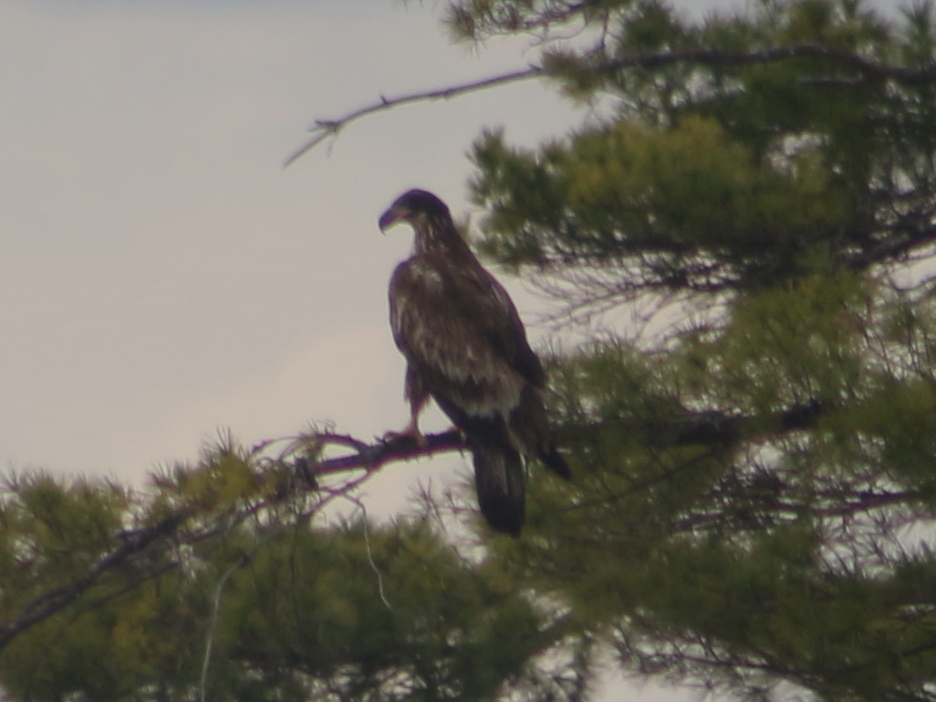 |
| A bald eagle's head and tail won't become white until 3 to 5 years of age. |
Even without chicks in tow I expect the loons don't like to see that watching over them.
Two weeks ago I mentioned that trillium were blooming in Canterbury, and earlier this week I saw my first in the Lakes Region; it's a compelling reason to get out on the wooded trails and find one of these beautiful flowers.
 |
| Painted Trillium (Trillium undulatum) |
While you're out there look for the many other early wildflowers blooming now including goldthreads, violets, and the just-now-emerging fringed polygala. Hopefully you'll be able to find them through the blurry vision of teary, watery, pollen-triggered eyes.