Showing posts with label Goldeneye. Show all posts

Sunday, November 27, 2022

November 27, 2022: A Gaggle of Goldeneye

There were a lot of feathered creatures out celebrating Thanksgiving this week:  woodpeckers, goldeneyes, mallards, geese - but none that I saw were turkeys.  Of these, the most interesting to watch was the pileated woodpecker.  It caught my eye as it flew, the flashes of white in its wings divulging its identity, and it was easy to follow it to its destination on an oak tree with a promising rotten spot on a large branch.  

This branch caught the pileated's trained eye.

It hopped up on the branch and listened for signs of life inside the decaying wood.

The red stripe on the cheek indicates this is a male.  Females have a black stripe.

He apparently found what he was looking for and pinpointed the exact spot to attack.

Right there, in that little gap surrounded by lichen.

He began his assault, chopping at the branch with long strokes of his powerful neck, up and down, up and down.  First he broke through the bark, making a small mark on the branch.

Woodpeckers use their strong tail as a third contact point to brace against as they drive their chisel into the wood.  This video, though blurry and out of focus, at least shows the force a pileated can apply to its work.  Note how he keeps his tail pressed against the tree, and stops to listen now and then:

As he worked, the hole enlarged and deepened.

Soon he broke through the outer wood and opened up a pathway to the insects' home inside, most likely a nest of carpenter ants, at which point he simply stuck his beak in the hole, pushing his sticky, barbed tongue into the nest - a pileated can extend its tongue out two inches - pulling out ant after ant, and maybe some eggs too.  

He sat for long time feasting on the high protein food inside.  

The whole process, from when he landed to when he got his first morsel took just five minutes.  Here's a video of him reaping the fruits of his labor.


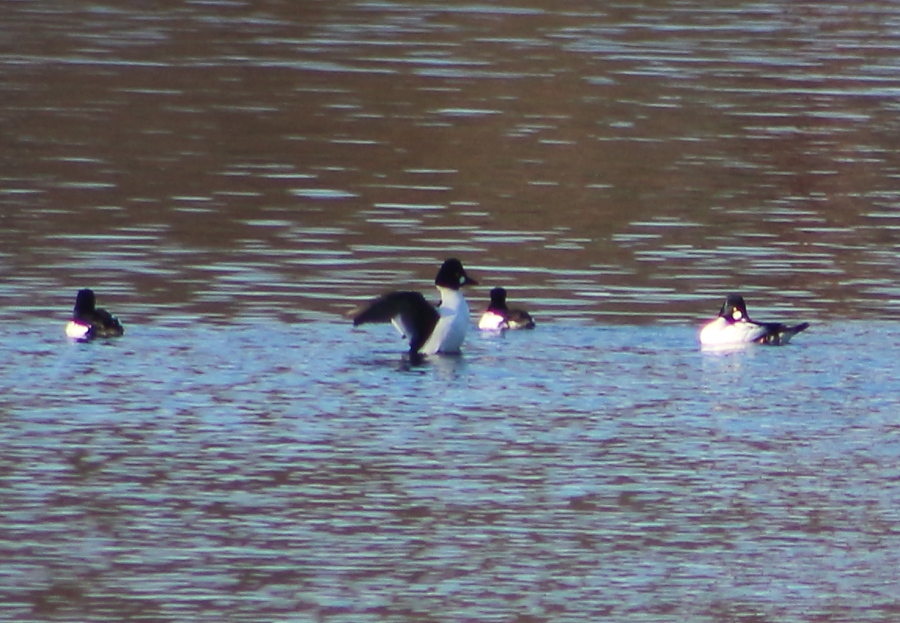
The next bird encounter came on Thursday morning when we took a walk along the WOW Trail between Laconia and Lakeport to rev up our appetite for Thanksgiving dinner.  There in Opechee Bay was a huge gaggle of goldeneyes that had gathered for their own Thanksgiving celebration - over 30 of them.

Goldeneyes, thankful for making it unscathed through the first half of hunting season.
For some reason, there was one lone hooded merganser leading the flock.
Or perhaps being chased by the flock?
I've seen large gaggles of goldeneyes on Lake Waukewan as well, but only small groups on Wicwas - it must be too small a water body for large family gatherings.  These are pretty little ducks with their white cheeks and bright golden eyes.


There were also a few mallards in the bay.
Mrs. Mallard stretches her wings.


Lastly, I'll share some pictures of needle ice that I found on a run up to the White Mountain Ledge in the Hamlin Town Forest.  I keep my eye out for this on the first cold days of the year, but these were easy to find as they were right in the middle of the trail.  
Needle ice on the Red Trail leading to the White Mountain Ledge
Needle ice forms when the earth is wet and still warm, but the air gets cold so water on the surface of the ground freezes.  As water in the soil is cooled from above, it freezes onto the bottom of the ice crystal, and the needle grows skyward.

The intersection of water and cold always fascinates me. 


Sunday, March 27, 2016

March 27, 2016

Last week I noted our Wood Duck pair had returned to establish its nest near the lake.  This week we watched as they had to fend off a small flock of would-be home-seekers that thought Wicwas looked like a nice place to raise a family. 
An intruding group of Wood Ducks exploring Lake Wicwas
But our local pair came down to defend their turf.
Our ducks standing their ground
There was a stand off, but after a bit of non-verbal communication (see the male pecking at the water) they were able to convince the visitors that this cove had been claimed.  Click here to watch video.  (I had to upload the videos to youtube to keep the resolution from being really bad - even there it's not great.)

The intruders did make a couple more approaches with the same result;  they ultimately gave up.
On the retreat

Earlier we had the unusual sight of a duck walking around in tree branches.
A duck in a tree?

It was Mrs. Woody, waiting patiently while Mr. Woody prepared the nest, probably working on enlarging a cavity in a rotten tree.  Wood ducks have claws on their feet - unusual for ducks - that let them climb around in the trees.  Mrs. Woody sat and watched patiently from her perch on the branch.
Waiting for her home to be ready

Hopefully we'll have little woodies in a few weeks;  these are truly stunning birds.
Female Wood Duck


This wasn't the only display of duck mating behavior this week - perhaps the earlier ice-out means we are seeing more mating activity than usual.  We witnessed a group of male Hooded Mergansers trying to win over a sole female by impressing them with their beauty and strength.

It began with some preening and head-bobbing while the female watched from under a hemlock tree - you'll see her dive and then swim back out to watch the antics.  Click here to watch video.

Then they went on to chasing each other and circling around the none-too amused female.  Click here to watch video. And a second.

As time went on the behavior escalated in more aggressive tactics.  Click to watch.

Until finally she decided she'd had enough and flew off with the whole bunch in hot pursuit.  Click to watch.

It must be frustrating when there aren't enough mates for all, but just like the deer and many other species, it ensures propagation of a strong gene pool.

The last of the bird feeders have now been taken in to ensure the bears don't learn to associate with humans.  It took the downy woodpecker's long beak to extract the final few seeds that the chickadees and nuthatches couldn't reach.
A downy woodpecker cleans out the last of the seeds


Soon enough, humming birds will swap places with the winter flocks, as they coax the sweet nectar from the bounty of Linda's summer flowers that will supplant the seed-feeders on the posts! 

Finally, we had a rare but special visitor to Lake Wicwas this week: a pair of the aptly-named Goldeneye.  These fabulous birds were stopping here for a short rest and a meal on their way to breeding grounds in northern New England or Canada.

Female Common Goldeneye (Bucephala clangula)
Male Common Goldeneye

A week like this with so much activity causes me to reflect on the amazing range of animals that this precious habitat attracts and supports.  And to remember the many generous people over the years who have worked so hard to protect this unspoiled spot in our ever-developing world.