Sunday, November 22, 2020

November 22, 2020: An Avian Love Triangle

It had been a quiet week on the lake until yesterday, when on a morning walk mother nature presented me with one wonder after another.  The most dramatic was the interaction of three Hooded Mergansers: two males in a lengthy encounter over a single female.

A trio of Hooded Mergansers

When I first saw them, the two males were circling around each other with the female some distance away.


It didn't take long before the action started, with one of the males swimming aggressively at the other.


I would assume the aggressor is the current mate of the female, trying to force off a would-be courter of his girl, but there's no way to be sure.  Un-mated mergansers will pair up in the fall and stay together through the winter months.  

After a few surface attacks, the fight became more animated and resulted in airborne maneuvers.  


The flight was short, with both of them circling back toward the object of their affection.

That swoop in the water shows their flight path.

But as they got close to her the battle was on again with one turning to push the other away.

This cycle repeated several times.  


After each foray they made their way back towards the female.  It makes me wonder what she is thinking.  Is she flattered?  Is she watching to see if she wants to pick a new mate?  Or is she just appalled by the whole ordeal?

She doesn't seem to be paying any attention to their antics.
Just looking away.

At any rate, after a stretch of this behavior, she either got fed up with it or decided that the distraction of one of their fights was a good time to take off and make her escape.

Watching, waiting for the right moment to make her exit.

In the foreground of the next photo you can see the wake from where she took off in the opposite direction just before the guys landed:


But she didn't get far - both males were immediately off in hot pursuit.

Running on the water for take-off.

Airborne!

It didn't take long for them to catch up to her.

And with that, they were gone, sure to continue their challenge elsewhere on the lake.  We'll never know who was threatening and who was defending, but it was fascinating to watch the competitive forces of nature in action.


Farther along my walk I saw, way far out in the lake, what I thought was my first loon sighting in many days.  It's behavior told me it had caught a large fish, too large to swallow alive, and the loon was playing with it, tiring it out enough to swallow it.  A picture in the low light was just good enough to show this was in fact the case, and a little flash of orange indicates the bird was going to  have sunfish for breakfast.

It's an awful photo, but you can see how big the fish is.
It also looks as though it may be a merganser rather than a loon, but it's too grainy to be sure.  It seems like all our resident loons are now gone.

A few other observations from my walk:  First, the Witch Hazel have started to bloom.

A witch hazel blossom

This is the only plant I know of that blossoms in late fall, almost winter.

Second, the Hobblebush buds for next spring are already in place.
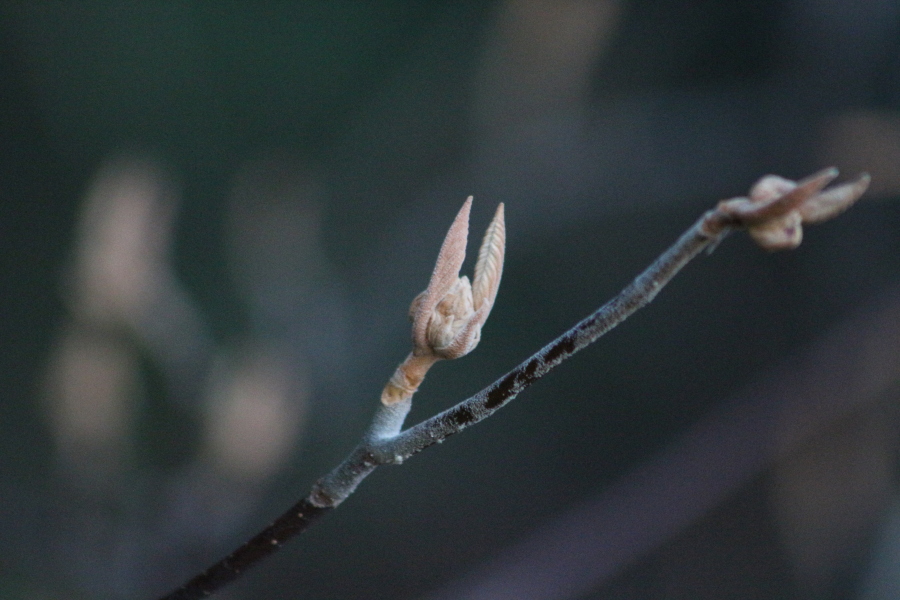
Next year's hobblebush viburnum.

Another unusual plant behavior: putting out buds in the fall.  Both of these have stories behind them, but they will have to wait for another day.

And finally, frost on the goldenrod.

Frosty goldenrod.

Even in November there's something new to see.


Sunday, November 15, 2020

November 15, 2020: It's November

Well, it had to happen sometime.  The nice da capo back to early fall was great while it lasted, but alas, reality has returned.  I even had to change the journal banner photo from fall foliage to November drab.  But wasn't that warm, calm, summer reprieve wonderful?


One benefit of drab November with no leaves on the trees is improved visibility through the forest and all the sights that become newly available.  Linda took advantage of that one morning when she spotted a barred owl that might have been hidden from sight a few weeks ago.

A barred owl watches me carefully.

I didn't realize it actually had its back to us until it turned its head around.

Now it's facing forward.

That neck rotation always amazes me.  I'll bet the owls also appreciate the better sight lines when spinning their heads around in search of prey. 

This particular bird was being harassed by a flock of blue jays which were scolding loudly, encouraging it to move along, and it did so, flying a few dozen yards at a time, perching in different trees on the way.  I doubt that a large owl is endangered by the much smaller jays, but the racket they make alerts every potential food source within earshot to take cover, so the owl might as well move on to a place where it can hunt in peace.

Last week I mentioned that we took a walk in the Kelley-Drake Conservation Area in New Hampton.  Along the margin between one of the fields and the forest I noticed a very interesting moss, one I didn't recognize.

Running Clubmoss (Lycopodium clavatum)

I had never seen a moss that grew like this and it took me a little time to track it down.  The unusual attribute was long trailing stems that ran along the ground - some over a foot long - which ended up being the trait that led me to its identification.

It turns out this is not a moss, but is in the family of "fern-allies", being more closely related to ferns than to mosses.  Way back in September 2015 I wrote about another clubmoss, the Tree Clubmoss, so I really should have recognized this relative.  

Running Clubmoss grows throughout much of North America, thriving in both moist and damp conditions.  As with mosses and lichens, running clubmoss reproduces via spores rather than seeds, and the spores are highly flammable.  In the early days of photography its spores were used by photographers as flash powder.  [Ref:  borealforest.org]  I once tried to ignite spores from a club moss, but wasn't successful.

Its spores have been used for many purposes over the centuries, including by Native Americans for treatment of eczema and chafed skin [ibid] which is interesting considering that the plant contains lycopodine (thus its scientific name) which is poisonous because it paralyzes motor nerves.  [Ref:  Plants for a Future]  Another feature of clubmosses, especially appreciated this time of year, is that it's an evergreen, and so provides a bit of color in the drab of November.

A bit of color among November's browns and grays.

Those warm sunny days this week may be the last we'll see for a long time, but every season, even drab November, brings it's own special beauty.

Jack Frost made a visit to the lake last night.

Maybe skating season is next.


Sunday, November 8, 2020

November 8, 2020: A November Day on Waukewan

It didn't feel much like November, but yesterday sure seemed like a perfect day to be on the water.  So I loaded up the kayak and took a paddle around Lake Waukewan.  It was a brilliant day:  bright, warm, a moderate southwest wind, and almost no one out on the lake beside the birds.

Chapman Island in Lake Waukewan

There were several flocks of Common Goldeneye on Waukewan, and they'd fly around from cove to cove searching for the best fishing spots.  They make the most interesting whistle when they fly, and between that and their conspicuous white and black coloring, they are easy to identify even from a distance.

Common Goldeneye in flight.
The gold eye and white face patch are distinguishing too.

I also saw three single loons (I couldn't tell if they were juveniles or adults), a few Common Mergansers, and several pairs of mallards.

Three Common Mergansers huddle under the Goldeneyes' flight path.

After circling the lake I paddled down the canal all the way to Main Street and Frog Rock Tavern.

The end of the canal before it goes under Main Street and on to the Mill Falls.

The Waukewan canal is quite a wonder of construction for circa 1818.

The 0.2 mile canal is lined with granite and has lasted 200 years.


Houses on Water Street (left) and High Street (right) line the canal

There was a slow but noticeable current in the canal.


On Friday, another fabulous November Day, Linda and I visited a very close-by conservation area we hadn't been to before, the Kelley-Drake Conservation Area in New Hampton.  

Lake Pemigewasset from the Kelly-Drake Conservation Area.

This is a beautiful piece of protected land that abuts the western shore of Lake Pemigewasset, less than two miles from Lake Wicwas.  We walked three miles of trails and the first stop was at the homestead of the very first settlers in New Hampton, arriving in 1775 and spending the first winter in a tent before developing their homestead.


One of several cellar holes.

The Lake Trail took us to the shore of Lake Pemigewasset; the Ridge Trail brought us through a tremendous stand of mature hemlock and pine - not old growth of course, because everything around here was cut at least once, but still very impressive trees.  There are also wonderful fields around the homestead that are being maintained, full of wildflowers and very old apples trees.


Milkweed seed pod

Add in a visit to the Drake Cemetery, and you can easily spend a couple of hours and walk three or four miles if you're so inclined.  I highly recommend a visit if you haven't been there yet.


Back at Lake Wicwas I've only seen mallards and wood ducks migrating so far, and I haven't seen the loons since before last week's snow.  We'll keep a watch out.  I did see the deer family come to visit again early one morning, but this time they were heading right into Linda's garden, and that's about the only time it isn't fun to have deer around.  Fortunately the local deer are not acclimated to humans and the slightest motion sends them prancing on their way back to the safety of the forest!

Mom and junior first.

With the straggler hurrying to catch up.

I still love to see them!

Sunday, November 1, 2020

November 1, 2020: Needle Ice

After seeing signs of deer last week, I decided to set my trail camera up in that area to see if they would return so I could see who's out there - and return they did.  In fact, every night the camera was out one or more deer came by.

This buck has a few points on its antlers.

Most often it was late at night, between midnight and 2:00am, but once early in the evening at 6:30pm, and never during daylight hours.  There were does and a buck, and one of the does appears to be particularly well fed!

Look at that belly!

I know there are a lot of deer in New Hampshire, an estimated 100,000 according to NH Fish and Game, but it's still nice to see them in the area and looking healthy.


Saturday morning was the coldest day so far of this fall season, down to 26 degrees, and I was surprised to see the first ice on Lake Wicwas.  It was a calm night so the surface cooled down enough for a thin ice skim to form in sheltered areas.

The marsh right along Chemung Rd.

Morning reflections show how calm it is.

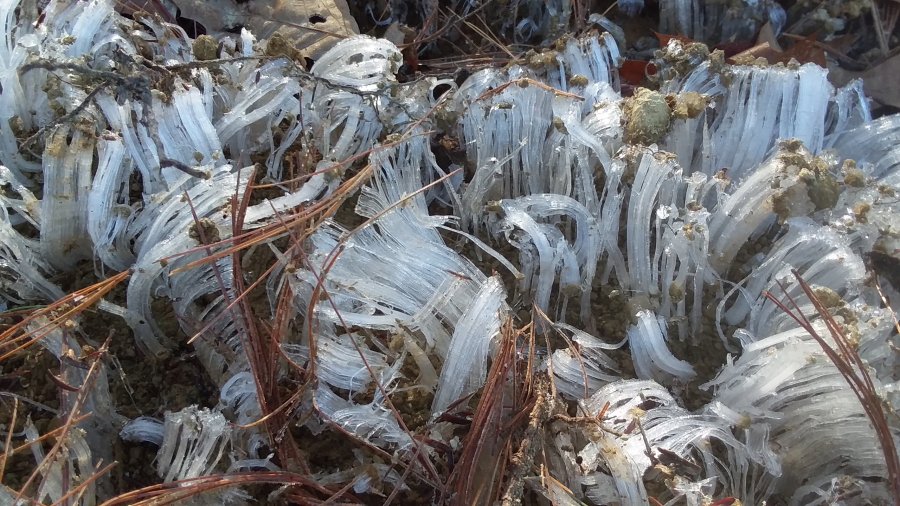
Arriving right after the recent precipitation (we had lots of rain this week, but only got about an inch of snow on the Friday storm) the cold temperature also spawned some of the coolest ice formations in nature, ones that I don't get to see every year:  Needle Ice.

Twisted, twirling ice crystals extruded from the ground.

These tiny, delicate growths occur when the soil is warm and has lots of moisture, but cold night temperatures rapidly chill small stones on the surface which in turn conduct heat out of the ground below them.

Thin and delicate, the slightest touch sends them crumbling to bits.

As heat from the soil is transferred to the stone, the moisture in the soil is cooled to the freezing point, allowing an ice crystal to form.  As more heat is pulled out of the ground the crystal grows, extruding itself skyward, sometimes as much as two or three inches.

A tiny stone or grain of sand sits atop each column of ice.

I'm always fascinated by these and can spend a long time with my nose to the ground studying them.

I wish I had a camera with me rather than my phone.
You can read more about needle ice at the Northern Woodlands website.

There were lots of ducks on the lake during the rainy days that provided the water for those crystals, including this group of mergansers.

A couple of female common mergansers enjoy a good day for ducks.

While they were here an eagle flew in and perched high overhead in a pine tree, watching down on them.


Would an eagle take a merganser?  I wouldn't bet against it.  And they seemed to be keeping an eye on it.

Keeping an eagle watch, even with raindrops falling in her eye.

I also saw Harold and Betty -as recently as Monday - but not in the past few days.

Out for a tour on a rainy day.

As they got closer I got a better look, and one of them gave me a good show of its wings.


We'll have to wait to see if this bit of cold weather has sent them on their way.  I will certainly miss them when they're gone.

One of the twins on a brighter day (Oct 25th).

I'll end this week with what may be one last look at fall.


Winter is closing in on us quickly.