Sunday, February 20, 2022

February 20, 2022: Green Shoots!

I know it's way too early to think about spring, but when I saw the first green shoots pushing up from the frozen ground, I couldn't help it.  

Snowdrops - the first plants of spring.

These are snowdrops, and they're always the first plants to arrive in the new year, often well before the snow is gone.  Even though they're cheating by being right beside the house it's still reassuring to see new life sprouting from the earth.  Being February, there are still many cold nights to come, certainly bringing temperatures well below freezing; most likely we'll see single digits if not negative numbers repeatedly over the next several weeks.  In fact, this is what they look like this morning at nine degrees:

Buried in snow at nine degrees Fahrenheit.

I've always wondered how these plants can survive those temperatures after they've sprouted, so I went in search of the answer.  I found the information I was looking for in a report called "The Science of Snowdrops" from biotech education company Edvotech (among other sources).  

Snowdrops are native to the high mountains of Europe where they evolved the ability to create something called "antifreeze proteins" that protect their cells from freeze damage in cold weather.  These proteins adhere to tiny ice crystals as they begin to form, creating a barrier that blocks additional water from adding to crystal.  This prevents the crystal from getting larger, and it's large, expanding crystals that burst cells in plants and kill them.  Other plants and animals (such as the wood frog that can survive freezing temperatures during hibernation) have glycerol or sugars in their cells which let them survive temperatures slightly below freezing, but the antifreeze proteins in snowdrops gives them protection against the much lower temperatures they will experience above the ground in February and March.  If all goes according to plan these snowdrops will survive the remaining weeks of winter and I'll see their pretty white blossoms in just a few weeks.

As often happens, researching one topic leads to discovery in other areas.  Snowdrops also contain the molecule galantamine which is an Acetylcholinesterase inhibitor.  The enzyme Acetylcholinesterase breaks down neurotransmitters between nerve cells and muscle cells.  By inhibiting Acetylcholinesterase, galantamine has been shown to benefit Alzheimer patients and is the main ingredient in the drug Razadyne.

This little winter bloomer contains a lot of power and may provide even more beauty to the world as scientists dig into all its secrets.

March 22, last year.


Although the gray squirrels have been at the bird feeders for weeks, the first red squirrel just appeared which makes we wonder if their winter stores are starting to dwindle.

This gray squirrel does its best to keep the others away from "its" feeder.

I also see lots of signs of red squirrels digging down through the snow to extract hemlock cones and acorns.

A pile of acorn shells dug up and peeled open by a red squirrel.

You can tell who was eating acorns by the shells left behind.  Squirrels leave large strips of shell while chipmunks tend to peel off thinner strips, and mice leave much of the shell intact, chewing a hole just large enough to eat the meat inside.  

Squirrels leave wide strips when peeling acorns.

Warm weather this week made for some icy trails, but then we got a bit of snow just in time for yesterday's guided tour at Page Pond Town Forest in Meredith, and we had gentle snow falling throughout our tour with an enthusiastic group of explorers.
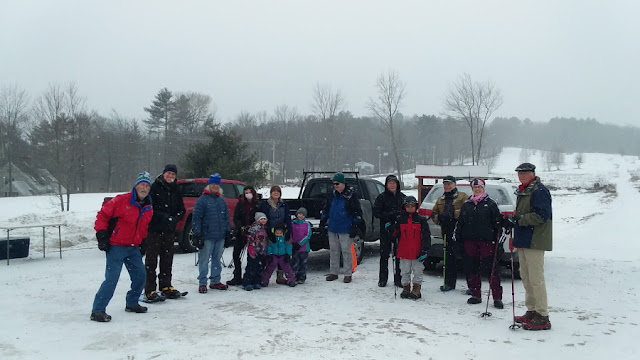
Fresh snow just in time for the Page Pond Winter Outing.

We took a loop around the field and over to Page Pond and the mill dam.

Heading out to the dam.

And Page Brook sure was flowing over the spillway at the dam.

The mill dam at Page Pond in its winter dress.

I'm not ready to think about spring yet, and I expect mother nature has a few more winter surprises for us, but we are now past the half way point from the solstice to the equinox.  Here's another early sign of what's to come:  the sun is already setting later in the day and farther to the north.


Spring will come - and snowdrops will bloom - before we know it.


Sunday, February 13, 2022

February 13, 2022: Superb Owl Sunday

No, I didn't coin the term "Superb Owl Sunday" but I think it's great!  Owls are among the first birds to nest each year, and barred owls, our largest and most common owls, are already looking for mates and nesting sites, so SuperbOwl Sunday is a good time to listen for their calls, whether it's to woo a mate or to defend its nesting territory.  I've heard a few in the area but haven't seen any this winter, so here's picture from three years ago, one of my favorite stories of a barred owl which you can find in the February 17, 2019 post.

A barred owl watches over the bird feeder.

Yesterday we went to the Laconia World Championship Sled Dog races, a three day event that went off with excellent snow conditions on the trails.  It's always fun to watch the dogs pull with such energy and enthusiasm, sometimes a little too much enthusiasm as when they get all tangled up at the start because they can't wait to get running.  We saw no such problems at the start of the six-dog teams on Saturday, but boy it takes an effort to keep all that excitement in control as they await their starting gun.

Bringing the first team out, one handler for each dog.

Some pretty high tech equipment.
These dogs want to run!
And they're off!


Next was team number two, another team with only five dogs, one less than allowed:

Bringing team number two the the starting line.
This handler has to manage two pups.
Raring to go.
And when the gun goes off you'd better get out of  the way,
because these guys aren't going to wait for you to move!
Team number two is off to the races.

Someone on team six was pretty excited:
Jumping for Joy.

Here they go:
Get out of the way!

It takes about 17 to 20 minutes for the six-dog teams to run their course; here team number one comes down the final stretch to the finish line.


The dogs look tired at the end, but it's hard work for the mushers too.


There was some tight racing on Saturday's six-dog classic.  Here, three teams bunched up just before the finish line.
Teams three, four, and five in a tight race.


It also shows that the mushers don't just stand on the sled, going along for the ride - note musher three working hard to keep things upright.

If you have never been to watch the races, it's definitely something to experience.  It's also interesting to think about how much canines have changed over the millennia, from wild wolves to domesticated dogs, comfort animals, service dogs, and loving pets.

But that's not all.  The Meredith fishing derby is also taking place this weekend.  We went out on Meredith Bay to see the action (and maybe get a snack from the Boy Scouts) and there was a lot going on as always.  

A whole village materializes on Meredith Bay in winter.


The leader board at derby headquarters on Meredith Bay.

I was impressed to see that Lake Wicwas was well represented on the leader board:  The largest pickerel and the largest black crappie - as of Saturday noon time - were both from Wicwas!

A  24", 3.6 pound pickerel from Lake Wicwas.


And a 13.5", 1.3 pound black crappie.

Those are some impressive fish coming out of our lake.

Lots of action on Lake Wicwas on Saturday.

This weekend is also the NH Audubon Backyard Winter Birdy Survey, and you can still participate as it runs through the end of today (February 13th).  You can find all the information on how to participate and submit your observations here.  On Saturday I observed nine different species, and am hoping to see a couple more today.

A white breasted nuthatch participates in the winter bird count.

Sorry for another long post, but it was quite a weekend up here at the Lakes.  Let's go Rams, Bengals, and Owls!

Sunday, February 6, 2022

February 6, 2022: A Bluebird Invasion

Forget Ukraine, the invasion is happening right here!  This week a flock of over 20 bluebirds has stormed into the area, being observed by many people around the lake and it's quite a treat to see them with their bright blue color in winter when most other birds have replaced their summer plumage with more practical, safe, muted plumage.

Eastern Bluebird


This is the first time we've had bluebirds at our feeders though I know others in the area have seen them.  Some range maps (e.g. Cornell) still show their year-round range south of Massachusetts, but we had seen them in southern New Hampshire for years.  Other maps (e.g. Audubon) do show their year-round range extending up to central New Hampshire.  

Eastern Bluebirds feed primarily on insects but in winter their diet consists of fruit and a very diverse set of berries; it seems only in recent decades that they've started to partake in the seeds of birdfeeders.  


Bluebirds aren't picky at the feeder - large or small, seeds are now readily consumed.


It was a cold morning when we first saw them, near zero, and after filling their bellies some of them found a most endearing way to keep warm.

Keeping warm - and keeping watch in all directions.

Bluebirds, like all birds, have no blue pigment in their feathers.  To present their blue color their feathers take advantage of the wave properties of light.  There are tiny air pockets in the cells of the their feathers that have the right dimensions to reflect light such that blue light reflected from each pocket all lines up "in-phase" while other wavelengths are reflected randomly.  Thus the blue wavelengths are reinforced while other colors are diminished, resulting in the bright blue color that our eyes perceive.  [Ref:  Sibley, 2020, What it's like to be a Bird, Knopf, pg. 133]

Blue light is reinforced by a unique feather characteristic.

Blue light is at the short-wavelength end of human's visible spectrum, right up against ultraviolet light, which got me wondering if bluebird feathers might also reflect some UV wavelengths.  Looking into this I found that many birds do see in the ultraviolet spectrum, and in fact use that trait in interesting ways including some that explain avian abilities that had stymied scientists until this was studied.  That's a topic for the future; I have much more I need to learn on that subject, and there was a lot more going on this week to be shared.

We have a spring that flows year round which we let collect in a small pool well protected by hemlock trees and we often see birds and squirrels drinking from it all winter.  But this winter there have been holes in the ice that have opened up - the reason is unknown to me - but they are in fact open all the way through the 14" of ice on Lake Wicwas at this point.  And the bluebirds seemed to prefer this water source, right out in the open.

Three bluebirds take a drink.

That seems like an unnecessary risk considering the known presence of many predators such as bobcats, hawks, and the kestrel we saw a few weeks ago which is especially adept at catching birds.  And there was proof this week of the danger.  On a cross country ski excursion this week I came across a fresh bloody mess beside the trail which had all the indications of gray squirrel meeting its demise at the talons of a raptor.  

Sign of a very recent kill.

Bits of gray fur make me think it was squirrel.


I expected to see more remains of the animal on the ground, but then looking up I saw a big branch hanging right over the spot, a perfect perch for a raptor to feast upon its prey.  Perhaps the rest of the animal was taken off to share with its mate, or maybe I disturbed it and it flew off unnoticed to another dining location.  

Assuming the victim was a squirrel, it's not the last one; the second invasion this week was a ground assault.   The gray squirrels have stormed the yard in force - at one point there were eleven of them out under the feeders even after that one had departed from the land.  

Plenty of squirrels still abound.

And then, another new bird appeared at our feeder during Friday's snow - a pine siskin.

Pine Siskin

This was the third wave of the invasion; I only saw a few but another bird watcher (thanks MT!) reported a huge flock of them at their feeder, so many in fact that they emptied their bird feeder three times in one day.  

If I have seen a pine siskin here before I didn't identify it.  Unlike the easily recognized bluebird, the pine siskin is rather non-descript and I first thought it was a sparrow, but a key identifying feature is the slight yellow band along the edge of its flight feathers and its tail.

You can just make out the yellow bands on the edges of its wings.

The yellow bands are seen in flight but are barely visible when perched.  The pine siskin's beak is also thinner and sharper than a finch's beak.

A sharp, pointy beak.

Also in contrast to the southern-ranged bluebird, the pine siskin is a northern bird, living year-round in Canada and very northern New England, and breeding even farther north from Newfoundland in the east all the way across the continent to Alaska.  According to my new Audubon book (thanks VP!) they move southward when seed crops in the boreal forests are poor.  One of their favorite seeds is that of the hemlock tree so maybe the bumper crop of hemlock cones around the lakes this year will keep them in the area.

Even though I've gone on too long with all the nature sights, I can't let the week go by without a note on the disappointing effect of the weather on the Pond Hockey tournament.  Friday's games were cancelled due to unplayable ice conditions, and then on Saturday the entire tournament was cancelled due to unsafe ice.  According to their report, the weight of pushing the heavy snow from Friday's storm into piles to clear the rinks was so great it was causing the ice to sink and crack and lake water was coming up onto the ice.  They removed all their equipment and gear and had to cancel the entire tournament.  The coming week is forecast to be mild but hopefully it will be cold enough for everything to freeze up for the fishing derby next weekend.  

So on a happier note, I'll close with one more look at those beautiful bluebirds!