Sunday, March 7, 2021

March 7, 2021: Coyotes on the Prowl

Note:  This post has images that some viewers may find disturbing.  Viewer discretion is advised.   ; )

In like a lion, out like a lamb - March is here, crazy changing weather and all - and it certainly has started out like a lion with some of our coldest temperatures of the year and plenty of wind to go with it.  Mt. Washington recorded average winds of 86 mph and gusts over 130 mph on March 2nd; the low temperature for the day was -28F, and that's not the wind-chill (that would be -80F).  It was not nearly as wild around the lakes, but still pretty cold and the wind brought in squalls with enough snow to freshen things up and even allow some animal tracks to be found, including this weasel track.

The classic 2-2 track of a bounding weasel.

This closeup shows the double imprint where one foot lands almost directly over the other.

Each print is a double-print where the rear foot landed on top of, or slightly behind, where the front foot landed.  I couldn't follow the track for long because the wind had obliterated the tracks after a very short distance, but the immediate habitat and what behavior I did observe tells me it was a fisher.

There was also a plethora of mouse tracks running all over the new snow, scurrying from one hiding spot to another.
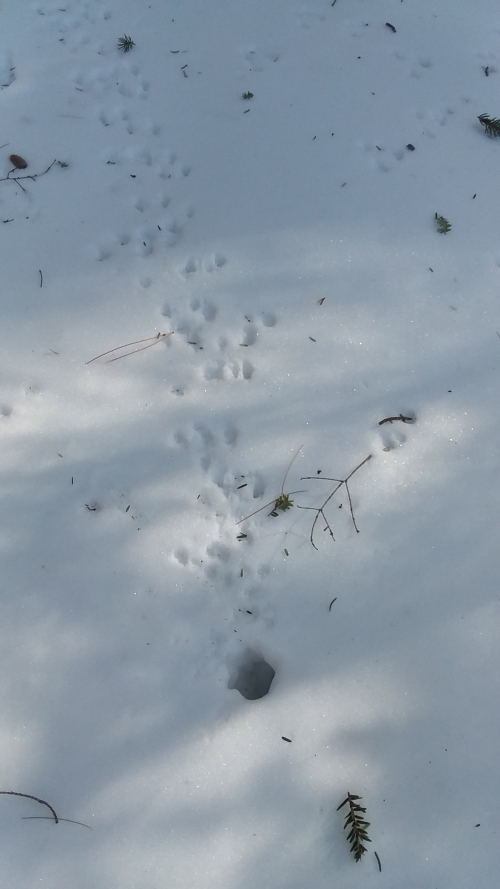


Mice like to travel quickly from one hole to another to avoid those pesky owls.  The largest tracks however, were those of the coyotes, out on the prowl for creatures of any size or shape.  

A coyote following along the shoreline,

and circling around something of interest.
Then heading off into the woods
to leave its marker.

Stumps, rocks, the middle of a trail - these are all favorite places for a canine to leave its mark, knowing  it will be readily noticed by visiting males and females alike.  

Those coyote tracks were left a couple of weeks ago, before the most recent snow, but they show coyotes have been traveling far and wide, both on and off the lake searching for food, and one morning this week, after a few inches of new snow, I came across evidence they had a successful night.


This digestive track can't be from anything other than a white-tailed deer.


It's one of the few parts of a deer the carnivores will leave behind.

It was an unusual situation.  I've come across deer kills on the lakes many times (see journal entries on January 21, 2012 and March 10th 2019) but it was hard to figure out just what happened here.  Clearly the kill was recent because the blood stains were still fresh.

Recent snow and fresh blood indicates a recent kill.

But there were very few tracks or evidence of a fight; everything must have been covered up by the snow the night before.  But why were the intestines exposed?  Were they warm enough that the snow melted on them as it fell?  And that doesn't really explain why some fur was exposed as well.  I could see some signs of struggle a few yards away on the shore line but other than these few remains of the deer, nothing.  

Fur on top of the snow.

I expect the carcass or least some stray bones will appear as the snow melts over the next few weeks.

Every time I see one of these deer kills it's disturbing even though I know it's part of the circle of life, and one deer killed will sustain the many animals that will partake of the feast during the difficult late-winter season, including fox, eagles, hawks, and crows in addition to the coyotes.  

A red-tailed hawk feasts on the carcass from a prior kill.

Even the mice and other rodents will chew on the bones to ingest the minerals they contain.  But it's still hard to accept.  So let's end on a brighter note:  Sunny days and blue skies.  Forget the coyote and dismiss the lion - the March lamb is on the way!


P.S.  If you were interested in seeing Beede Falls which I described last week, it appears the ice over the falls has started to collapse.


Sunday, February 28, 2021

February 28, 2021: Beede Falls Ice Cave

This week I witnessed one of the most amazing natural phenomena I've ever seen, and it's all due to friend and outdoor enthusiast Shayne Duggan, who told me about this unique experience.

Inside the Beede Falls Ice Cave

Just this past autumn I had stopped by Beede Falls in Sandwich Notch on my way up Mt. Israel from Sandwich Notch Road - the first time I had seen this waterfall.  This is what that beautiful waterfall looked like in November.
Beede Falls after a good rain last November.

But Shayne shared some incredible winter pictures from the falls, and I had to see it for myself.  With Sandwich Notch Road closed for the winter, Linda and I hiked along the Bearcamp River Trail from Mead Base to the upper falls.  Arriving at the falls there was absolutely no running water visible in the river.  

The same waterfall in winter.

But there were openings at either side of the now-frozen waterfall.

An intrepid hiker peers behind the curtain.

Poking my head in one of those doors opened up a whole new world hidden behind that wall of frozen water.

Looking in behind the wall of ice.

The swirling water over the centuries has gouged out the rock where the water crashes down so the pool undercuts the bottom of the cliff that forms the face of the falls.  When the pool freezes over you can crawl along the surface of the ice, passing behind the water flooding down, which over the course of the winter has frozen into a crystal ice curtain.  

Behind the falls.

Linda enters the cave, walking on the frozen pool.

Linda took this next picture from that spot, looking along toward the other opening.


There was enough light shining through the ice that the cave was reasonably well lit on the inside.


Drops of that perfectly clear mountain water coming off the rock has formed beautiful, lustrous ice formations inside the cave.


The rush of water pouring down into the pool makes a fair racket resonating inside the cavity, though you can barely find the moving water in between  the stalactites and the frozen wall.  Here are a couple of videos of what it looks and sounds like from behind that wall of ice.


I imagine the ice wall builds up from the bottom as water crashing into the frozen pool freezes higher and higher until it reaches the top of the ledge, but that's just speculation.  

Talk about mother nature giving us a spectacular treat to enjoy in winter!  Perhaps this was the inspiration behind the ice castles that have become a popular attraction up in North Woodstock.  
Nature's own ice castles.  (Looking back to where I came from.)


We were there in the afternoon when the falls were in the shade; I'd like to go back in the morning and see what it's like with the sun shining directly on the ice.

We made the trip a loop by continuing past the falls up to Sandwich Notch Road which is closed in the winter, then followed that back to Diamond Ledge Road and returned up to Mead Base.  Sandwich Notch Road is a dead-end snowmobile trail in winter; we didn't encounter a single snowmobile on a nice Friday afternoon.

It may be deep winter up in Sandwich Notch, but back at the lakes some early signs of spring are just becoming perceptible, such as the stronger sun melting snow on south facing slopes and the first tinge of yellow appearing on the goldfinches.  


We're about to start that transition period of March where chick-a-dees are singing one morning, and the morning next there's a blizzard.

More snow just yesterday.

March can be our snowiest month of the year!

Sunday, February 21, 2021

February 21, 2021: Blue, Blue Skies

The snow conditions haven't been very good for tracking lately.  First we had some rain which put a crust on the top of snow preventing any tracks from registering except for the deer which have sufficient weight on tiny hooves to break through the crust.  But for obvious reasons, they don't much like walking around in those conditions.  On the few occasions I did see deer tracks there were often blood stains on the snow where the sharp crust cut into their lower legs.  One place I saw these tracks was on the trail up to Red Hill on Wednesday, an absolutely spectacular blue-sky day.

Fire tower on Red Hill.

I didn't check the numbers, but the dew point that day must have been below zero for the sky to be that blue.  

One night we got a dusting of snow which was just enough for little mouse tracks to be seen on top of the crust.

Mouse tracks running from tree to tree.

Trees tend to make openings in the snow next to the trunk, either due to wind blowing around the tree or from sun warming the dark trunk, which provides easy access up and down through the snow cover for the mice.  As I mentioned last week, I have trouble differentiating between voles and mice, but I think these are mice tracks.  Not only are they running around above the snow (voles tend to tunnel underneath the snow) but they also show tail tracks - look closely at the tracks in the lower right - blown up here:

The tail drag mark is evident.

Voles can also leave tail tracks in snow but it's less common with the shorter tail they have.

Then on Friday we received a nice little snowfall of a few inches to put a good surface on top of the crust, but I didn't get out locally to see what was around, instead taking a trip over to Dorchester to ski on the nicely prepared trails at Green Woodlands.  


If  you're a cross country skier and have never been there, you should check it out - many miles of trails groomed for classic and skate, plus many other trails left for backcountry skiing.  And it's all at no cost.  Usually they have warming huts with fires and hot chocolate, but they're closed this year, although they do have one outdoor fire pit open with the fire burning, ready to cook up s'mores.  You can find out more at their website or facebook page.

Back on Lake Wicwas, during a ski along the west side of the lake, I came across this neat sight over the frozen water:

A Kingbird nest from warmer days.

It's the nest of an Eastern Kingbird, nicely being kept safe for next summer under a blanket of snow.  Evidently they have taken advantage of some human trash to reinforce their nest with strong fibers of blue plastic.  Animals will certainly make good use of whatever they can find.  I remember my grandmother putting out pieces of strings for birds to use in their nest building.

This kingbird nest raised a brood of four chicks in 2016 though I don't know if it's been used since then; kingbirds don't usually reuse a nest the way the phoebe, another flycatcher, does.  If the nest hasn't been rehabilitated since 2016 it certainly has held up well over the years.  Right now the kingbirds are enjoying winter in South America, somewhere along the Amazon River living off of fruit; they won't return to New Hampshire for quite a while yet, waiting until the insects they live off have emerged.  It's too bad the flycatchers will never get to experience that beautiful blue New Hampshire sky.


Sunday, February 14, 2021

February 14, 2021: Prey and Predator

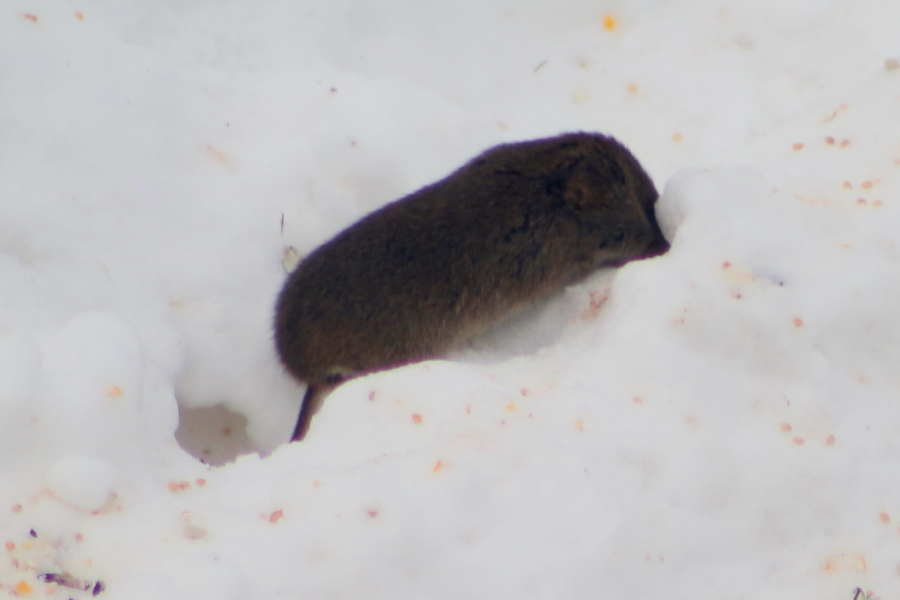
This week we had one of our littlest visitors come to the birdfeeder, a meadow vole.

A meadow vole munches on a dropped seed.

I always want to call these furry little guys "mice" and have to remember that mice are nocturnal while voles are the ones out during the day.  Sometimes skiing I'll have to dodge a vole as it sprints across the ski slope, it's little dark body looking like a sunspot moving across the snow.  Other identifying features are the ears - mice have large ears while voles' ears are tiny.  Another is the tail: Mice have long tails and voles have short ones, though this guy never showed me his whole tail.


I only see them in the winter when they stand out against the snow - during the summer they must blend in perfectly with their surroundings, though sometimes I'll hear a rustling of leaves by the trail and I presume it's a vole scurrying away.  In winter voles spend most of their lives safely protected under the snow in the subnivean zone (see post from 17 March 2019, The Subvivean Zone) but they'll pop up to the surface and take the risk to collect the abundance of dropped food under a bird feeder.  

Poking out of one hole, with another tunnel seen just above him on the left.

Voles must be in cahoots with the nuthatches which throw piles of seed onto the ground as they dig through the feeder to find a seed they deem worthy of eating.

It took some patience to get a picture of this guy as he would barely show just a bit of his body for an instant before ducking back down for safety.  But a couple of times he exposed himself enough that I was able to see who was down there.  


And he is smart to be so wary.  I still haven't seen our bobcat, but there are regular fox tracks going around the feeders.  Others around the lakes have had good reminders of just why those rodents are so careful.  

A bobcat stalks a feeder- photo by Tom Witham.

That picture of a bobcat stalking a birdfeeder was sent by a friend who lives near Meredith Bay. (Thanks TW!)  While foxes travel continuously in search of prey, bobcats will often settle down in a spot with a good view of a promising stretch of landscape and wait for food to come to it.

Another local bird watcher sent this photo along (thank you AC!):

A barred owl keeps watch over a Wicwas feeder - photo by Annie Crane.

Do you think this owl has its eyes open enough to keep watch for its prey?  I also wonder how it manages to balance itself way out on the end of that dead branch!  At least it has nice fluffy feathers to keep its toes warm.

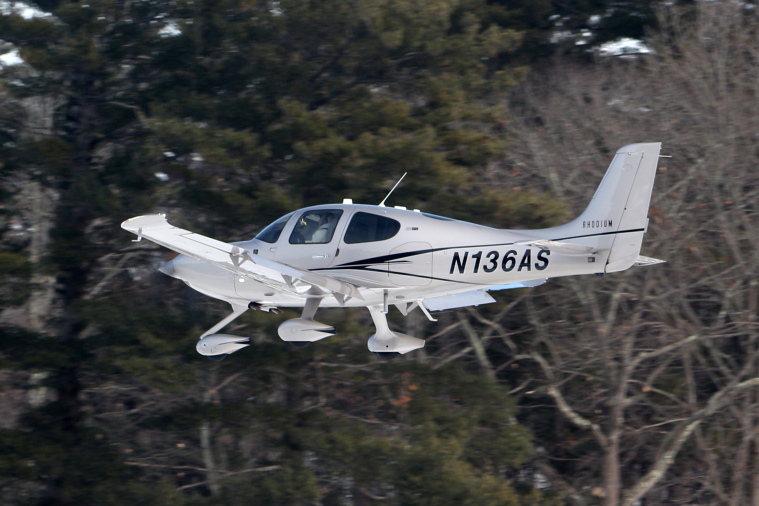
Yesterday we braved the cold to go out and take in all the action on the big lake, but this year we went to Alon Bay rather than Meredith Bay so we could see the ice sculptures and watch the planes on the Alton ice runway - it's their Winter Carnival weekend.

Coming in for a landing on the nice.  Note the large winter tires.
See the ice fishing tip-up?


Yes, it's fishing derby weekend as well.  I wonder if that tip-up right next to the runway will have any luck.  

The Alton Bay ice runway is the only FAA approved ice runway in the continguous United States.  If you've never seen it, it's definitely worth the trip.  It was a beautiful day and there was a constant stream of planes coming and going.  I'll add some of the may different planes we saw yesterday in case there are any aircraft aficionados reading the journal.


This is a nice winter set-up.
Another one with skis.


Ground control kept things safe and orderly.
Lots of planes in the parking area.

Arriving in formation.
And taking off one after another.

A fun day on Alton Bay.

And the action continues today if you want to head over this afternoon - what a great way to spend Valentine's Day!  💘💘💘

The runway will stay open as long as the ice is safe and they can clear the runway.