Sunday, March 11, 2018

March 11, 2018 - Changes, Fast and Slow

It was a week of contrast in most of New England, even throughout much of the Northeast, as the second nor'easter in six days passed through.  The week started like this

transitioned through this

and ended like this.


The 12 to 15 inches of dense snow resurrected the skiing and may have averted an early end to the season for many ski areas.

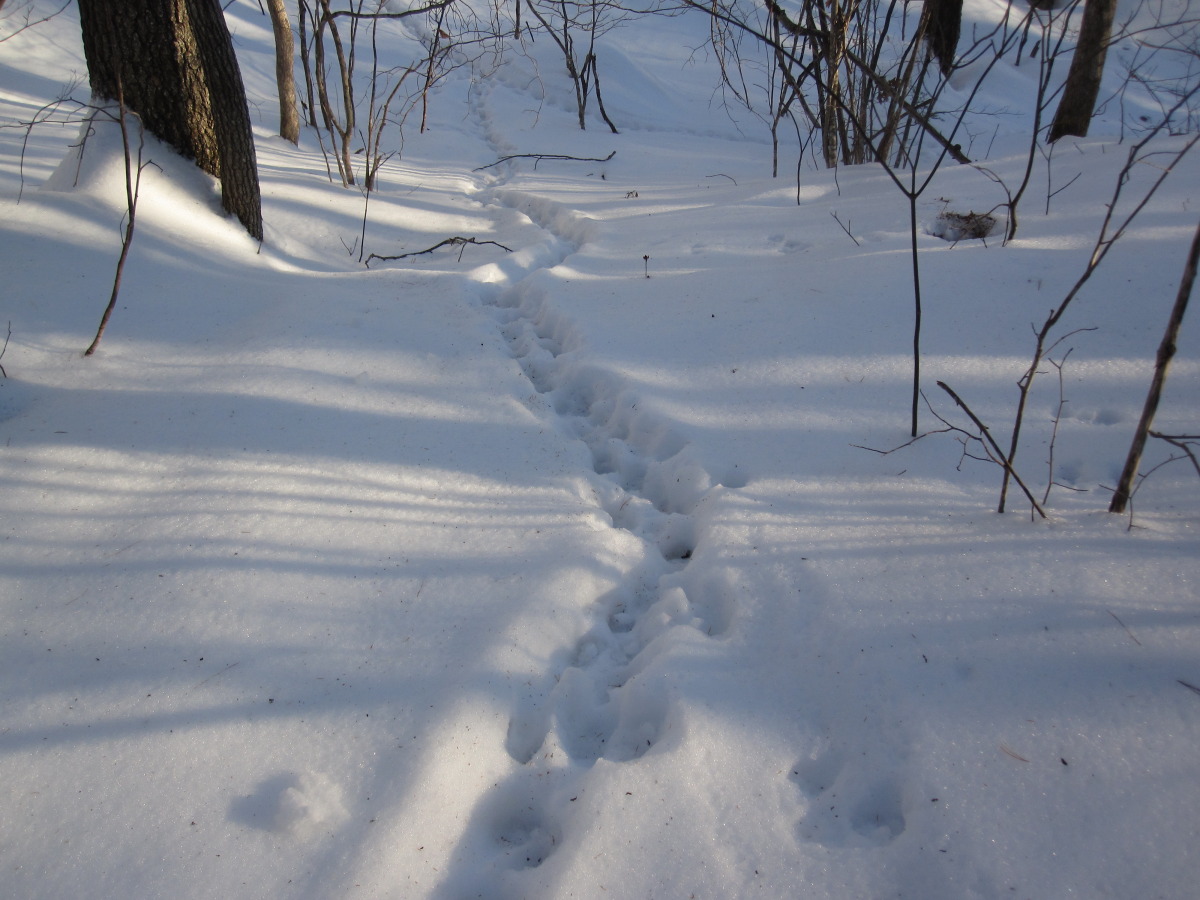
Fresh, pristine snow always entices me out on the snowshoes, and on Friday I crossed paths with our local bobcat, so I followed it along for a bit as it wound through the woods.  It took a good part of a mile before I found a print that was clear enough to confirm I was following the path of our only wild feline.
The round shape and boomerang foot pad of the bobcat

Nothing of note was observed from the cat, but one of the perks of following tracks is being taken places you've never been before - or would never go on your own volition:  through dense hemlock stands, across (barely) frozen swamps, and up ledges, all of which an 18 inch tall, four pawed creature thinks nothing of traversing.
Across almost-frozen wetlands
Up rocky ledges

This particular bobcat led me on a trip where I discovered an old relic from New Hampshire's agrarian past.

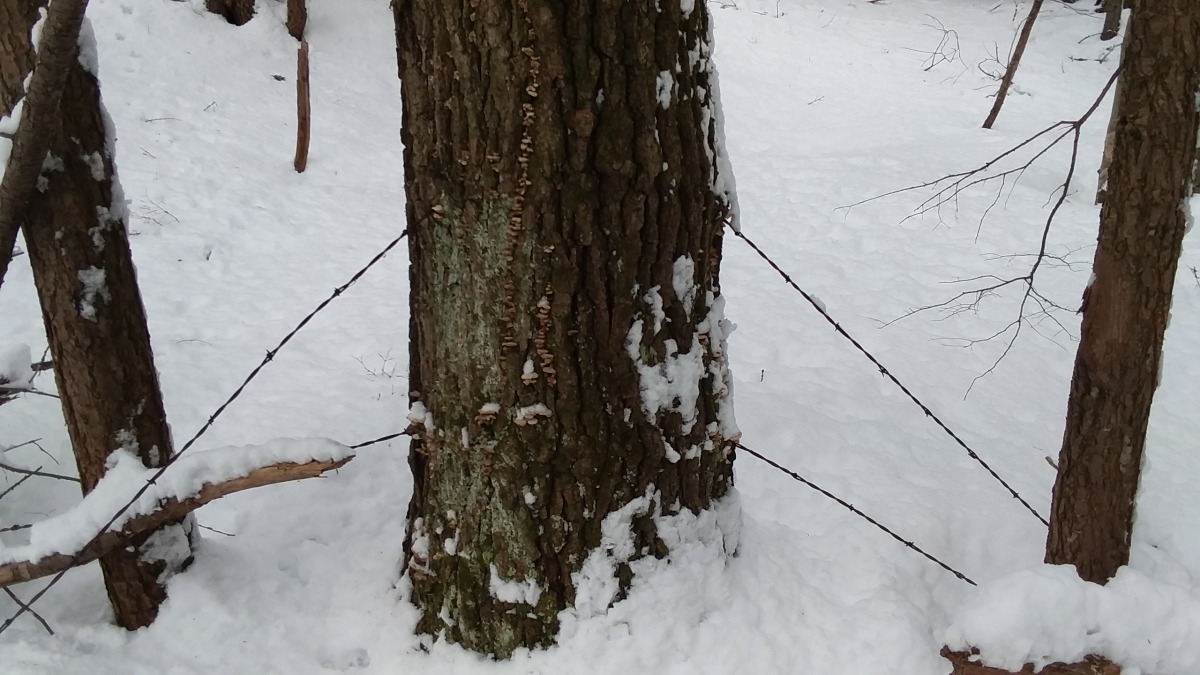
I love finding these old barb wire fences passing through the center of sizable trees.
I'm no expert on tree aging, but this red oak could easily be 100 or 125 years old, and since the wire is pretty close to the center it means the fence was set when the tree was just a tiny sapling, dating the wire to perhaps the late 1800's.  This recalls a different contrast in the New England landscape, one that happened slowly over the better part of a century.  A hundred years ago this land as well as most of the Lakes Region and much of New Hampshire was completely cleared of forest for farming, for lumber, and then for grazing.  Picture all the land around the lakes as fields rather that forest;  it's a stark contrast that happened slowly over so many years it was hardly noticed.
A typical New England landscape in the late 1800s

Another tree farther down the fence line has died and almost completely rotted away, again showing the age of the fence.
Wood around the wire indicates the size of this tree before decay set in

It appears that scar tissue grown to isolate a foreign object is more rot-resistant than the rest of the tree.

I also found a pretty ambitious pileated woodpecker excavation project.


It's hard to see, but the bottom is about 3" below the opening
This looks like a nice future residence for some bird or rodent.  And speaking of rodents, it sure was strange to see the chipmunks struggling to get through a foot of new soft snow.  They probably aren't enjoying the change back to winter any more than many humans, but at least we can appreciate the restored winter splendor.

Sunday, March 4, 2018

March 4, 2018 - The animals are stirring

Meteorological spring arrived on March first and brought with it spring weather and other early signs of the coming season.  The chipmunks are out and running around on top of the snow looking for food and chasing one another to defend their territory.
On lookout duty

Gray squirrels are out all winter but their food supplies must be shrinking as they are spending more time under, around, and on the feeders.  Sometimes they'll hang upside down to eat.

Other times they'll take a seed up to the top in their teeth and put on a safety belt while they dine.


One morning after a slight dusting of snow there was a set of weasel tracks passing right through a major squirrel hang-out spot.
Where squirrel and weasel meet
Weasel tracks

I've had two reports of bear-sightings already, so the bird feeders are about to disappear for the season even though I haven't seen any bear signs around Lake Wicwas.  Earlier in the winter I saw this example of just how committed bears are to getting to something that smells like food.

This deer feeding is station made of strong, hard plastic, but Mr. Bear had no problem tearing a hole through it to sample the contents once he couldn't get in through the top.  
Nice teeth

Roads around the Lakes Region have already been posted which is a good indicator that the sap is flowing.  Sure enough, the row of sugar maples beside Lakeland School has been tapped.
The sap is flowing


Before the rain this weekend there was enough snow to allow snowshoeing and we enjoyed a beautiful trek with longtime friends up to the White Mountain Ledge in the Hamlin Conservation Area.
A beautiful day for a hike

One of the highlights of the trip was hearing two Barred Owls caterwauling with each other in the middle of the afternoon - probably a pair, as barred owls are just entering their mating season which runs through April. But it could have been two males, each trying to outdo the other with the quality of their haunting baritone voice.

Let's hope there are a few more opportunities for winter activities in the cards.  It would be nice to reschedule the snowshoe tour that was cancelled yesterday due to poor ice conditions; by Saturday there were gaping holes around the shoreline and large pools of water collecting on the surface of the ice.

Want even more encouraging signs of spring?  In the warmest locations there are even a few shoots of new green life pushing up through the soil.
Crocuses!
But don't unpack those swimsuits yet - there is still over 20 inches of ice out in the middle of the lake!

Sunday, February 25, 2018

February 25, 2018 - Avian Concussion Protocol

We are less than four weeks from the vernal equinox and it felt like it could be tomorrow with the record warm temperatures throughout New England last week - it was in the 60's in the Lakes Region, and it hit 80 in northern Massachusetts.  The birds certainly thought spring was coming as a flock of titmice were up in tops of the trees singing their spring arias, and the chick-a-dees were sharing their gentle "dee-dee" song of springtime.  I also saw my first purple finch of the year.

Another finch, however, had an unfortunate altercation with a window.  I heard the bang on the window, knew what happened and went out to assess the damage.  What I thought was a poor little goldfinch was sitting on the snow, stunned and motionless.
A stunned finch
I could see it was going through the NFL concussion protocol before getting back into the game.  I checked on her several times over the next 15 minutes and was getting concerned she might not recover.  But on the last check she reacted to my presence and flew off to join her flock with no obvious impairment.  But while she was stationary on the ground I was able to get a good look at it and see it was not a goldfinch, but rather a female red crossbill - the bill was the obvious factor.
Female Red Crossbill (Loxia curvirostra)

The fine elements of its feathers show how it can insulate itself in the winter with tiny pockets of trapped air, and the cross-beak facilitates the extraction of seeds from pine, spruce, and hemlock cones.

I hadn't seen a red crossbill before, so it's a new one for my list.  And I had to look it up, passing by the red crossbill at first, not expecting a yellow bird to fit this name.  But only the male is red;  the female is yellow.  An interesting aspect of this bird is that it will breed at any time of year, even in the middle of winter, if there is a good food supply.  And this winter is certainly a good cone year as indicated by all the white pine cones in the trees last summer, and all the cone shreds seen all winter long on the snow.
White pine cone shreds
Hemlock too
There are scenes like this wherever coniferous trees are present
Still a few whole cones lined up for the next meal
Even with warm weather there's still a good amount of snow around except for open areas with southerly exposure, and fresh snow early in the week and again today helped freshen things up.
Fresh snow shines brightly in the morning sun earlier in the week
And more snow today

Just a couple of days ago things were looking grim and this weekend both the dog sled races and the LRCT ski event at the Castle in the Clouds were cancelled;  today's snow was just a little to late for them.  Let's hope next weekend's Lake Wicwas Association snowshoe tour doesn't also fall victim to the weather (everyone is invited - let me know if you're interested).  If it does, at least we'll enjoy the signs of spring in advance of the coming equinox.
Photo by Linda Powell

Sunday, February 18, 2018

February 18, 2018 - A Winter Tracking Mystery Solved

Snow conditions set up good tracking parameters this week;  tracks that were set in dense snow froze in place by the rain that followed, so a lot of animal activity was captured around New Hampshire's lakes and forests.  I finally found where the bobcat has been prowling for its meals (although it's missing out on plenty of food right under our bird feeders).  I found these tracks up on a north-facing slope of dense hemlock.
The round, toenail-absent print of a bobcat

Following them led me to a spot where it nestled in behind a tree to hide in hopes of ambushing a hapless squirrel - or perhaps just for a catnap.
A catnap in the sun?
And another spot where it lay down to watch over its world from the top of a knoll with a commanding field of view. 
A good location to scout for dinner

Farther up near the top of the hill, overlooking a ledge I call "porcupine ridge", the presence of its namesake resident was clearly evident.
Procupine tracks leading away from the ledge
Porcupine tracks are quite distinct especially in deep snow where they just sort of plow along though the snow making a miniature bob sled run;  I went down to the bottom to take a look.
Recent tracks follow a previously plowed road
Looking back up Porcupine Ridge shows their preferred habitat of rocky ledges
Porcupine will follow the same path over and over again, to the same tree which they feed upon until they finally kill it off.  The signs of them eating - and dropping their food - is evident under the hemlocks on which they feed.
Tracks and debris around the current food source
Here is what's left of a hemlock tree after they have feed on it for years.
A gnarled, nearly dead tree with one lone branch they left behind

The highlight of my trip though was a set of coyote tracks which led me to this scene.

It was not evident to me what had happened here.  The fur had the color of a gray a squirrel, but there was far too much fur for that explanation, and the hair was too long. 
Gray fur with some golden tips

Could it be from a gray fox?  The lack of any bones, skin, and almost no blood further added to the mystery. 
Just the slightest hint of blood at the scene

After consulting with a good friend with much wilderness knowledge (thanks JK) we considered and ruled as unlikely a kill by a large raptor (including an eagle) that might have eaten everything but the fur. 

So, the call went out to the New Hampshire Fish and Game Conservation Officers for some expert opinion (has anyone been watching North Woods Law: NH on Animal Planet?).  The answer from Fish and Game Wildlife Biologist Patrick Tate came quickly:  It is from a deer that was killed many days, probably weeks ago, and all that's left after being dined on by many animals is the fur.  He noted that the very cold weather did cause some deer mortality, and that coyotes and even bobcats can kill a deer.  Where the rest of the carcass is remains unknown.  Experience has shown that animals will drag away portions of a deer to eat in safety, and perhaps more of the animal is buried under the snow.  A deer killed on Lake Wicwas in 2012 disappeared slowly over the course of several weeks.
Sad as it may be, this deer fed the neighborhood - from coyotes to eagles - for weeks
In the spring the spine was found in the middle of a trail a quarter of a mile away.
Spine with most of the skull still attached

Who knows what we'll find this spring when the snow melts.

Elsewhere in the area, the sled dog races were postponed until March 2-4 due to poor trail conditions, but the ice racing was held on Meredith Bay for the first time in many years as part of Meredith's 250th Anniversary celebration.  Perhaps you were able to catch some of the action - it was great fun!

The days are noticeably longer now, and the sun is growing stronger.  It's a great time to get out and enjoy the beauty that is New Hampshire in winter.