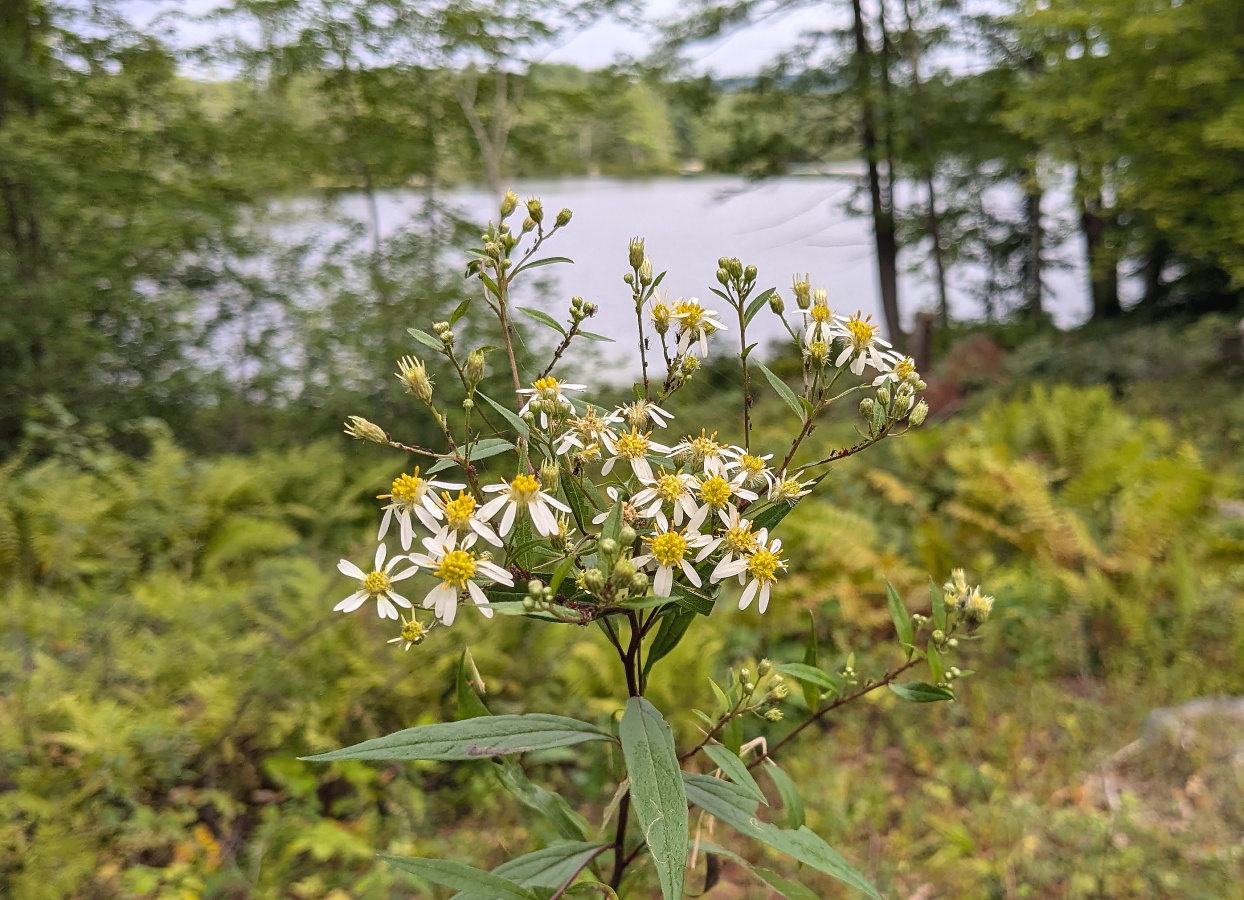
I took my final weed-watch tour of the summer around my section of Lake Wicwas this week, searching for signs of invasive weeds that may have found their way into the lake. I was pleased to see that our
Lake Host Program continues to be successful, as I found no Eurasian Milfoil or other exotic species in the lake. Eurasian milfoil is just one of several invasive species to watch for in New Hampshire Lakes; the Lake Wicwas Association Website has an excellent
overview of invasive species - take a look so you'll recognize them if you come across them. If you see something suspicious you can take a picture or collect a sample and contact our Weed Watch coordinator at 279-5242 who will arrange to pick up your sample and deliver it to the NH Department of Environmental Services if needed. You can also become an official weed watcher yourself for any New Hampshire lake -
learn more here or contact me or the Weed Watch Coordinator.
Not finding any invasive weeds doesn't mean the trip around the lake was uneventful - there are always interesting sights when one takes a slow paddle around a New Hampshire lake on a quiet day. How about a young turtle, still light enough to float on top of a lily pad while sunning itself?
 |
| This painted turtle was about 3 inches long |
The next one was enough large that it had to find a old log to support its greater mass.
There were also numerous birds to be seen, both on the water and in the air.
 |
| A pair of ducks on the mud flats |
 |
| A cormorant fishing by the (non-invasive!) weeds |
 |
| An osprey flies over Wicwas |
I have heard osprey calling frequently around the lake the past few weeks, so they are spending a good amount of time fishing on Wicwas.
There are still plenty of colorful plants to be seen around the shores of the lakes, both in the water and on the shore line.
 |
| Buttonbush (Cephalanthus occidentalis) with some bright red berries photo bombing |
 |
| Fragrant Water-lily (Nymphaea odorata) |
Signs of the fall harvest continue to appear around the lakes. Perhaps you have noticed the abundant crop of pine cones growing like bunches of bananas in the tops of the white pines.
 |
| A bumper crop of white pine cones |
Down at their roots the furry animals - squirrels, chipmunks, mice - have been feasting on their seeds, leaving table scraps all over the trails.
 |
| Pine cones stripped for their seeds (probably by a red squirrel) |
It is also looking like an excellent year for beechnuts.
 |
| Beechnuts are plentiful |
These also have the appearance of being consumed by rodents, but the bears will be after them as well. Keep an eye out for bear claws on the trunks of beech trees as evidence they have climbed the tree to access the nuts.
 |
| A single set of claws is hard to discern |
 |
| But multiple sets provide more definitive evidence |
Other signs of bears going after beechnuts will be branches broken or ripped right off the tree in order get the nuts. Sometimes a bear will just pull the whole tree over so it can sit on the ground while it eats its lunch.
 |
| Breaking a tree over makes for lazy snacking |
Beech trees are an important food source in the forest; the forestry plan for healthy and diverse forests includes leaving some of the largest beech trees for both their aesthetic value and their food value for the animals. Good foresters do this even though it would be more financially valuable to remove them.
When you're traveling around the Lakes Region during the upcoming fall season you are bound to see land-based invasive species such as Japanese knotweed, purple loosestrife, and oriental bittersweet. These can be quite beautiful, but sadly will crowd out native species that are more important to our wildlife, and are just as beautiful in their own right.
 |
| Orange Jewelweed (Impatiens capensis), a native North American plant, enjoyed by humming birds, bees, and butterflies - as well as humans |