Showing posts with label Floating Bladderwort. Show all posts

Sunday, July 12, 2026

July 12,2026: Blake Brook Paddle

This week the Lakes Region Conservation Trust sponsored a guided paddle tour on Lake Wicwas.  It was a small group, but they were adventurous, powering through the thick weeds to paddle all the way up to the beaver dam that impounds the beaver pond in Blake Brook before it flows into Lake Wicwas. Once we got past the shallow cove and into the brook the weeds thinned out and the paddling was easier. 

Working our way up to the beaver dam.

Blake Brook is the second largest tributary feeding the lake; Dolloff Brook is the largest.  Both tributaries have beaver dams which provide great value to clean the water before entering the lake, as well as providing flood mitigation during heavy rain events, and storing water to supply the lake through prolonged dry spells.

As far as one can paddle before reaching the beaver dam.

There are literally thousands of White Water Lilies blooming in the lake now, and we saw quite a few Floating Bladderwort.
White Water Lilies - and several Yellow Water Lilies
White Water Lilies
Floating Bladderwort

There was even a painted turtle posing for us as it was sunning on a log.

Back in the middle of the lake we noticed a stand of tall dead trees reaching up above the forest canopy west of the lake.
Ash trees killed by the emerald ash borer.
These are White Ash trees, killed by the invasive Emerald Ash Borer which I mentioned in the May 17, 2026 Journal Entry.  
The remaining live ash trees in the Lakes Region won't last much longer.

Speaking of invasive species, here are a few of the most notorious invasive plants to keep an eye for at this time of year as they are easily identifed right now.  All of these spread very rapidly and should be addressed as soon as they are noted.  Once they have grown into a large area they are much harder to eliminate.

Glossy Buckthorn

Purple Loosestrife
Japanese Knotweed

I mentioned recently that a skunk family has taken up residence behind our house.  I'm pretty sure that's what's been digging holes beside our steps at night, so I set the trail camera to see if that's the case.  Well, I haven't seen the skunk yet, but I did catch this animal which was probably following the skunk's scent.

I wonder what a bobcat would do if it came upon a skunk....

We also have a broad-winged Hawk nest somewhere in the vicinity.  They've been driving the chipmunks and small birds crazy whenever they're near.  I saw this one swoop in, causing all the other birds to scatter.

Broad-winged Hawk

Finally, a check in with our loon chick, Pip, thanks to Deb Crowely.  

Loon photos by Deb Crowley

Pip is doing fine, and somehow swallowing ever bigger fish.

At this rate, Pip will start shedding its baby fluff soon!


Sunday, July 6, 2025

July 6, 2025: Introducing Spangle and Star

Let's welcome the two newest additions to Lake Wicwas, Spangle and Star, hatched on or about July 1st and 2nd, probably one day apart.

Spangle and Star, about three days old.

We don't know the sex of either, but I'm going to say Spangle is the big sister and Star is the little brother.  The first time I saw them, Spangle was riding up atop one of the parents while Star, very shy, was hiding out under a wing - or least trying to.

Star is half hidden under mom's (?) left wing.

Star was kicking hard with surprisingly large feet, trying to get far enough up to climb aboard.

Can you see his not-so-little foot kicking up the water?

The parents are very attentive.  Whenever something gets anywhere near the parent with the chicks, the other parent starts hollering loudly.  Thus I stayed far away and got only blurry pictures.  When I received a report that the family was out of Harris Cove and around Loon Point into the main part of the lake, I went to the nest to collect any shell fragments for the Loon Preservation Committee to analyze. 

You may have seen the nest from Chemung Road.

Analyzing the egg shells will help us understand the health of the loons as well as the lake itself.  The nest is surprisingly small, perhaps 18" in diameter.  They did a good job of getting on and off the nest and turning the eggs over without them rolling into the lake.

There were quite a few shell fragments and one piece of egg membrane still in the nest.  

We were fortunate to be able to collect them before some other animal consumed them for their calcium content.

As of yesterday the family was travelling all the way down to the southern tip of the lake and back up the western shoreline.  Dean Cascadden was able to take some video of the parents feeding the chicks near his dock.  You can find the video on the Lake Wicwas Community Forum page on Facebook.  If you're a Facebook user you should follow this page!

When you're on the lake observing the loons (carefully from a safe distance of course!) don't forget to take note of all the other beauty that's on the lake in summer - the aquatic plants are spectacular.  Larger plants like Yellow and White water lilies and Pickerel Weed are easily seen, but you'll have to tuck in close and slow to see some of the more delicate water-based flowers including Floating Bladderwort and American Cranberry.

Large (American) Cranberry

Floating Bladderwort

The natural adaptations of plants is incredible.  Take the floating bladderwort for example.  It has six appendages filled with air to give the plant the ability to float stably on the surface of the lake to support its bright yellow flower which attracts pollinators.  Trailing below in the water is a long stem that acts as a weighted keel to keep it from capsizing.  

If we're lucky, come August we'll get to see Purple Bladderwort blooming too.  By then Spangle and Star should be past their most vulnerable days, but for the next month, let's hope they and their parents can defy all the challenges they will surely face!


Sunday, July 19, 2020

July 19, 2020: Who Lives on a Primrose?


This spring an interesting weed sprouted right by the house, growing fast and interesting enough that it was tolerated by the resident gardener in order to see what developed.  As it grew taller and taller with no sign of being anything other than a weed, there were numerous temptations to yank it, but still, we waited.  Then one morning, a small yellow flower appeared.  The next morning, a couple more, and after a few days, there were numerous bright flowers, enough to be able to identify this now three and a half-foot tall weed towering over the black-eyed susans.
Evening Primrose (Oenothera biennis)

It is an Evening Primrose, so named because it blooms in the evening, greeting the owner with a bright good morning welcome.  The flowers are supposed to close up by noon, but ours seems to want to enjoy much of the afternoon as well.  

This primrose is biennal, meaning it has a two year cycle, producing flowers only in the second year, which is interesting because although we remember seeing a plant like this last year, it seems unlikely it would have survived the summer appearing to be only a weed.  But perhaps we watched it long enough to mature sufficiently, and only cut if off rather than pulling it up.  Anyway, it's a pretty plant, and being biennial, I'm saddened it won't come back next year.  But if any of its seeds take root, we'll know to let them grow for a couple of years.


Looking closely at the plant to identify it, I noticed it was home to several different forms of life.  Did you notice the little green bug sneaking over the blossom in the the previous pictures?
A katydid?

I think it's a katydid.  It doesn't have wings, but the nymphs hatch without wings;  thier wings appear only after their final molt.  

There was also a small brown beetle crawling around on the stem.
An unknown beetle

But the best find was this pretty primrose moth.
Primrose moth (genus Schinia)

At first I thought it was a rosy maple moth, but learned otherwise after looking closely at the color pattern.  It's another new species for me, and its name certainly makes sense considering the plant it was calling home.


It's always fun to find cool insects and spiders hanging out in Linda's flowers!

I did some boundary monitoring on the Harris Conservation Easements with Leah from the Lakes Region Conservation Trust this week which included monitoring from both land and sea.  In shallow water along the protected shorelines we found these pretty yellow flowers blooming (I guess yellow is the color of the week):
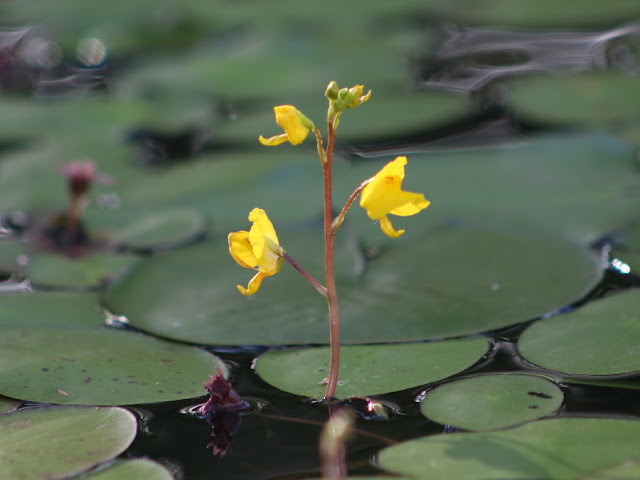
Floating Bladderwort (Utricularia radiata)

This is the flower of the Floating Bladderwort, I think.  I'll repeat that I'm not an expert on these matters.


Bladderworts don't have a root, they just float along in the water with a stem that drags down on the bottom of the lake.  The coolest aspect of bladderworts is that they are carnivorous.  Their underwater bladders are their "mouths".  The plant creates a vacuum in its bladders by pumping water out of them.  When the hairs on a bladder detect its prey, the plant opens the bladder, sucking in water, and its victim along with it.  Here's a description of the process from The Native Plant Trust
"Like other bladderworts, greater bladderwort is carnivorous, trapping small organisms in its tiny bladders. The trap door operates at speeds that rank among the fastest plant  movements known. Triggered by protruding hairs on the door, trap bladders open in about 0.5 milliseconds, sucking the animal in, and closing in about 2.5 milliseconds. This comes to about three thousand feet per second, almost three times the speed of sound."
And yes, bladderworts eat mosquito larvae, so they are our friends!  Easement monitoring can be quite educational - thanks for the trip Leah, and for this picture:
Monitoring Conservation Easements is a highly strenuous job.


Speaking of the Harris Conservation Easement, that's where our successful loon nest was this year, and both of their chicks are fine, being well attended to by their parents, and learning to fish by watching them.  Here's a link to a video Ron Naso captured of the chicks and the parents fishing.  Look carefully - the best part is when you can see one of parents flashing by under the water chasing a fish - it happens at 43 seconds into the video.  It's amazing how fast they can swim under water.  

There has been a lot of loon drama in Marion Cove this week, with three loons in regular confrontation - lots of circle dancing and lots of wing-rowing and vocalizing as they chase each other around.
"Get out of my cove!"

It may be the rogue loon we've had the past several years ("Solo") claiming ownership of the cove, while the long-resident (banded) pair still feels they have fishing rights to the waters.  At any rate, it seems to be keeping them all occupied and staying away from the new family, which is a good thing.

I'll end this entry with a great storm cloud building up before one of the late afternoon showers this week.

Just another beautiful moment on New Hampshire's lakes.