Showing posts with label Alder. Show all posts

Sunday, June 11, 2017

June 11, 2017 - Green is the Word


What a fabulous weekend!  Kayakers, fishermen, waters skiers, hikers, motorcyclists - everyone was out enjoying all that the lakes and mountains of the Lakes Region have to offer.
Verdant hills and aqua blue water
Lake fun on a hot summer day

There was only one really wet day this week, but it was a doozey and the lake level went right back up again, so no loon nesting yet.  A few lake tours this week determined there are three loons on the lake and one of them is the long-term resident female, proven by a good look at her bands when she was preening.
The banded female loon on a house-hunting tour
Two bands on her left leg

They sure are limber birds, able to reach every inch of their bodies with their beak to pluck old feathers and spread oil to keep themselves waterproof.
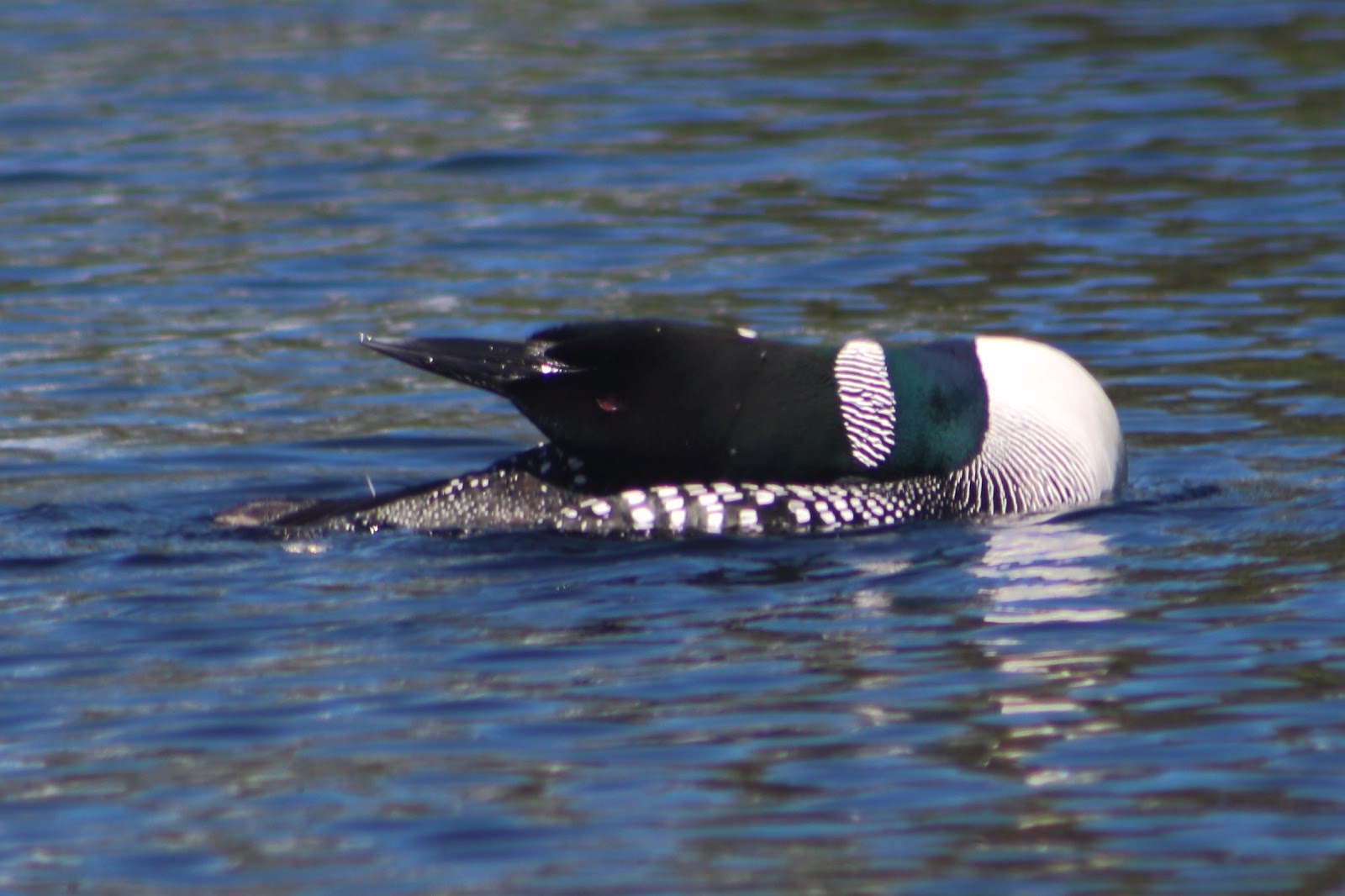
The contortionist

Lots of rain followed by sun and heat means lots of green as vegetation grows fast and lush.  Ferns love this weather.
Cinnamon Fern

The pale green leaves of the alder are contrasted against chocolate brown cones.
Alder tree with female catkins

These cones are the female catkins of the alder, the male catkins are long, soft, and light.

Plants don't don't have a monopoly on the greens - check out this iridescent Six Spotted Green Tiger Beetle:
Six Spotted Green Tiger Beetle (Cicindela sexguttata)

That one has a pretty easy name to remember, although all six spots can be hard to see.  The tiger beetle is harmless, unless you're a caterpillar, ant, spider, or some similar small insect on which they feed - not a bad neighbor to have.

Here's another green bug, also with a catchy name.
Assassin Bug (Zelus luridus)
This beetle looked somewhat familiar;  when I checked pictures from other sightings I found why it looked different:  it must have just emerged from its nymph phase as it had little tiny wings still developing.  Compare it to the mature insect.

I wrote about this interesting bug a few years ago, how it injects its prey with a poisonous enzyme that liquefies the insides of its victim so it can suck out the nutrients with its proboscis.

On that pleasant note, lets look at a non-green species, but one in a family that also thrives in wet conditions - mushrooms.
Fly Amanita (Amanita muscaria)

This fungi has hallucinogenic properties - it contains the psychoactive compound muscimol - but it's also considered poisonous, so let's not try it out.  There will be many more mushrooms emerging in the coming weeks.

Now that spring has moved aside and summer is finally here it's time to enjoy the green that is all around us.
Even the hummingbirds are wearing green


Sunday, August 28, 2016

August 28, 2016

As the labor day holiday approaches, signs of the waning summer are becoming hard to ignore even though we continue to be treated to glorious summer weather.  Sunrises are later and have moved noticeably towards the south compared to their June horizon crossings.
Sunrises over Lake Wicwas are moving the south

At one of those sunrises I had my first good look this summer at a local osprey, its underside brightly illuminated by the sun as it flew overhead.
An osprey on its morning fishing route

Another tell tale sign of late summer is revealed on cool mornings when the warm lake dislodges  water molecules into the atmosphere which are immediately condensed into low hanging fog.  The sun shining through the layer fashions some of the most ephemeral scenes on a lake.
Mist rises to reveal the far shore


The fog has long cleared by noon time, providing clear skies with long views from the lake shores and hilltops.  Here is a view of the white mountains from the top of Arbutus Hill, just west of Lake Wicwas.
New Hampshire's White Mountains from Arbutus Hill

The summit of Arbutus HIll is accessible from the Hamlin trail head - follow the Yellow Trail to the Magenta Trail, through the Smyth Conservation Easement and up to the view point on Arbutus Hill.  It's just over a four mile hike and well worth the trip.  Here's a link to the trail map.  (This and other maps of hiking trails in Meredith are available at the Meredith Conservation Commission website.)

While you're hiking in any of the conservation areas in Meredith you are likely to come across something interesting, whether plant, animal or mineral.  And as fall approaches, both plants and animals will become more evident (the minerals don't change their behavior so quickly).  Listen for the chopping of a woodpecker - it will usually be a downy or a hairy woodpecker, but this week I heard the loud hack of a Pileated and was able to track it down using the sound as a beacon.
Pileated Woodpecker

He (note the red mustache) was kind enough to continue his work on the oak tree so I could get a video, complete with wood chips flying into the air.  The blog doesn't like video, so I posted it on youtube here.

I also saw a Great Blue Heron, though not in its usual venue in the water, instead stalking some small morsel right through the woods at the edge of the lake, probably a frog or a toad.
A Great Blue Heron stalks its prey

On the plant side, the Speckled Alder are starting to develop their seed cones.
Speckled Alder (Alnus rugosa) catkins

The cones are actually the alder flower and are called catkins.  Alders are important trees for many animals;  moose, deer, and rabbits take advantage of their low and thick cover, and mammals such as beaver, muskrat, rabbits and moose browse on their bud, twigs and foliage.  Many birds eat their seeds and buds, including redpoll, grouse and woodcock.  It is also a favorite of beavers for use in their dams and lodges as it is quick to regenerate.  [Ref: USDA National Plant Reference Center]   Alder has medicinal applications and has even been used to improve water conditions in shrimp tanks!  [Ref: The Planted Tank]

Remember the pretty trillium back in May?  Well, by late summer those tiny plants have turned into giant leafy creatures, and their flowers have developed large seeds.
Painted Trillium in its late-summer foliage

How things change over the summer.

With a little bit of rain this week combined with shorter days and cooler temperatures at the end of August, mushrooms are starting to come on in force.  I believe this is the tiny Orange Mycena, less than an inch tall.
Orange Mycena (Mycena leaiana)

Look for many more varieties of fungi to sprout up during your forest walks as fall approaches.

Sunday, July 28, 2013

July 28, 2013


Late July already - the summer is flying by as usual.  We found a quintessential New England summer scene from the waters of Lake Wicwas yesterday:  Harvesting the field.
 

The water temperature has cooled down from last week, but it is still pretty warm.  Last week during the warm spell it reach 86 degrees near the surface.  I have not seen any cyano-bacteria blooms, but there have been reports of them.  Right now in the lake there are many small green globules floating everywhere in the lake that may be clumps of algae.
Possible Algae Flocculation


Perhaps the water quality experts can identify these for me at next week's Lake Wicwas Association annual meeting.  We'll get a full report on the lake water quality at the meeting.

I noticed another aquatic flower floating in the lake this week - a tiny yellow flower.

It is kept afloat by a seven-pointed star pattern of its leaves, and suspended in the water below is a soft network of roots (the weeds trailing to the lower left in the picture below).

It appears that the mother plant releases these when it is ready to send off its seeds to propagate itself, as they are free floating and not attached to the lake bottom.

Back on shore, I have seen many times the cones of the Alder tree after they have matured, but for the first time I noticed green cones just emerging.

The alder is interesting in that it is a deciduous tree, yet it has cones like an evergreen.  The cones are the female flower containing the seed, and they remain on the tree long after releasing their seeds, which is why they are so noticable in the fall and winter when all the leaves are gone.  This mature cone is on the same tree, left over from 2012.

Reading about the Alder tree, I learned some interesting facts.  The Native Americans used Alder bark for medicinal purposes;  we now know the bark contains salicin, which the body turns into salicylic acid -  or asprin.  Also the wood is a favorite of electric guitars manufacturers.  According to Wikipedia,  Fender has used Alder wood for their bodies of their Stratocaster and Telecaster guitars since the 1950s!
Fender Stratocaster


Let's not tell them we have Adler trees in New Hampshire.   ; )    Long live beautiful summer days at Lake Wicwas!