Sunday, November 20, 2022

November 20, 2022: First Snow

Jack Frost made his first appearance this week, bringing just a few inches of snow Tuesday night, but it was enough to make it look like winter before the calendar says it's time.


Jack Frost, Mother Nature, Father Winter - they all ignore human calendars.
November snow.

They roll to their own agenda.

The beaver ponds and marshes have started to skim over with ice on cold mornings and even small areas of the lake are seeing ice form.

A beaver lodge in Double-dammed Pond in the Hamlin Town Forest.

Soon the beavers will be locked into their underwater world for the winter.

I always anticipate heading out on the morning of the first snow to see which critters been out on the trails, but this snow was wet and still falling over night so tracks were melted and filled and pretty much unrecognizable.

Ill-defined tracks not easily identified.

I'll enjoy the anticipation a bit longer.

A few more mergansers stopped by Lake Wicwas on their way south this week including three males courting a single female.  

It seemed as though one male had been eliminated from the competition.

He was left all alone behind the others.

The hen was still deciding between the two remaining contenders.  

She's in complete control of the situation.

Hooded mergansers often pair up in the fall with the drake spreading it's showy crest to impress it's intended beau.  Once a pair has formed they will usually stay together for life.  Like wood ducks, hooded mergansers nest in trees, often as high up as 50'.  When the chicks hatch in the spring they climb out of the nesting hole and fall to the ground just 24 hours after hatching.  They then follow their mother through the woods to the nearest body of water which may a journey of several hundred yards.  It's a good thing they lay a lot of eggs, typically a half dozen to a dozen in a single clutch.

And, wasn't I surprised to see our young Maddie on Friday!

Maddie, on November 18th.

There had been no reported sightings for a while, so I don't know where she's been hiding, but I can only assume this juvenile loon is our Maddie.  


November is an interesting transition month that brings a multitude of changes including interesting skies, clouds, and sunrises.  

Pink sunrises

30 minutes later the sun shines bright white on new snow.
And another 30 minutes later, sun on the shoreline, with dark clouds overhead.

November - it's a never ending circle of wonder.


Sunday, November 13, 2022

November 13: 2022: Frost on the Fountain

We're finally starting to get some colder weather around here.  I walked past the fountain on Main Street in Meredith one cool, bright morning this week and got a clear message that it's about time to put away the hoses and turn off the outside spigots.
Frost on the Fountain.

Still, many of our hardy plants are hanging in there even though it was cold enough that night to put a sheet of ice on even the moving water in the fountain.


Perhaps it's due to the mild weather, but we haven't seen a lot of migrating ducks this fall - just a few wood ducks, and then this week, a couple of hooded mergansers paddled by.
I say a couple rather than a pair because these are two males.

I love the way their tail feathers fan out on the surface of the water.

One of our loon observers responded to my question last week about the presence of our loons.  They reported that until about November 4th they had seen the chick and an adult most every day, but after that, nothing. So it's possible our young Maddie has now left her childhood home and flown off to the ocean where she'll spend the next four or five years.   I'll wait another week to be sure, but we may have seen the last of her.  Most of our summer visitors have also left by now, but there are plenty of brave birds that will tough out the New Hampshire winter with us.  One of these, the stealthy barred owl, flew out from its perch as I was on a run and landed on a tree almost right above me.  I only had my phone so I didn't get a great picture.
It's a little unusual to see an owl in bright sunlight.

When it looked right at me its eyes looked like huge black saucers.

Were you able to see the eclipse of the full beaver moon this week?  I wasn't, as there was a layer of clouds at the horizon at the time of the eclipse.
The morning of the full lunar eclipse.

From the red color on the clouds I could tell it would have lived up to the name of a "blood moon".  Of course, the next morning was perfectly clear.  

Earlier that night, the beaver moon shone through the trees.


So let's honor the namesake of this month's moon to close out the week:
A beaver cruises Lake Wicwas in search of winter food.

It's a busy month for beavers as they stock up for the coming New Hampshire winter - which might actually make an appearance next week!


Sunday, November 6, 2022

November 6, 2022: The Elusive Marten

 Hello November, though it sure doesn't feel like it.  

A warm November day on the lake.

We've had more good paddling weather and I've been out a couple of times this week to take advantage of it.  Though most of the leaves have come down there are still a few bright yellow trees accenting the hills around the lakes.


I wasn't sure what kind of tree was holding on to such bright leaves this long so I took a trip over to Wicwood Shores Road to investigate, and they are in fact bigtooth aspen trees - very large and impressive bigtooth aspen.  

Mature aspen can grow to 60' high

The only down side of the warm weather is the high water content in the atmosphere brought up from the south with the warm air mass which makes for a lot of haze, particularly looking south with the sun low in the sky. 

Looking south from the summit of Mt. Osceola on Thursday,

But even looking north towards Canada it was hazy.

North from the summit.

It was hard to drag myself off that warm and peaceful spot on our planet, knowing it may well be the last summer hike of the year.  There were few people on the trail this late in the hiking season, and even fewer birds to be heard - just a few scolding chickadees and a barely perceptible "pip" of some tiny bird in the trees.  But there was one exciting find, evidence of the elusive marten right in the middle of the trail.  

Marten scat deposited on a boulder for all to see.

Other animals will leave their scat in prominent spots for all to see and smell, including other members of the weasel family, so I had to look this one up.  I knew it was a weasel by the twisted form of it, but not which weasel.  My go-to reference book, "Tracking and the Art of Seeing" by Paul Rezendes [HarperCollins, 1999] indicated it was left by a Marten.


They definitive factor is the size.  Marten scat is 1/4" in diameter and 1-1/2" long, whereas the other likely candidates, the least weasel, long-tailed weasel, or ermine, have scat less than 1/8" in diameter and 1-1/4" in length.  Supporting this conclusion is the location, in a mixed forest at an altitude of about 2500' in the White Mountains.  In winter this animal may move to higher elevation to take advantage of the dense cover of the spruce-fir forest for dens and hunting.  The marten is the rarest of our weasels, having been driven from most of its range by logging and trapping, though recent regulations on trapping have allowed a rebound in its numbers.  It's range in New Hampshire is still constrained to the White Mountains and farther north;  marten are secretive and reclusive so I don't expect to ever see one.

I didn't see any loons on the lake this week, so I'm interested if anyone has seen them.  It doesn't seem like they would have left while the weather is still so nice.  The herons certainly haven't left; I've seen them several times this week, fishing, and flying over the lake.

Note the toes on its upheld leg as it stalks the shoreline.

I can't be sure what the heron think, but I'm perfectly happy with 70 degrees in November - as long as it gets cold in time for winter to start, and I know I'm not the only one that likes a quick transition from summer to winter.  

I'll end with a couple more scenes that reflect the beauty of the late fall season around the lakes.

Looking south down Harris Cove.

The Rawson Wood Islands from the Red Trail viewpoint in the Hamlin Conservation Area.

This weather can't last forever.

One last note as I'm about to publish this on Sunday morning - a bunch of woodpeckers have just arrived and are flitting about the trees all around the house:  two big hairy woodpeckers and two smaller downys.  A sign of the changing season.


Sunday, October 30, 2022

October 30, 2022: Leaf Recycling

The palette of the lake is becoming less varied by the day as November gathers near, but there are still splashes of brightness to be found:  shiny red partridge berries, deep orange beech leaves, bright green moss, and gently frosted oak leaves.

Oak leaves on a frost morning.

Many cultivated flowers survived the first freeze on Friday night so if you planted some hardy flowers in your garden this summer they are likely still blooming.  

Linda's foxglove continue to bloom.

A very few wildflowers are also soldiering on.

The aptly named Frost Aster (Symphyotrichum pilosum)

But most have passed by.  Even the goldenrod has succumbed to the cold.

Goldenrod, no longer golden.

The most prevalent hues in the forest now are green needles and brown leaves.  Shuffling though the  blanket of leaves on the forest floor this week I was struck by the amount of energy that trees put into the thousands of leaves they construct every summer, just to cast them off in the fall.  Each of these tiny chemical factories - and a single oak tree might have a quarter of a million leaves on it - spends the summer taking carbon dioxide from the atmosphere, and using solar energy, manufacturing the sugars that are essential to the plant's existence, as well as to every animal on the planet.  And when the factory shuts down in fall, a deciduous tree just lets them all go.  
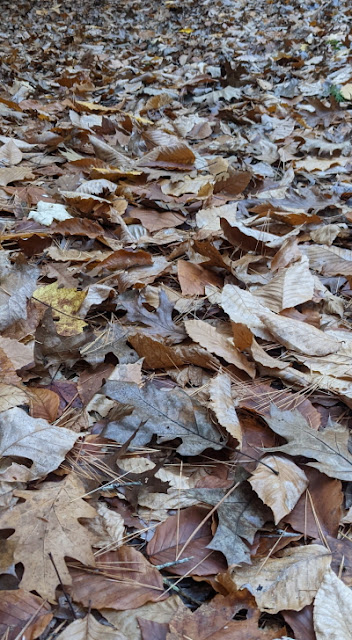

But then I realized the tree is not actually done with them.  In fact, trees may be the original recycling plant.  Once the leaves and all other tree debris are on the ground a whole new biological system of fungus, bacteria, and other life forms takes over.  There are literally billions of living organisms that process this organic material and in turn allow the tree to reabsorb many of the nutrients it put into making those leaves.  

A single teaspoon of soil in the forest contains billions of living organisms, including perhaps half a millions round worms, half a billion fungi, and many billions of bacteria.  [National Geographic, Sept. 2022, Ferris Jabr, pg. 92]  Most of these are obviously microscopic and far too small to see with the naked eye, but some, such as the snow flea which I most often see in the winter when their black dots stand out on top of a white layer of snow, can be readily observed.  These organism seen under high magnification are absolutely fascinating, many of them having legs and mouths, and look like creatures from a Star Wars movie.  The above referenced article has amazing pictures of them taken with an electron microscope.  All these organisms decompose those leaves, releasing the nutrients within, which can then be taken up again by the tree and many other plants and animals.


The past week's events brought us to our childhood home of Concord Massachusetts where we had a moment to visit the the Old North Bridge, the scene of the "Shot Hear 'Round the World" (Ralph Waldo Emerson).  Although just 90 miles to the south of the Lakes Region, some trees in Concord have many of their factories still attached, though even there the production of carbohydrates has ceased.

A maple tree at the Old North Bridge.

While marveling at the beautiful colors that nature gives us I noticed a nice size hornets next snuggled in with the leaves.

A bald faced hornet's nest by the "rude bridge that arched the flood".  (Also Emerson)

The inhabitants of the nest are likely gone at this point, but I'll bet there were a lot of hornets buzzing the tourists all summer.

We witnessed no musket fire at the revolutionary battle field, but we did see a huge red-tail hawk fly across the open field and land in a tree directly above us.  

A bird of prey stands sentry over the historic battlefield.  (Poor photo - all I had was my phone.)

This bird was clearly acclimated to tourists as it had no concern with us at all and spent the next hour flying from tree to tree searching the field for small animals as people passed near by.  


Back in New Hampshire, cool nights means fog has been forming over the lake - perfect for the upcoming spooky night.


Happy Halloween!

Sunday, October 23, 2022

October 23, 2022: Maddie and Mom

I said last week that it looked like both of our loon chick's parents had left the lake, but in fact mom is still here.  I saw two loons far apart during a paddle this week and I could tell one was a juvenile and one was an adult by the plumage and I was confident the juvenile was our chick Maddie.

The chevron pattern on her back is the plumage of a juvenile loon.

It's difficult to tell an adult loon apart from a first year chick at this time of year due to the adults losing their distinguished black and white plumage, but the second bird I saw had remnants of spots on its back indicating it was an adult.

From a distance I couldn't tell this wasn't a juvenile.

But blowing up the pictures revealed a few faint white dots.

I watched to see if I could catch a glimpse of a band but the loon wasn't cooperative so there was no indication it was connected to Maddie.  Until, that is, Amy Wilson was able to collect the proof that in fact, Maddie and her mother are still here and together.  

Maddie and her mom enjoy a peaceful early morning moment.  Photo by Amy Wilson.

I say peaceful, but based on others' reports, Maddie was probably nagging her mother for breakfast.  Though she is perfectly capable of fishing on her own, when mom's around she's more than willing to let her do the meal prep.

It was this moment however, that provided proof of identity:

Photo by Amy Wilson

Our female loon had two feathers clipped during its banding process this summer, and the absence of those feathers is conclusive.  


Now I'm not complaining about the great weather we're having, but we will need some cold to arrive in time to send the loons on their way before they molt their flight feathers and can't leave the lakes.  It probably won't be a problem on the small lakes which freeze early, but the larger lakes sometimes freeze over so late now that loons can get stranded without the ability to fly.


In spite of the warm weather the season is progressing, though it's easy to convince myself it isn't when we have gorgeous days like the past two have been.  They started out cold with a touch of frost forming in areas exposed to the sky and radiational cooling.

Oak leaves tinged with morning frost.

Then the days quickly warmed as the sun rose, and by noon the forest was warm and bright, glowing with October sunlight illuminating vibrant yellow and orange leaves.

Beech trees in their fall glory.

The red maples have dropped much of their foliage, letting the oaks, beech, and aspen have their moment in the spotlight.  On a bike ride in Dorchester on Friday the aspen were the stars of one section of trail even as many of their leaves lay freshly fallen on the trail.

A trail passing through a stand of aspen trees.
A pastel pallet of aspen leaves.

Even the beavers appreciate the fall colors, using them to decorate their homes for the season.
Beaver lodge dressed up for fall.

Frosty, foggy mornings, warm afternoons - I'll take as many of these fall days as mother nature will give us.


We still have two more weeks of daylight savings time!