Sunday, December 7, 2014

December 7, 2014 - Black Bear on the Hunt

Early snow followed by warm weather provided a rare opportunity, something I have not had before:  the chance to track a Black Bear on its travels through the forest in search of food.  Usually bears are fast asleep by the time the snow comes.  The supposed safe-date for putting bird feeders out is December first, but this year put that theory to waste.  On both December first and second I found bear tracks in the snow - right across my ski trail - and I took the opportunity to follow it on its travels.
Bear Tracks across the Trail


The soft, wet snow left beautiful prints.


And an indication as to just how large an animal this is!

It was out taking advantage of the warm weather to add a bit more to its fat stores, as a bear will lose 20 to 30% of its weight during the winter.  And if it's a pregnant female, it needs sufficient stored energy to give birth and nurse its young during this time. 

The first stop on its way was to raid a Red Squirrel's cache of acorns and pine cones, which the squirrel had diligently stashed under a large boulder (though not well enough to hide it from a bear's nose).
Raiding a Squirrel's Food Supply

An Empty Stash

Mister squirrel won't be happy to find its winter food supply depleted.

Next, the bear spent a long time digging up a large area of the forest floor under a stand of mature oak trees in search of acorns.

Foraging for Acorns
As mentioned on October 12, this was a mast year with copious acorn production, so I expect it found an abundance of high energy food at this stop.

Farther along in its journey it came across the remains of deer, killed by a coyote, or perhaps a hunter which had not removed the carcass.  At any rate, the bear picked up a couple of choice pieces of deer remnant and brought them along to a comfortable resting spot under a hemlock tree.

A Quiet Spot for a Meal
Here the signs indicate the bear lay for quite a while, licking the bones clean.
Parts of Deer Spine and Ribs

Bear are opportunistic consumers, eating just about anything they come across.  Remember the hornet's nest back on August 31st?  They eat mostly vegetable matter, but will take any carrion they find, and will kill a fawn or a weak deer if they have they opportunity.

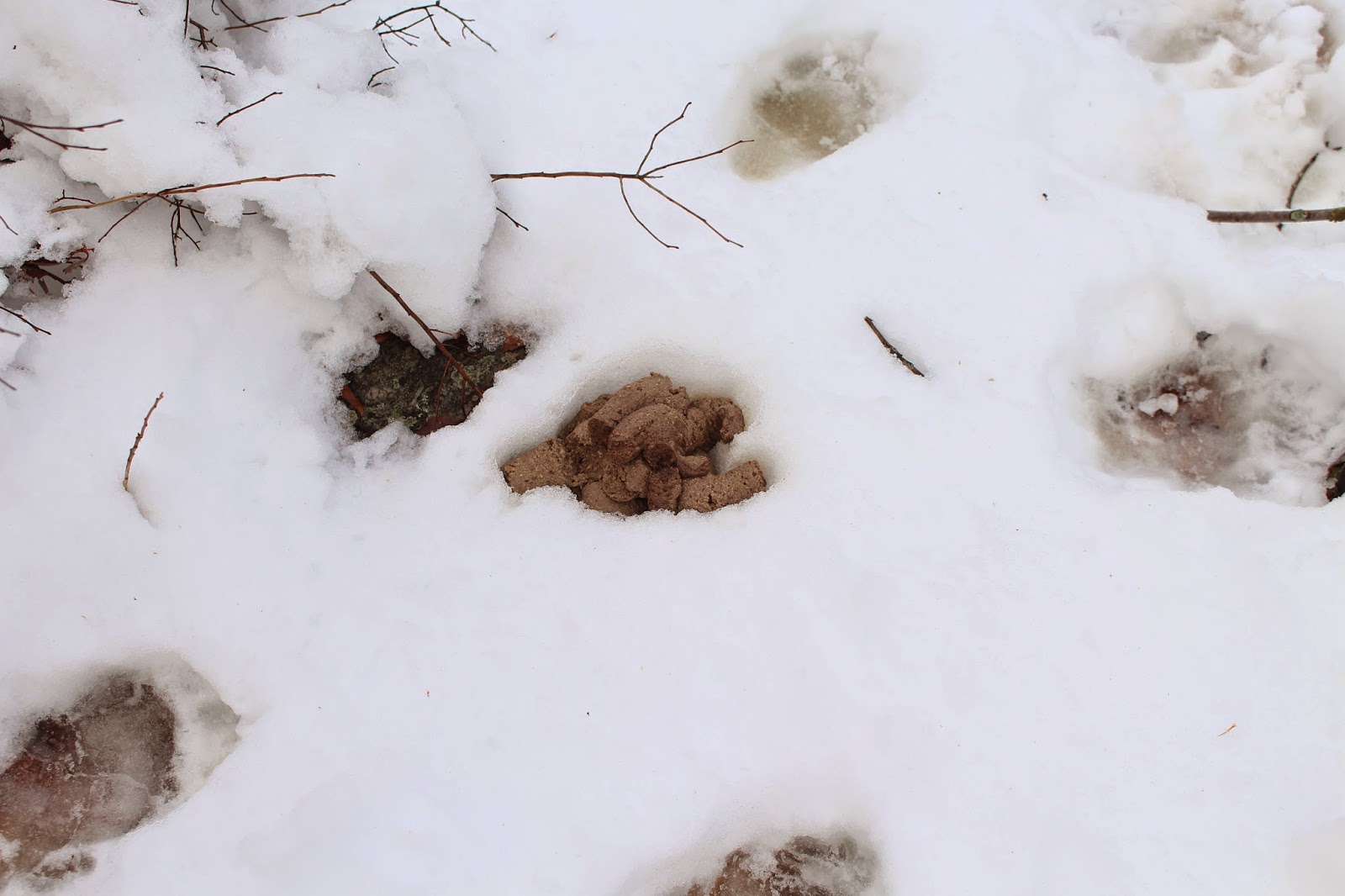
Throughout this bear's feeding voyage it left its calling card - large piles of scat and urine holes in the snow.


Back close to home, it was attracted to the scent of bird feeders and bird houses.  It stood right up and peered into our bird houses.  Had their been anything of substance inside I have no doubt it would have ripped the wooden bird houses to shreds.


Now cold weather has returned, and I haven't seen any more activity for the past few days, so maybe it has finally decided it is time to sleep.  As much as I enjoyed the rare experience of tracking a bear, I must admit it's a little unsettling to think about this animal roaming around the forest where I spend so much time.

The cycling back and forth of warm and cold temperatures has formed, and then melted, ice on Lake Wicwas, but each time the edge of the ice extends farther out into the lake.  Today, I estimated about 80% of the lake is covered, with only the widest part in the center of the lake still open. 
(The White Mountains in the distance are upholding their name)

Winter is steadily increasing its grasp on Lake Wicwas.

Sunday, November 30, 2014

November 30, 2014

Tremendous changes transpired this past week around Lake Wicwas.  The warm weather early in the week melted most of the ice that had formed during the prior cold snap, but then an early winter storm hit and changed the landscape completely.  Many people woke up Thanksgiving day to a beautiful blanket of snow covering everything - and no electricity to cook their turkey.
Thanksgiving Sunrise after the Storm

It was a wet snow that stuck to trees and power lines, causing over 200,000 customers in New Hampshire to lose power.  Some were out until Sunday. 

There was enough snow to allow snowshowing and skiing, but it was slow going due to the trees knocked down and blocking the trails.


But it sure is beautiful when the sky turns blue and the sun comes out after a New England snow storm.

It warmed up today, helping our efforts to clear out the snow;  some thought is was down-right balmy.

You have to love New Englander's attitudes towards winter!

The snow filled in much of Lake Wicwas with an inch or two of slush, though the widest part of the lake remained clear.  Whether or not this layer freezes will depend on the weather over the next week.  If this does freeze it will require patience and care before traveling out on the ice, as these conditions make for weak and widely variable ice.  It's not like the solid black ice that forms when the entire lake is cold and freezes at once.
Sunday, November 30, 2014

The last week of November transformed Lake Wicwas rapidly from fall to winter, but it is too early to know whether this will last.  New England weather is far too fickle to predict winter is here for good.


Sunday, November 23, 2014

November 23, 2014

I missed being able to track the changes around Lake Wicwas the past few weeks, as we were away on a trip to the south.  We managed to stay just ahead of the first polar plunge for the year, but traveled back through it.  It was in the twenties way down in South Carolina!

I am always surprised by how similar the southern Appalachian mountains are to our own white mountains.

Caesars Head State Park, South Carolina
 The foliage there is several weeks behind ours, with some nice color still to be found at the right elevations.


Farther south in Florida I observed very different water fowl than we have in New Hampshire, with some interesting methods of catching their food.  My favorite were the pelicans, which soar low over the ocean, flying up when they see lunch, and then just letting themselves crash-land into the water to load up their bills with small fish.  The seagulls follow closely behind, hoping to pick up any stray leftovers.


Back in central New Hampshire, I was surprised to see a layer of ice already on parts of the lake.

There were also a few remnants of snow from a storm while I was away.

As it was warm today, the ice is mostly gone, and with more warm weather and rain coming, it will likely all be gone soon.  I'll then get to watch it form again.

I probably missed most of the migratory birds, but I did see a large flock of what looks like mergansers on the lake.

They were far away, so it was hard to tell.  Also far away was a lone, grayish-brown diving bird.  It looked like our loon chick, but again, I will have to watch over the next few days to be sure.

Hunting season for deer is in full swing now - for humans with firearms, that is.

Watch out Bambi!
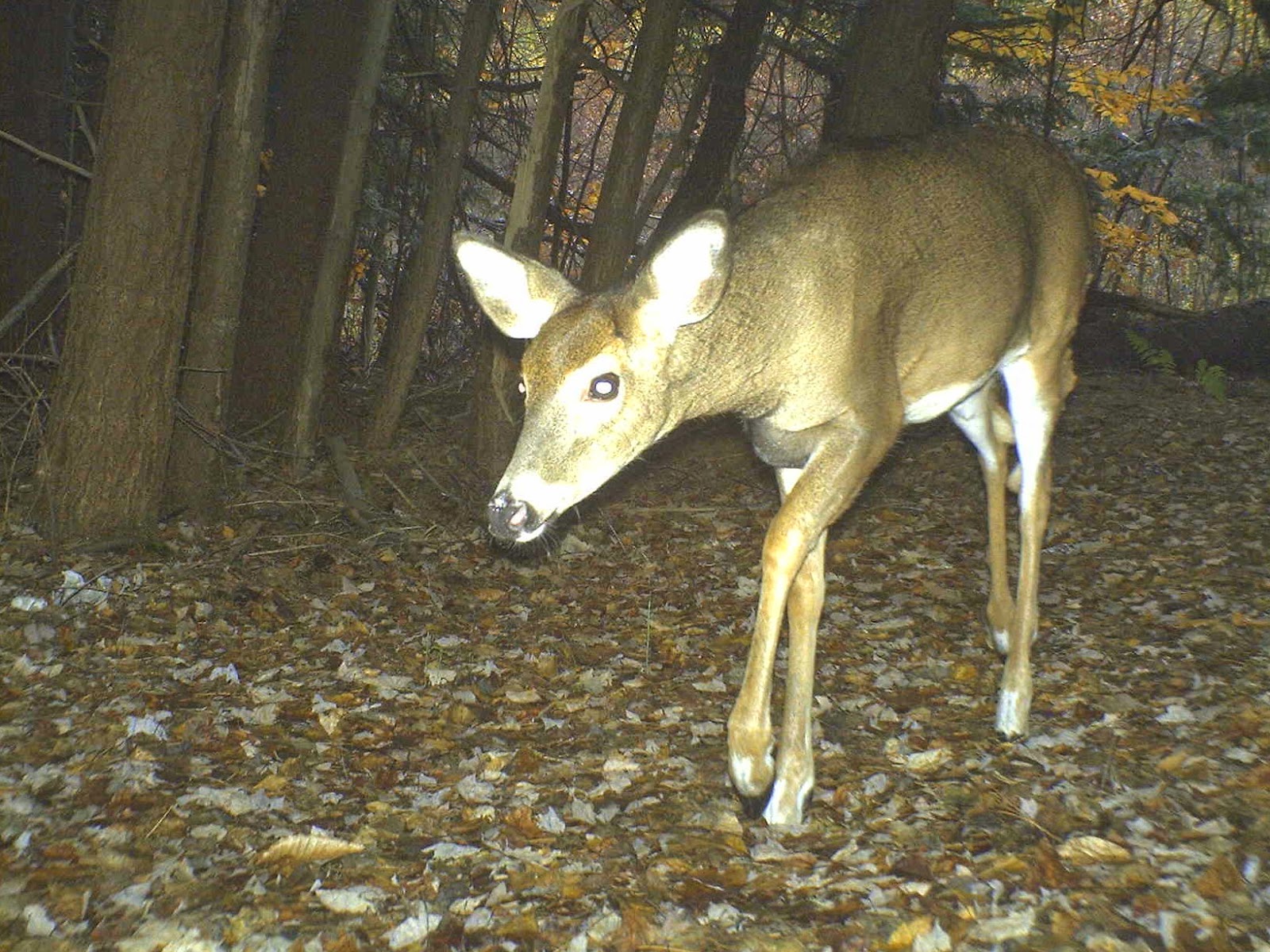
Deer are always in season for other predators.  One evening a deer walked carefully along a frequently traveled game trail, followed just a few hours later by a coyote, close on its trail.


There is never a safe moment for a deer.  I couldn't count how many deer we saw killed along the highways between New Hampshire and Georgia.

Although is rather gray and drab around Lake Wicwas in late November, there are still some beautiful sights to be seen at the right moment.


The beauty of winter isn't far off now.

Sunday, November 2, 2014

November 2, 2014

It has been a week for the birds, including the weather.  October is the wettest month of the year in New Hampshire, and this year it sure followed the trend.  I did manage to get out for a kayak on one nice day;  this time of year I treat every trip on the lake like it might be my last for the year (at least on liquid water).

I saw quite a few ducks stopping for a rest on their migration trip, including four ducks that kept flying off ahead of my path around the lake.


Other birds on the lake this week included various ducks, including three pairs of Ring-neck Ducks on one rainy day, and a Pileated Woodpecker flitting from tree to tree along the shore.  The Canada Geese are still here as well - the first to arrive, and one of the last leave. 
Canada Geese
If they knew hunting season for Canada Geese in our region lasted until December 23rd, they might leave sooner!

There are a few random splotches of color around, mostly from the huckleberries on the shoreline and an occasional maple.
The last of the Color
The water level was very low, making the trip interesting, as terrain usually submerged was revealed above the water line.  Evidence of a lake changing slowly over time became evident;  rocks that used to part of the shore have been deposited into the lake as erosion washed away the soil that held them in place.  Over the decades the lake has become a bit larger in area, though shallower as a result. 

The Shoreline Revealed
I could also see the thousands of cavities that are used by a myriad of animals for homes and hiding places. 

All those little holes between rocks and tree roots, hidden under the water, provide coverage for mink, muskrat, snakes, and other aquatic animals. 

The bird feeder went out this week, hoping that the bears have gone off to find their winter resting sites.  Within an hour the desired visitors had found it, starting with chick-a-dees and both Hairy and Downy Woodpeckers.  Soon thereafter a large flock of Tufted Titmice came by, and they were not being very charitable;  there was lots of aerial dogfighting going on, and chasing each other away from their new-found food supply.
Tufted Titmouse

All the creatures are preparing for the coming winter, whether by securing food sources, finding a spot to hibernate, or heading to warmer climates (including many homo sapiens!).  Signs of the impending change is evident almost everywhere I look, including the evening sky, which is displaying the hues of the coming season.
Looking West from Meredith Center Road

Sunday, October 26, 2014

October 26, 2014

It was a wet week around Lake Wicwas with almost two inches of rain falling on the lake.  Nonetheless the water level continued to drop as the dam has been lowered and water is flowing rapidly from Lake Wicwas, through Meredith Center, and into Lake Winnisquam.  The lake is six inches below full level and a lot of typically unseen shoreline is visible. The rain and wind drove yet more leaves from the trees, leaving mostly brown oaks and beech.

The occasional green tree stands out in contrast to its drab surroundings.


The White Tail Deer have started the fall rut and I have come across a couple groups of four or five deer that a buck has probably rounded up.  I have also seen a few scrapings on the ground where a buck is marking out its territory.
Deer Marking its Territory

Other than this, it was a quiet week for wildlife around the area.  There were a few more Wood Ducks on the lake, and I heard at least one loon still on the lake.  I did notice an old rotten tree that had been ripped apart by something.
What ripped this tree apart?

Could it have been a bear looking for insects?  It's more than a woodpecker usually does, and there are no wood chips around. 

A couple of weeks ago we took a trip up to the Sky Pond State Forest.  This is a beautiful State Forest right near-by in New Hampton with geology and an ecosystem very similar to that of Lake Wicwas.  From the parking area it's a short hike to a ledge high on the west side of Lake Winona, very much like that on the west side of Lake Wicwas.  It is a common formation created by glaciers as they scoured the earth moving south over what is now the Lakes Region.

From the ledge one can see Lake Winona, Lake Waukewan, Hawkins Pond, and even a bit of Winnipsaukee.

Lake Waukewan from Bald Ledge

There are also nice views of Mt. Chocorua, the Rattlesnakes, and the cliffs on Mt. Whiteface.

Lake Winona and Hawkins Pond with the Sandwich Mountains in the distance
Mount Chocorua from Bald Ledge
This is an easy hike that I highly recommend.  You can find driving directions and details of the hike here.


Sunday, October 19, 2014

October 19, 2014

Heavy rain and strong winds have taken their toll on the trees around Lake Wicwas;  there are still a few pretty sights left, predominantly in the deeper yellows of the oaks.  Most of the maple leaves are now lying on the ground, getting ready to provide nourishment for next spring's wild flowers.

On a walk along Chemung Road one morning, while appreciating an unusually hued maple,


I noticed birds flitting out of the branches, and landing on the ground right at the edge of the pavement. 
Did you see the Chick-a-dee?

They had found a good supply of seeds that they were feasting on, fattening up for the coming winter. 


Nuthatch

I think it likely they were white pine seeds that had been liberated from their cones by cars driving over them on the side of the road.

On the opposite side of the road were the tracks of several deer that must have passed by that morning.
White Deer Tracks

I have put out the trail camera a few nights recently, and though I haven't captured any deer, I do continue to see the gray fox most nights, passing in both directions on its hunting trips.


The very same morning I saw (and smelled!) a fluffy little skunk waddling along the side of the road. 

Autumn is good time to see nature!  I resisted the urge to get a closer picture....

The fog hanging over the lake was thick that morning, but now and again it would lift enough to see part way across, revealing a solitary creature out getting its breakfast as well.

This looked like an immature loon, perhaps our chick, but in the middle of the storm on Saturday I saw two loons out fishing in the rain.  One looks like an adult, but with the gray sky and rain in the air I can't be sure  - they both look rather mottled and gray.


The Wood Ducks must also have started their migration, I have seen several on the lake.

With more wind and cold temperatures tonight, maybe even a hard freeze, this may the last of the colorful offerings of 2014's fall season.