Sunday, February 21, 2016

February 21, 2016


2016 is turning out to be the year of the rodent - there's just no end to the stories they are telling this year.  A couple of weeks ago I noted ten red squirrels in the yard at once - they were everywhere!  But recently, ever since I've seen the hawk flying over the cove on an almost daily basis, the squirrels have become much more scarce - only two or three, and frequently none.  Even the gray squirrels have gone AWOL, and I'm pretty certain it's not a coincidence.  Well, this week I found where at least one squirrel has gone off to, and it wasn't pretty.  Consider this fair warning to those who would rather not experience the harsh reality of nature up close!

Walking along a well trod trail, right in the middle of the path I found a bloody bit of creature.  

By the whiskers and markings, I presume it is the remains of a red squirrel, apparently the nose and skull of the little guy.

Located under a large tree with a branch protruding over the trail, I surmise a hawk - but maybe an owl - caught the animal near by and then sat on the branch and tore it apart, devouring the portions it liked, and leaving this remnant behind.

Its little teeth, fine for grinding seeds and other small food, were no defense against a predator.
These are teeth made for grinding - not much help in a fight

Here are a couple of somewhat more-intact specimens I saw this week, and they were doing their best to keep an eye out for trouble.

But sometimes they just have to go heads-down in search food, and that would be the time for action.
Hurry up, dear!

I wonder if birds watch and wait for that moment to launch their attack.

Later, out in the middle of the lake I was attracted to some animal tracks that appeared to come from nowhere, just random tracks in the snow with no path coming or going.

Going to investigate, it became clear these were the marks of a very large bird.

Large footprints

And there was another small smattering of left overs.

I don't know what event took place here;  I doubt a bird landed to eat - it would be too exposed and there were no other leftovers to be seen.  Perhaps one bird was being harassed by another, and it dropped its meal, and one went down to collect it?  I guess this is just one more mystery that Lake Wicwas will keep to itself.

Have you noticed the sun is getting brighter, and higher in the sky, and the noon-time shadows a bit shorter?  Mating season for red squirrels and many other animals is about to begin, so their population will rebound quickly.  And just in time for the subsequent mating season of owls and hawks which will take advantage of the increased food supply to nourish their offspring. 

Days are noticeably longer now - only four weeks to the equinox!

Sunday, February 14, 2016

February 14, 2016

Happy Valentine's Day!  We needed that little extra warmth in our lives as the coldest temperatures of the season hit early this morning: -15 degrees in Meredith with the windchill at -30.  This arctic air mass was large enough to reach all the way down south to touch our friends who ventured to warmer climes for the winter.  Even the animals were avoiding the cold this morning as there were only two red squirrels out and relatively few birds making an appearance for the annual Audubon Backyard Winter Bird Survey.  Every inch of Lake Wicwas froze over, even the flow right up to the dam, but Winnipesaukee, as of yesterday (according to Emerson Aviation) was not - too much wind.  But when the wind dies it will probably happen.

I've seen a lot of rodent activity this winter and have commented that many predators rely on them for their sustenance through the winter.  I have not mentioned the largest rodent however.  The beaver has few predators, and essentially none in the winter, with one exception:  On Lake Wicwas I occasionally see trappers out in pursuit of their pelts, which are most valuable in winter, thick and soft with their warm coat in place. 
Three beaver traps surround an active beaver lodge

These traps were set up beside an active beaver lodge where the lake runs along Chemung Road.  The beaver population is very healthy in New England after recovering from near extinction years ago;  there seems to be little concern over trapping, which helps prevent over-population.

In a different part of the lake I also noticed a hole in the ice which appears to be a muskrat escape-hatch from the lake. 
Muskrat hatch in the ice

Muskrat footprint

I'm not aware of any activity to trap these somewhat smaller members of the rodent family.

I saw a beautiful red-tail hawk soaring over the lake a few times but haven't seen it or any other raptors at our feeder this year.  Nonetheless, I'm sure our birdseed is finding its way up the food chain one way or another.  I followed some weasel tracks through the woods, seeing it poke into every squirrel den and mouse hole it came across.
The tell-tale double print hop of a weasel
Scoping out below a branch where a red squirrel enjoyed a meal
Anyone home?  Mouse prints show he's on the right track
Mouse tracks running back and forth from one hiding spot to another

I didn't see the pileated woodpecker this week, but the new snow provided proof it is in the area, splintering the trees in search of insects and eggs. 
New snow provides a time-stamp for visitors

A 40 degree warm up is forecast two days out, but for now, another cold night lies ahead for the Lakes Region.


Sunday, February 7, 2016

February 7, 2016

It was another crazy week weather-wise, which is to say, completely normal.  I think the weather and Wall Street are having a competition to see who can be the most volatile this year.  We had 50 degrees and rain which left the lake shrouded in fog and covered with water.
 

This is February?

That was immediately followed by a tiny snow storm before the lake could freeze, squashing any hopes for more skating.
Now that's better

Then temperatures dropped to 14 degrees, which kept the snow around for a day or two, and making it at least look like winter again.

The cold air returned just in time to save the New England Pond Hockey Classic, with only a few wet spots in the corners of some of the 25 rinks set up on Lake Waukewan.
The ladies ripping up the ice on Waukewan


Cider Bellies kept the players warm with coffee and donuts
 
The thin layer of new snow made it possible to see who's been out in the woods, and I learned that a pair of foxes cruised through the yard the night after the storm.

These tracks are so small and round that at first I thought they were from a bobcat, but the symmetry of the print and the pyramid between the toes and the heel pad indicate fox.  The pair walked so perfectly in each others foot prints that I never knew there were two of them until the trail separated into two for a short stretch before melding back into one.

The object of their night time excursion was also evident.


Lots of mice tracks throughout the woods, running from hole to hole to find food while evading all the predators, dragging their tails along behind them.

But not all of them were successful in their travels.  One unlucky furry critter popped out of its hole when someone - probably a mink based on the location right on the waters edge - was passing by.

There was only a short skirmish, with little blood shed, but there was clearly a casualty, and some happy mink had secured its dinner.
Short pieces of fur - from a mouse?

All those predators are missing an easy meal by not stopping by our house during the day;  one morning I counted ten red squirrels out running around the house.  And the gray squirrel looks like easy prey, up on the feeder, distracted by its mission.

This volatile winter has brought about many changes in the surface of the lakes - ice, water, snow, slush, ridges and drifts, but has also brought along with it some unusual and spectacular sights.


Sunday, January 31, 2016

January 31, 2016

It's hard to believe January is over when it doesn't feel like winter has even started.  Already the days are noticeably longer, and the sun higher in the sky.  The chickadees are even out singing their spring "dee-dee" song.  It has been so warm that the larger lakes are still not completely frozen over, and some loons have lingered here past the point when they lose their flight feathers.  Loons are unlike most birds which lose and replace their flight feathers continuously, one or two or a time - think about how often we see a hawk soaring with a gap in its wings.  But loons are such heavy birds that they can barely fly with all their feathers intact!  That's why they need such a long stretch of water to take off;  if they lost even one feather they would have difficutly flying.  So instead, they molt all their flight feathers at once, leaving them vulnerable for a few weeks with diving their only mode of escape.  They are supposed to do this after they leave the lakes and are on the open ocean, far away from most predators. 

Scientists don't know if the warm weather is causing some loons to stick around, but at any rate, five animals have been rescued by the Loon Preservation Committee on Lake Sunapee, four of which have already been released on the ocean (the fifth is being treated for lead poisoning).  You can read the LPC press release about the rescue by clicking here.  If you become aware of any loons still on New Hampshire lakes during this warm year, contact the Loon Preservation Committee immediately.  In addition to delaying the animal's schedules, the warm winter has also delayed the Meredith Fishing Derby by two weeks, and the Pond Hockey Classic has been relocated to Lake Waukewan.

On one of those warm winter days this week we took a trip over to Prescott Farm, a beautiful environmental education center managed in partnership with the NH Audobon Society, and located in the center of the Lakes Region just a mile from Weirs Beach.
Prescott Farm on White Oak Road near Weir's Beach

It is a wonderful example of early New Hampshire farms, originally encompassing 700 acres, set high on a hill with views of the Belknap Mountains.

The Belknap mountains frame the farm to the south
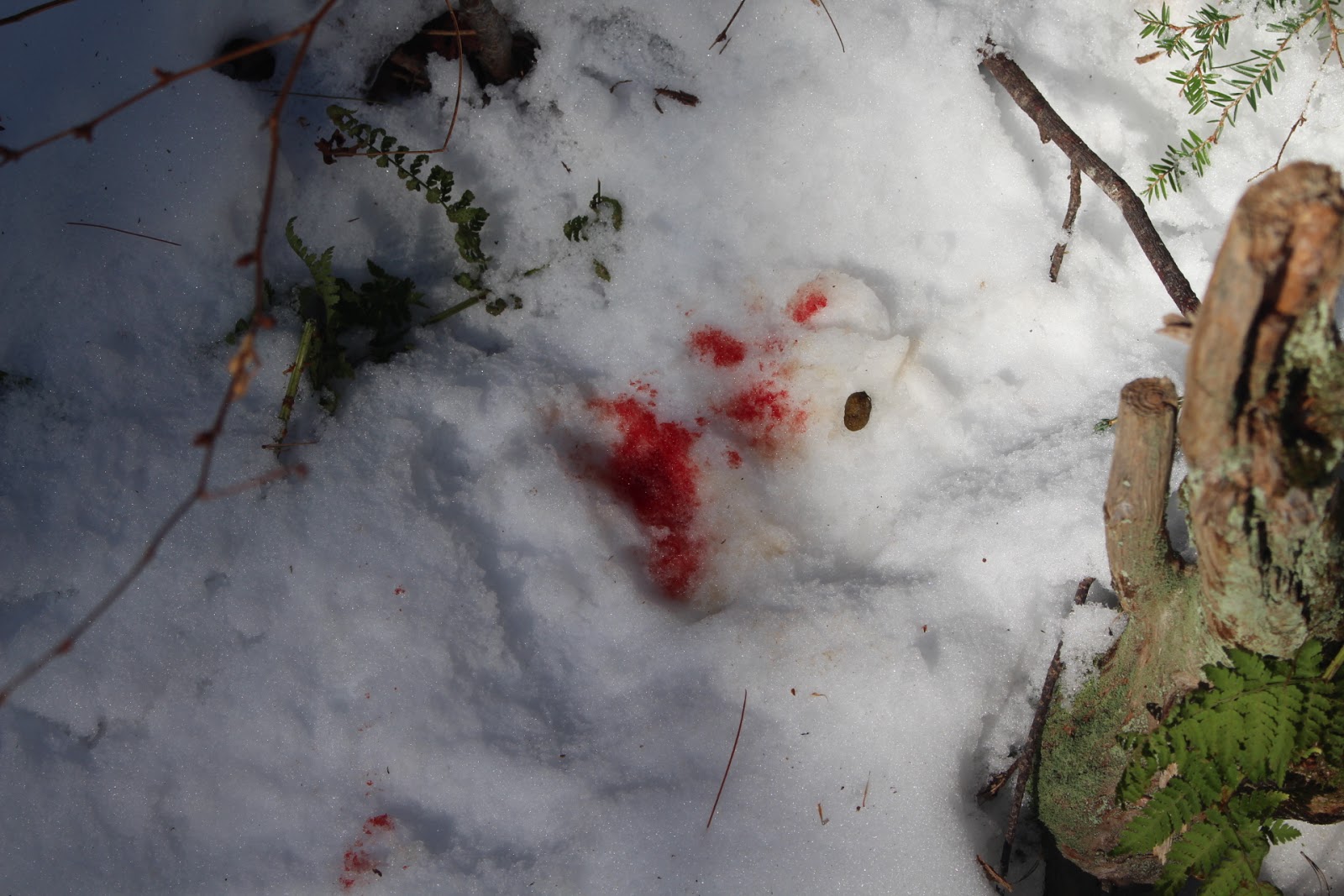
The property includes well maintained trails through forest, fields, wetlands, and a working sugarbush;  we hiked the Pond Loop and Sugar Trails, seeing lots of animal signs along the way.  At one point we noticed a spot of fresh blood on the trail.
Something was recently injured here

Looking further we saw a porcupine trail and more spots of blood along the trail up to the ledge where it undoubtedly has a den, and down the trail in the other direction as well.  We followed the trail back to see what we could learn.  It wasn't far - porcupines don't cover a lot of territory - before we found the origin of the event.

The porcupine had been dining on the tender bark of these small beech trees.

These trees will likely die, the reason orchard farmers don't appreciate porcupine

When somehow it became injured up on a tree.


Now it wasn't clear just how this guy got injured.  Did it cut itself chewing on something sharp?  Did it fall on a pointed branch?  (Supposedly it's not uncommon for a porcupine to fall out of a tree.)  At any rate, it appears it cut itself up on this beech tree and decided to head back to its den to recover.  At least a porcupine doesn't have to worry too much about a predator following a blood trail - about the only animal willing to take on a porcupine is a fisher, and even that would have to be pretty hungry.

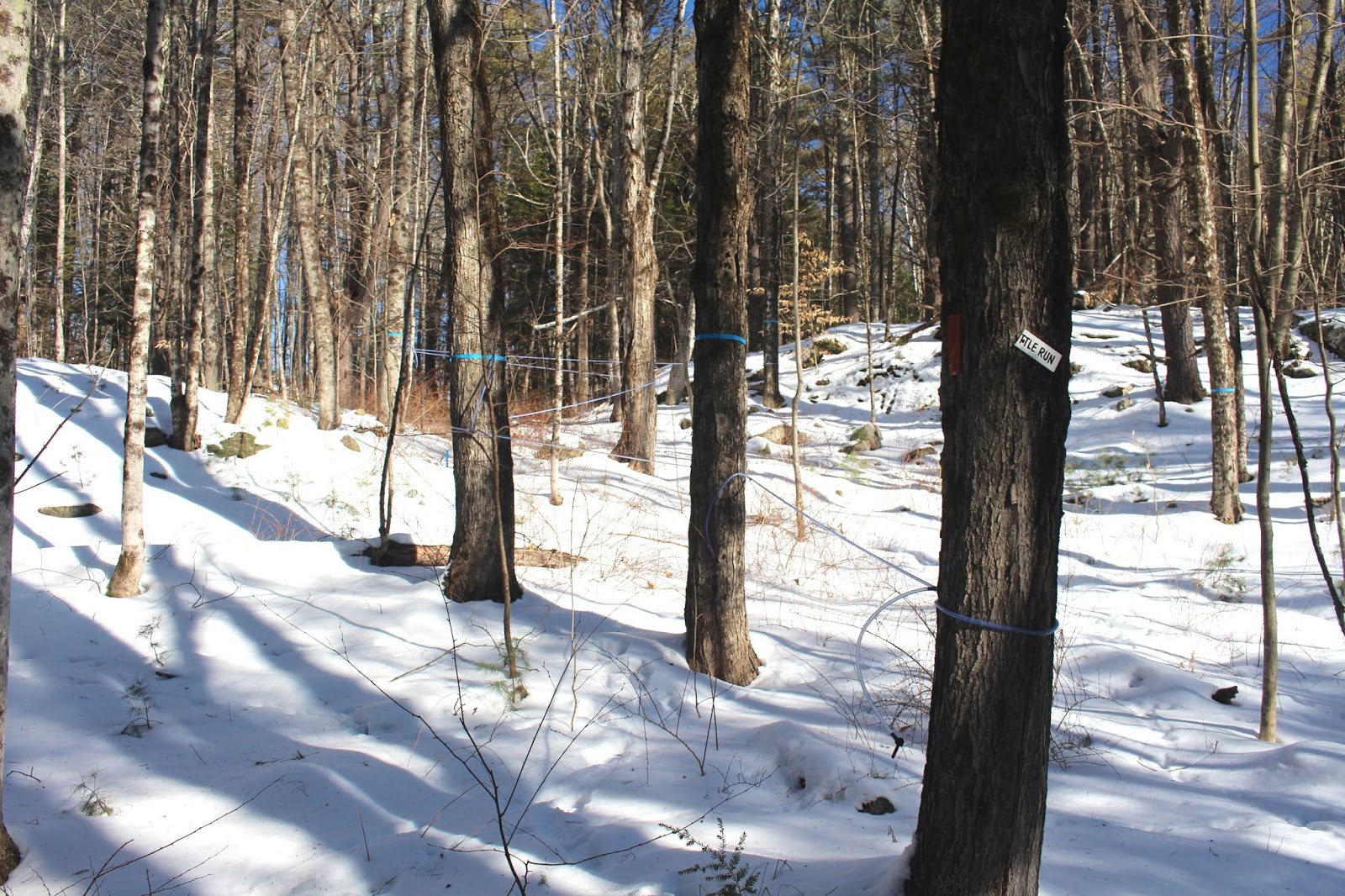
Farther along the hike we came upon the sugar house and some of the tubing ready to collect this winter's harvest.
Sugar Shack at Prescott Farm
Plastic tubing set out to let gravity direct the sap to a central collector

The farm holds educational events in sugaring season.  I wonder what kind of product this year's warm winter and thin snow pack will deliver....

Back at Lake Wicwas we continue to have lots of rodent visitors (the porcupine is a rodent as well, one of the largest).  The squirrels are having fun with their corn cob feeder.

And we've had a little vole scurring around taking advantage of the dropped seeds and corn kernels.


It took a little research to determine what this is, but the short tail, small ears, rounded snout, and daytime excursions distinguish it as a vole rather than a mouse.

It has a multitude of paths running around under the snow, so it pops up suddenly out of the snow in random places with no warning.

It then dashes under a feeder, grabs a morsel, then dives back under cover.

Supervole!  Rescuing that sunflower seed!
So far it has avoided the neighborhood barred owl as well as all the other creatures out hunting for a meal! 

I'll bet the owls had good hunting this week with the bright full moon - I hope you saw it!
The Full Wolf Moon sets over a stand of white pine